Fat Man Squeeze!

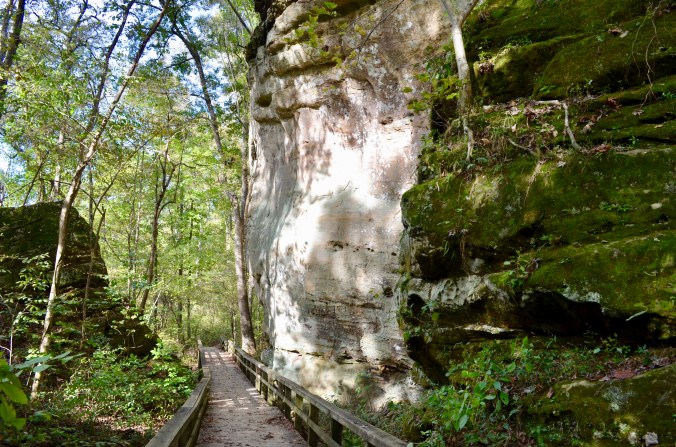
Nestled in the Shawnee National Forest, 10 miles south of Carbondale, Illinois is the Giant City State Park, home of the “Giant City Streets” formed 12,000 years ago by huge bluffs of sandstone.

The area was named for the unique impressions made by its massive sandstone structures. Eons of geological faulting and folding have molded the landscape which is now covered in lush ferns, moss, hundreds of species of flowers and over 70 varieties of towering trees.

The first European settlers moved into the area from Kentucky and Tennessee in the early 1800s, and by 1850, settlers were using the land to cultivate fruit trees. During the Civil War, many of the cliffs and canyons were used as havens by solders from the Union and Confederate armies.

In 1927, the State of Illinois acquired over 1,000 acres of land and dedicated the area as Giant City State Park. Today, the park has grown to include 4,000 acres of beautiful countryside.

fullsizeoutput_2c31

Mike, Miss Poppy and me hiked the Giant City Nature Trail a rugged, one-mile trail. Unfortunately, we had to turn around at Fat Man Squeeze (behind Mike, marked with the red tape) as it was closed because venomous copperhead snakes were moving into hibernation! Needless to say, we kept Miss Poppy on a short lead along the trail as two walkers stopped to tell us that they had just shooed a copperhead snake off the main trail!
fullsizeoutput_2c2f

Large blocks of Makanda sandstone slid down hill due to the undercutting action of a glacial stream forming the Giant City Streets as they are known.
 

The Little Prince!

Did you know that 80% of the USA’s recreational vehicles (RVs) are manufactured in Elkhart County, Indiana? So much so, that it is known as the RV Capital of the USA and includes a museum that Mike and I visited!

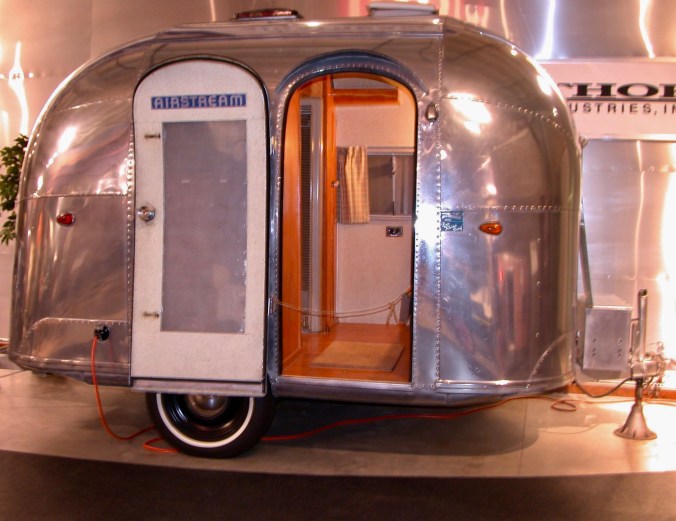
In September 2004, Airstream collector Ken Faber turned up to a “Tin Can Tourists” RV rally in Michigan with a tiny, silver trailer in tow. As Faber made his way to the registration area, the campground looked like a scene from the Pied Piper as dozens of rally attendees walked behind his trailer trying to get a better look. When Faber finally parked and got out of his car, he told the audience the tale of Der Kleine Prinz (the little prince), the smallest Airstream ever made.

Faber said that although there was no original bill of sale, it was clear that Airstream built the trailer in 1958 at its Jackson Centre facility in Ohio. It is believed that the trailer was built at the request of the company’s founder who had returned from an Airstream caravan in Europe and who may have entertained thoughts about producing a small trailer for the European market. The European connection may also explain the trailer’s German name.

fullsizeoutput_2bfc

Unique features of the trailer are the Lilliputian bathroom that includes a shower that Airstream managed to wedge into the left rear corner, a three-ringed oven, a refrigerator, a gas-fired heater and a bed! All in a trailer that measures 10 feet long and six feet wide!

The Golden Domers …

… because they wear gold-coloured helmets, or the Fighting Irish as the American football team at Notre Dame, Indiana is also called!

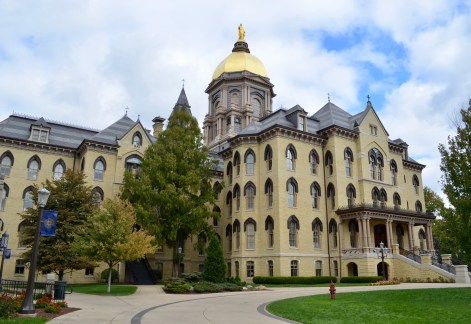
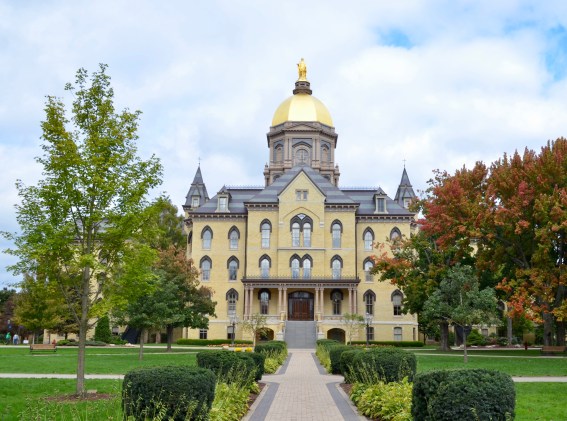
The main building, with its famous Golden Dome, is the center piece of Notre Dame’s past and present. Today, it serves primarily as a headquarters for administration, although it still contains classrooms, harking back to a time when it was a crossroads and students learned, ate meals and lived within the building.

Golden Dome, Notre Dame campus, Indiana.

The Golden Dome was added in 1882 and was most recently re-gilded in 2005. The re-gilding process uses only about a fist-full of gold leaf to cover the entire structure. On top of the dome you will find the most recognizable landmark of the University – a 19-foot, 4,000 pound statue of Mary, the Mother of God, “Notre Dame” (“our Lady”). With this beautiful adornment, the main building is 187 feet tall making it the second tallest structure on the campus after the Basilica of the Sacred Heart.

fullsizeoutput_2bf6

The current structure is actually the third building to stand on the site; the first was built in 1843 which was replaced with a larger one in 1865; that one burned down in 1879, after which the third, and current building, was erected. It really was a sight to behold and I am only sorry that I was pressed for time and unable to take a tour of the beautiful campus.

The average fees at Notre Dame University, before aid, are in the region of $48,000 per year for tuition plus around $17,000 for books, on-campus room and board!

Basilica of the Sacred Heart

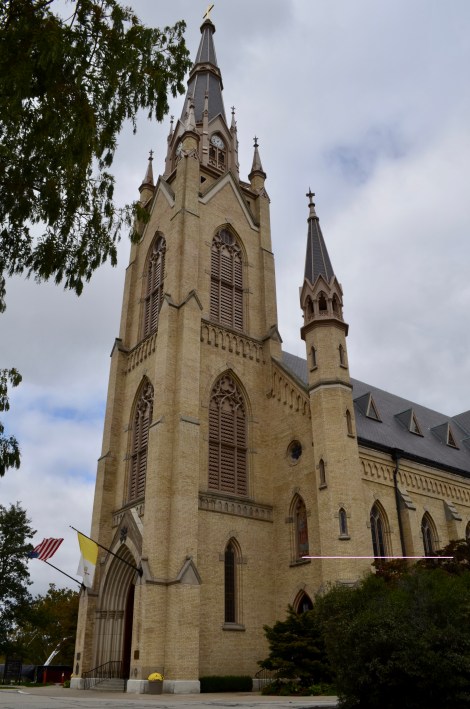
The Basilica of the Sacred Heart in Notre Dame, Indiana is a magnificent Roman Catholic church on the campus of the University of Notre Dame.

It is the second church built on the campus as the University’s needs outgrew the original building. Work on the foundations for the new church began in 1870, and the cornerstone was laid on May 31, 1871. The building took many years to finish and underwent many changes along the way. As soon as it was inhabitable, university leaders installed an organ and held functions and celebrations in the unfinished building.

Since its initial consecration in August, 1888, the church has undergone three renovations. The most recent upgrade took place in 1988 when the conservation and restoration of historic stained glass windows, created by Le Mans, France was one of the largest single projects including 116 windows and over 1,200 panels of glass.

On January 17, 1992, Pope John Paul II raised the Church of the Sacred Heart to the status of Minor basilica. This designation is one factor in making it a popular destination for some 50,000 pilgrims and tourists who visit annually. The church has since been elevated to a basilica.

fullsizeoutput_2bee

Basilica of the Sacred Heart built of brick and limestone in the Gothic Revival style. 

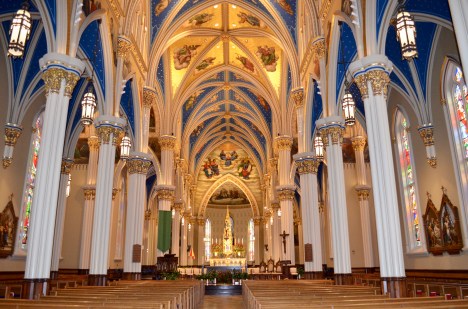
fullsizeoutput_2bf0

The magnificent nave and vaulted ceiling.

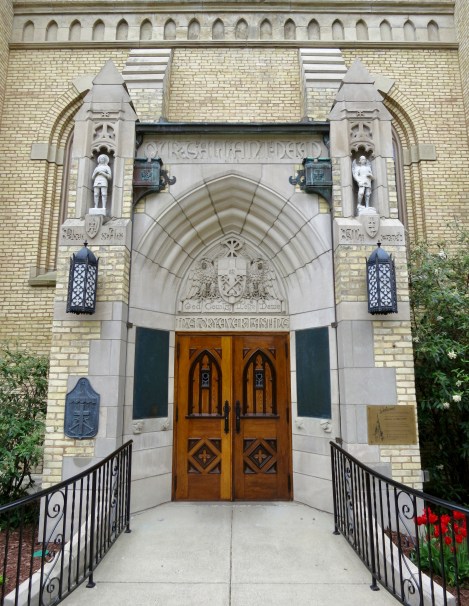
Basilica_of_the_Sacred_Heart_(Notre_Dame,_Indiana)_-_exterior,_east_portal,_memorial_to_Notre_Dame_students_killed_in_WWI 2

The World War I memorial door was dedicated on May 30th, 1924 in recognition of Notre Dame’s contribution in World War I.

Stan Hywet Hall

At the turn of the 20th century, the Industrial Revolution was transforming the very fabric of America, fueled by the entrepreneurial spirit of innovators and visionaries like F.A. Seiberling.

In 1898, F.A. alongside his brother C.W. Seiberling founded The Goodyear Tire and Rubber Company, named for Charles Goodyear, a self-taught American chemist and the inventor who patented the process for vulcanizing rubber.

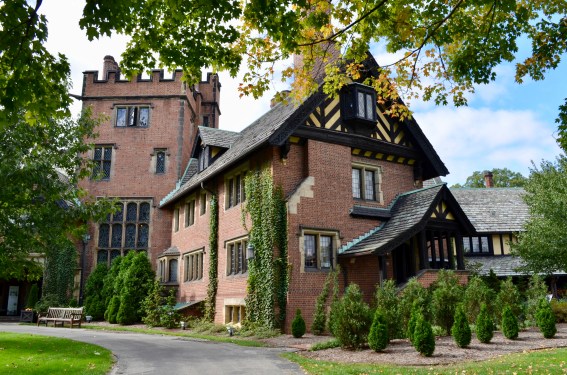
Between 1912 and 1915, F.A. and his wife Gertrude built Stan Hywet Hall for their family and it is one of the finest examples of the American Country Estate movement, which flourished during the Industrial Age. England provided the inspiration for the Tudor Revival Manor House and service buildings, and also prompted the name of the Seiberling’s estate. Stan Hywet is Old English for stone quarry, the property’s most prominent natural feature when the land was purchased.

The estate became a beacon of progress for F.A. and his business associates, who often met here to discuss and negotiate the challenges of the day as well as serving as an international stage for well-known figures in music, the arts and politics.

On Mother’s Day, 1935, at the Gate Lodge where F.A.’s son Fred Seiberling lived with his wife, Henrietta and their children, Henrietta brought together Bill Wilson and Dr. Robert Smith (known as Dr. Bob) for a discussion that ultimately let to the founding of Alcoholics Anonymous.

fullsizeoutput_2bdc

The estate in Akron, Ohio features an historic 65-room Tudor Revival Manor House.

fullsizeoutput_2bdd 

The main Manor House is a whopping 64,000+ square feet that was home to the Seiberlings for 40 years. 

… 45 Stars!

On September 6th, 1901, President McKinley stands in line for a public reception at the Pan-American Exposition in Buffalo, New York when he is approached by Leon Czolgosz, a Polish-American anarchist. Czolgosz fires two shots into the president at point-blank range! President McKinley dies nine days later at the age of 59.

The McKinley National Memorial in Canton, Ohio is the final resting place for President McKinley, his wife Ida, and their two young daughters who died in infancy. It is a magnificent tribute to the 25th President and was built entirely from private donations, organized by the McKinley National Memorial Association.

Built from 1905 to 1907, nine states contributed material for the project, arriving in Canton by rail and then brought on horse-drawn wagons to the work site. Workers were from many nationalities and races. There are accounts of African-Americans traveling from the Southeastern region of the US all the way to Canton to ask for employment because of their deep admiration for President McKinley.

fullsizeoutput_2bcf

Harold Van Buren Magonigle, the architect, envisioned the Monument at the centre of a large cross, representing a martyred President.

fullsizeoutput_2bcc

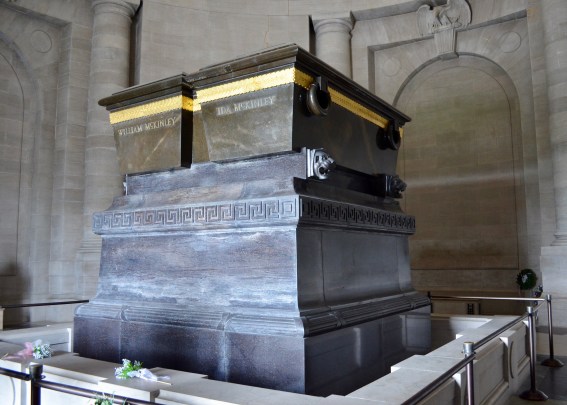
In the centre of the monument rests a double sarcophagus carved from dark green granite from Windsor, Vermont. It is carved from a single block but designed to appear as a two-in-one. It rests on a base of black “Berlin” granite from Wisconsin.

fullsizeoutput_2bcd

At the top of the dome is a magnificent red, white and blue stained-glass skylight. It contains 45 stars representing the 45 states that were in the Union at the time of the President’s death.


A Scarlet Carnation

Although campaigning for the presidency without leaving home is not a new strategy, William McKinley, and his campaign manager Marcus Hanna, take the 1986 “Front Porch Campaign” to a whole new level!

By arranging for the party faithful to travel by special trains to hear McKinley speak, Hanna is able to give him advance notice of who is attending enabling McKinley to tailor his speeches to the concerns of his audience.

Every day, people from all over the country arrive at the station in Canton, Ohio where bands play and visitors march and wave flags up Market Avenue to McKinley’s home.

For eight weeks, Canton enjoys this festive atmosphere. Meanwhile, his opponent, William Jennings Bryan, travels 18,000 miles in three months speaking to an estimated five million people!

William McKinley wins the election and is sworn in as the President of the US on March 4, 1897. With his wife and mother seated behind him, he kisses the bible and then delivers his inaugural address. His is the first presidential inauguration to be recorded on motion picture film.

After a buffet at the Senate and a three-hour parade in his honour, President and Mrs. McKinley attend the inaugural ball and by 11 p.m. they are in bed in their new home, the White House.

In 1900 President McKinley wins a second term and alongside his new vice president, Theodore Roosevelt, they are poised to lead the country into the 20thcentury …

fullsizeoutput_2bc4

A scarlet carnation is the state flower of Ohio and one always worn by William McKinley, 25thPresident of the United States.

fullsizeoutput_2bc7

The rocking chair used by William McKinley in his front-porch campaign.

The Canton Bulldogs!

On September 17, 1920, representatives from ten professional football teams met in Canton, Ohio and formed the American Professional Football Association, which two years later became the National Football League (NFL). Professional football evolved from club football in the 1890s and by the early 1900s had begun to spread across the country, concentrating in the Midwest.

Considered one of the most versatile athletes of modern sports, Jim Thorpe was the first native American to win two gold medals for the pentathlon and decathlon at the 1912 Summer Olympics. Thorpe was the most recognizable face of pro football’s early years having started with the Canton Bulldogs, an early pro football power, in 1915. He also played professional baseball and basketball!

Thorpe went on to play for six NFL teams during his career and in 1920 the founding members of the NFL elected him its first president.

JimThorpe2

Thorpe, pictured above, lost his Olympic medals after it was discovered that he had been paid for playing two seasons of semi-professional baseball before competing in the Olympics, thus violating the amateur status rules that were then in place. In 1983, 30 years after his death, the International Olympic Committee restored Thorpe’s Olympic medals!

291541068

In 1959, the citizens of Canton launched a well-organized effort to have their city monument to the sport’s historic stars. The Professional Football Hall of Fame opened on September 7, 1963 and that’s where we visited today. It was fun learning about the history of the game.


The Outtakes!

fullsizeoutput_2ba6

Fresh off the catwalk, Mike sports this season’s must have mac!

fullsizeoutput_2ba3

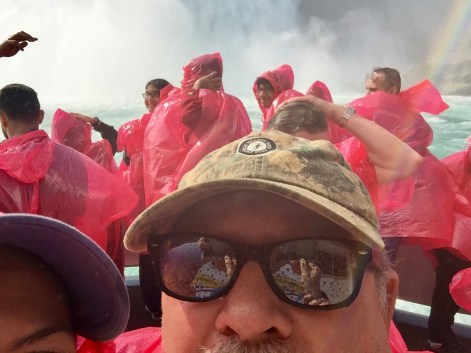
Mike and my left eyebrow! Just as he took the selfie of us, the Hornblower boat lunged towards the Horseshoe Falls and this was the resulting photo!

fullsizeoutput_2ba8

Our fellow shipmates busy capturing the moment they visited Niagara Falls! 


Snap shooters!

In 1880, George Eastman founded what would become the Eastman Kodak Company, a world-spanning organization that revolutionized photography.

The Kodak, introduced in 1888, was one of the most important innovations in photography. Designed with the amateur photographer in mind, the Kodak was the first “point-and-shoot” camera that began the trend of capturing everyday life on film. The camera was sold with the advertising slogan, “You press the button, we do the rest.”

Within a year, the company released an improved number one and number two models which created circular negatives.

The Kodak number three model was the first to produce rectangular negatives. Snapshot photography and photo finishing services, simplified the production of image capture and print out, a practice that was previously labour intensive and expensive became more accessible to consumers.

 fullsizeoutput_2b9f

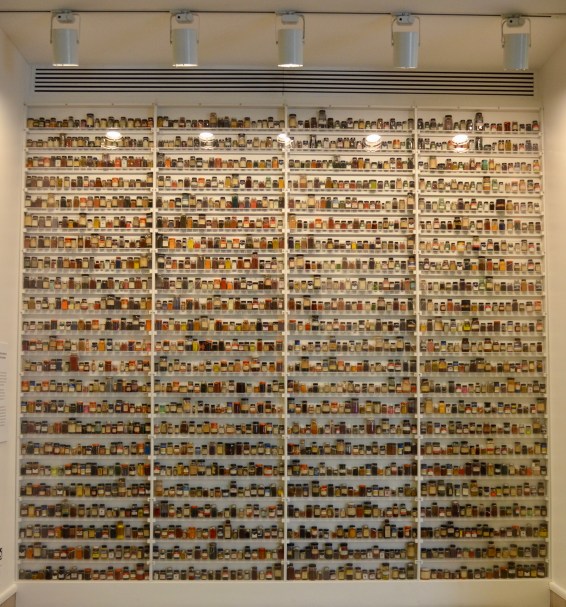
The George Eastman museum, the world’s oldest photography museum and one of the leading international film archives, was founded in 1947. It has a set of over 3,000 dye bottles collected by the Technicolour Motion Picture Corporation during the heyday of the classical Hollywood era. The corporation’s researchers painstakingly worked to create a sophisticated dye-transfer printing process, using many different combinations of dyes and dye solutions available from a number of international chemical companies.

 fullsizeoutput_2ba1

This was the world’s first professional digital camera to use a complementary metal-oxide semiconductor sensor. Previous digital cameras used analog charge-coupled device sensors requiring additional circuitry to convert the analog signal to digital.