Opa’s Story

Walking into Opa’s Smoked Meats in Fredericksburg is a little like stepping foot in your grandparents’ kitchen – especially if you call your grandparents Oma and Opa!

Despite selling nearly six million pounds of slow-smoked German sausage every year, Opa’s remains a humble smokehouse run by the same Fredericksburg family that founded it more than 70 years ago.

Opa’s story begins in 1947 when Arno Schwethelm, a merchant and rancher from the nearby town of Comfort, Texas gave a small meat market to his daughter and son-in-law as a wedding present. The young couple renovated the building and established their meat market. They made a living running their small processing plant and slaughterhouse and by renting out lockers to locals for cold meat storage.

Fast forward to 1968 and Arno’s grandson and his wife write a new chapter for the company shedding the processing plant and locker rental and renaming the business in honour of his grandfather – Opa’s Smoked Meats.

Paying tribute to their German heritage, they develop original recipes for smoked sausage using a blend of coarsely minced cuts of meat and German-style spices. They start small and grow the business through local supermarkets across South and West Texas.

Today, Arno’s great grandchildren run the business with an expanded menu using the same recipes that their parents developed and with an extensive online business serving across the US.
63A149F0-EEDA-4A75-AFBE-C411463DA821

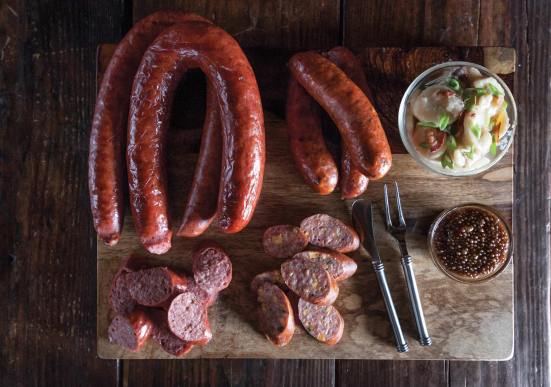
Opa’s sausages work well with German-style potato salad and whole-grain mustard. We will be stocking up before we head for home!

Willkommen!

Welcome and greetings from Fredericksburg, Texas, some 200 miles west of our home! 

The history of Fredericksburg dates back to its founding in 1846 following the arrival of liberal, educated German immigrants fleeing the social, political and economic conditions of their homeland. The town was named after Prince Frederick of Prussia and was unusual in that Texas German was spoken – a dialect used by the first generation of German settlers who initially refused to learn English!

The town promotes its German heritage through craft breweries and distilleries, wineries, peaches, smoked meats, music and the arts. There is a lovely “Main Street” which acts as the town’s focal point where there are no high-rise buildings and no billboards! It was good to reminisce today as the last time Mike and I walked down Main Street was with Mum and Dad back in 2007!

We are visiting Fredericksburg now because it’s still in Texas and although Coronavirus numbers are rising elsewhere in the state, this area, which I check daily, seems to be good; and, during our time in lockdown, we have revisited our thoughts for our next home and this area just might offer all that we now think we want! We shall see …

It’s great to have you along for the ride and even with safety measures in place because of the virus, I hope to show you as much as is open and able to be enjoyed!

Our-Animals-pic-blackbuck-1 

We were out driving around today and saw this magnificent beast – a blackbuck Antelope which is found in the area. I’m not sure that I would like Miss Poppy-dog to mess with those antlers!


Traveling in comfort …

We are home!

Our journey this time has covered over 3,000 miles even though we have focused our attention on just one state, Michigan, which we have both fallen in love with.

Michigan has glorious summers and is a very popular destination for second homers. The weather is warm and without humidity, the views are spectacular and there are so many opportunities to enjoy the outdoors, whatever your hobby – hiking, biking with incredible bike trails everywhere and 11,000 lakes if water’s your thing – and still I didn’t get my kayak out and paddle around!

There are great restaurants, wineries and craft beer places and a whole host of festivals to enjoy.

It’s been a great trip and super special to have you along with us. I will be back blogging in February/March next year when we are going to hit Florida for five weeks or so. Florida is fast becoming a state of interest to us for our winter home. We shall see.

I will update my blog on February 1st when I’ll know more about our 2020 plans.

Until then, Happy Thanksgiving, Happy Christmas and a Happy New Year!

The Blogging Brit

fullsizeoutput_3fa7

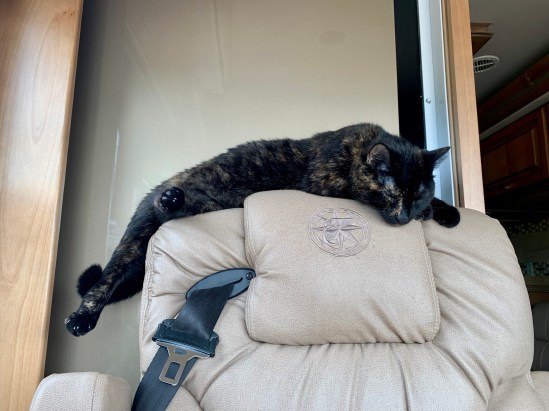
This is Miss Cricket’s preferred place and pose while we are driving. She stretches out on the headrest of my seat and stays there for hours. The only problem is that if we have to make a sharp turn, she extends both front paws and digs her claws into my baseball cap to ensure she doesn’t move!

Michigan moments, part 2 …

In northern Michigan, the roads are predominantly two-lanes, one in each direction, some are four lanes with a turning lane, as we have at home, but there are no eight-lane motorways and certainly no fly overs which dot my Texan landscape!

The townships actively promote “artisan” and “Mom and Pop” businesses so that one is able to enjoy boutique restaurants and shops which was such a refreshing experience.

There are farm shops selling fresh produce everywhere. It was wonderful to stop and buy fresh blueberries, peaches and honey directly from the farmer who had grown them!

fullsizeoutput_3fac

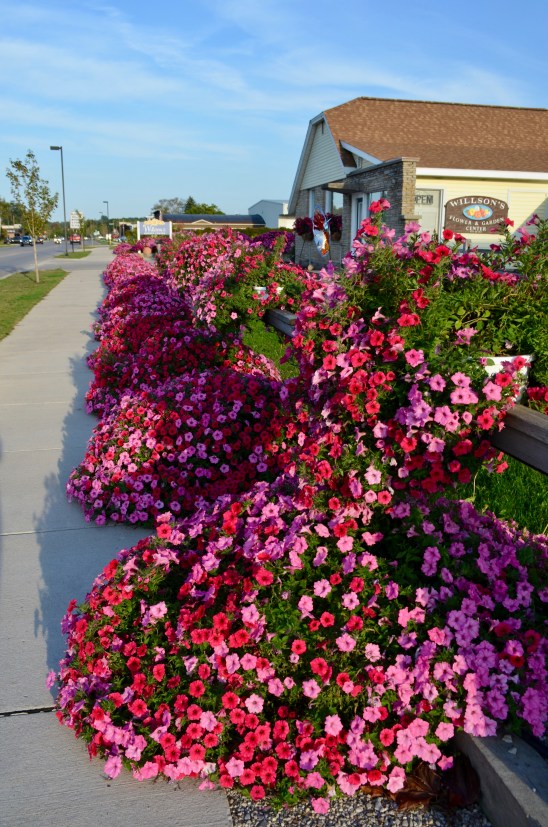
A lot of the towns we visited really went in for colourful flower boxes and hanging baskets but the above picture, taken in Petoskey, took the biscuit! Admittedly, this was outside a flower and garden centre, but even so, it was spectacular.

DSC_0087

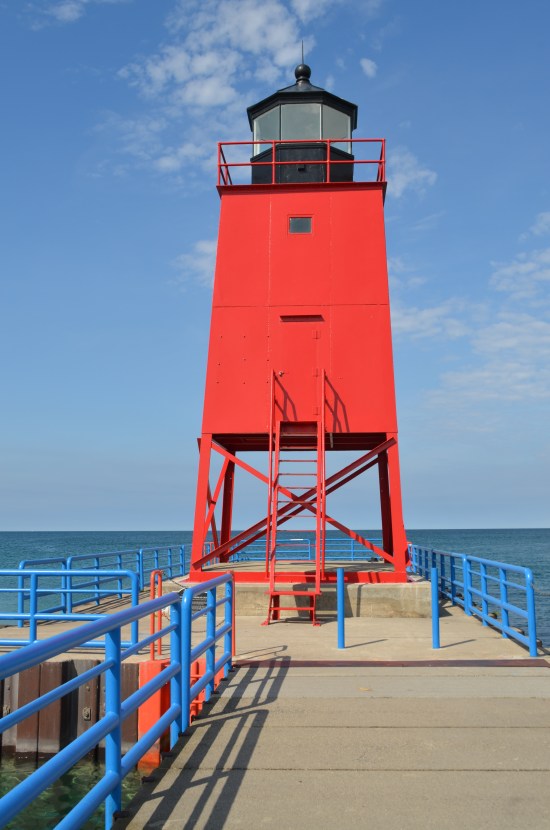
Seriously red! This is the light station at Charlevoix South Pier. Now, close your eyes, and imagine to the left of this picture that there is a monstrous concrete plant, seriously! I got chatting to some folks from Michigan who told me that long before it became popular to have a home overlooking the Great Lakes, industries were a common sight due to the access to fresh water! 

Three of the properties we looked at, only from the outside! From Left: an apartment in Petoskey that overlooked Lake Michigan; top right, a house in Petoskey that faced a marina; bottom right, a house (r/h side) that overlooked Lake Michigan in Manistee!

Michigan Moments … #1

A few comments on Michigan which may surprise you, as they have certainly surprised me!

Once you reach the northern part of Michigan on the west coast, the scenery changes, the towns change and it takes some pondering as to what is different!

Here are the thoughts of chairman Abbott:

  • in northern Michigan, there are no high-rise buildings. You don’t see anything over three stories, which is unusual, and the closer you get to water it reduces to two and mainly single storey buildings;
  • the townships keep all the “chain” restaurants on the outskirts of town – the McDonalds and the like – and there are certainly no golden arches advertising the restaurant chain. Instead the chain restaurants are in keeping with the style of each town with no over-the-top neon gimmicks ruining the landscape.

fullsizeoutput_3fa9

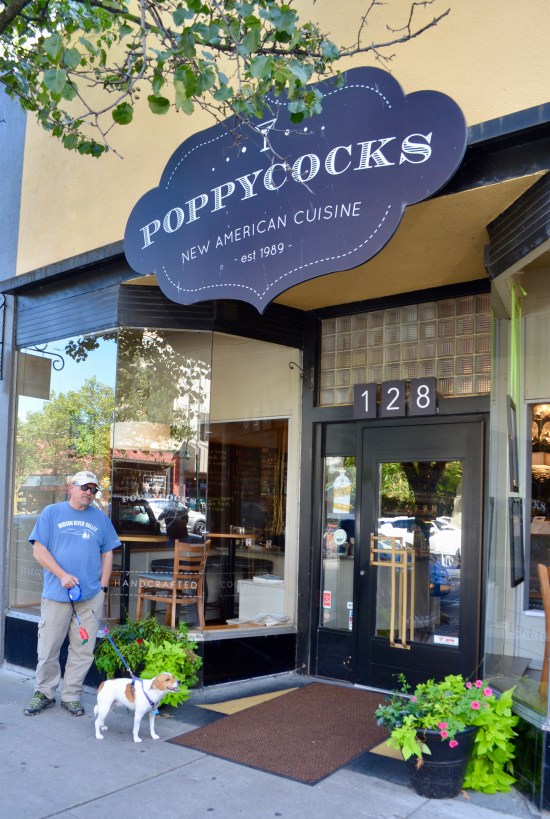
Miss Poppy outside Poppycocks restaurant in Traverse City, Michigan. I struggle to decide whether this or the venue named below was the best food experience of the trip … no wonder my clothes are a little tight!

fullsizeoutput_3fba

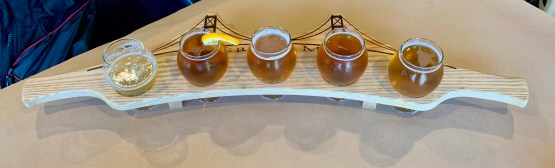
Biere de Mac Brew Works by the Mackinac Bridge in Michigan. A local teacher in the area hand carved these miniature replicas of the bridge to hold flights of beer for which the venue is known. As mentioned above, I struggle to decide which of these two venues was my favourite eating experience: a roast beef and pickled carrot sandwich versus a bowl of soba noodles so fresh and zinging with ginger and lime that the hair on my head grew an extra inch! 

Lewis & Clark

The US purchased the state of Louisiana from France in 1803. The huge part of the land west of the Mississippi River was completely unknown to Americans and needed to be examined ahead of anyone settling there.

President Jefferson decided to send an exploratory expedition west and appointed his own private secretary, Meriwether Lewis as Commander in charge of the expedition. Lewis invited his former superior officer from the Army, William Clark, to be his Co-commander.

Their mission was to explore the unknown territory, establish trade with the natives, affirm the sovereignty of the US in the region and find a waterway from the US to the Pacific Ocean.

While still in the Ohio River Valley, Lewis and Clark briefly made camp near where Paducah sits today. In 1827 Clark returned to the region and helped to establish the town of Paducah, Kentucky.

fullsizeoutput_3fa2

Mike and I visited Paducah to have lunch with our friends who live there. From left: Daryl and Jim Schaefer, Jim & Tom DeCillis (Mike worked with both brothers while at ExxonMobil) and Mike.

fullsizeoutput_3fa6

Another one of the magnificent wall murals in Paducah. This time depicting an event in 1996 when all three of the Delta Queen Steamboat Company’s boats docked simultaneously at the Port of Paducah where they were enthusiastically welcomed by the Red Coats.

Today, the steamboats still dock in the port and visitors are able to enjoy Paducah’s vibrant arts scene, acclaimed theatre/concert hall and regular festivals.


Oh, buttons!

We are on the move, homeward bound, and are in Marion, Illinois!

Today, we schlepped some 50 miles into Paducah, Kentucky to catch-up with friends whom we have not seen in two years – since we were last here witnessing the Solar Eclipse!

Paducah’s flood-wall murals present a public art experience available at all hours. They depict Paducah’s rich history in life-sized paintings on the river city’s flood-wall. These panoramic “Portraits from Paducah’s Past” overlook the confluence of the Ohio and Tennessee Rivers and illustrate Paducah’s historical significance and relative connection.

Area riverbeds are rich with mussels whose shells, when polished, have luster suitable for processing into “pearl” buttons. In the late 19th century, mussels were harvested from the river bottom; they were then cooked in vats for meat removal, and the shells were stockpiled on the riverbanks for shipment to the button factories.

For many years, shell-digger camps and huge piles of shells could be seen along the banks of the Ohio and Tennessee Rivers. The pearl button business became an important local industry when Captain Louis Igert moved his family to Paducah in 1920 and established the McKee Button Company.  By 1928, the National Button Producers Association proclaimed the business the largest producer of freshwater buttons in the world!

fullsizeoutput_3fa1

Pictured above is one of Paducah’s wall murals depicting the mussel shells on the banks of the river ready for their onward journey to become pearl buttons! The murals were really spectacular.

Betty Bloomer …

Born Elizabeth Bloomer, Betty Ford grew up in Grand Rapids, Michigan, where she attended Central High School, worked as a model and studied and taught dance.

Although she tried, a dancing career was not in her future and on returning to Grand Rapids, she met Gerald Ford who would assume the role of President of the US.

Throughout her husband’s term in office, Betty Ford maintained high approval ratings despite opposition from some conservative Republicans who objected to her more moderate and liberal positions on social issues.

She was noted for raising breast cancer awareness having been diagnosed with the disease, was a passionate supporter of the equal rights amendment, pro-choice on abortion and a leader in the women’s movement where she gained fame as one of the most candid first ladies in history.

She also raised awareness of addiction when in the 1970s, she announced her long-running battle with alcoholism and substance abuse.

In 1982, Betty Ford founded the Betty Ford Centre for the treatment of chemical dependency, including treating the children of alcoholics, substance abuse and addiction.

betty ford

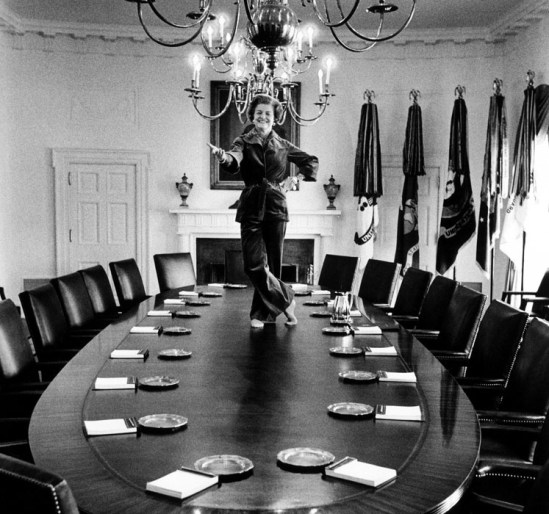
My favourite photograph at the Gerald Ford museum – the day the Ford’s left office, the First Lady took her shoes off and jumped up on her husband’s cabinet office meeting table and posed in true dancing style. 

Extraordinary Circumstances …

In 1968, in the midst of violent anti-Vietnam war demonstrations and race riots,  Richard Nixon was elected president. He ran again in 1972 and during the campaign, the Democratic National Committee Headquarters at the Watergate office complex in Washington, D.C. was burgled.

Following Nixon’s re-election, evidence that his administration knew of the break-in began to surface, and the public grew distrustful of his leadership. In the midst of this scandal, Nixon’s Vice President resigned over allegations of bribery when serving as governor of Maryland!

Enter Gerald Ford who had been a longtime friend and colleague of Nixon. Sharing similar viewpoints on defense and spending, Ford was an obvious choice to fill the vacant post and he became Vice President as the Watergate scandal began unfolding.

In August 1974, the president’s chief of staff contacted Ford to tell him that an Oval Office recording of Nixon discussing plans to impede the FBI’s investigation by falsely claiming the break-in was a CIA operation had been found. The tape left little doubt that President Nixon has been part of the Watergate cover-up.

Mr._and_Mrs._Ford_and_Nixon_13_Oct_1973

Happier times: pictured above, from left, Richard and Pat Nixon, Betty and Gerald Ford on the day Ford was appointed Vice President of the US.

When Nixon resigned on August 9, 1974, Ford automatically assumed the presidency. This made him the only person to become the nation’s chief executive without having been previously voted into either the presidential or vice presidential office.

Mike and I enjoyed a super visit to the Gerald R. Ford museum in Grand Rapids, Michigan nearby to where we are currently staying.

The Swan

When residents from the town of Holland in Michigan, Willard Wichers and Carter Brown, were looking for a way to pay homage to the city’s Dutch heritage, they began a project to purchase a windmill from Holland and bring it to the US!

However, many of the Dutch windmills had suffered serious damage during World War II resulting in the Dutch government placing a ban on the sale of windmills outside the Netherlands.

After three years of negotiation, Wichers and his group were able to gain an exemption by selecting a heavily damaged windmill named De Zwaan, the Swan, they had found in Vinkel, Holland.

In April 1965 the windmill was formally dedicated on Windmill Island, a site reclaimed from a swamp on the eastern end of Lake Macatawa in Michigan. Its reconstruction had taken some six months to complete and was overseen by a Dutch millwright, a stipulation of the purchase by the Dutch government.

fullsizeoutput_3f6e

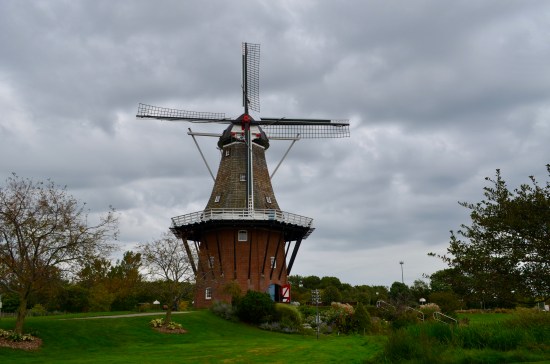
Looking at the windmill, the section from where there is a white guard rail to the top is the original windmill bought from the Dutch government. It was reconstructed on top of a brick tower to ensure the blades could catch the wind as it is a working windmill producing flour and cornmeal when winds are favourable.

Behind the windmill is a field which is planted with tulips imported from Holland. However, the winter weather here in Michigan can be very harsh and some years the tulips don’t bloom giving way to what locals refer to as the stem festival!