Fourteener – Part I

In mountaineering speak, a fourteener is a mountain peak which has an elevation of at least 14,000 feet (over 4,000 meters), and Colorado is blessed with 53 of them, the most of any US state!

Likely the best known is Pikes Peak here in Colorado Springs which is where we headed today. There are insufficient superlatives to describe how breathtakingly beautiful the experience was from start to finish and so I am not going to rush and try to cram everything into one blog, but will spend the next few days sharing with you the jaw-dropping scenery we have enjoyed all day!

Our journey begins at the Pikes Peak Highway, a 19-mile toll-road that starts at an elevation of 7,500 feet and winds up the mountain depositing you at the summit where the elevation is 14,115 feet and the temperature has dropped 30 degrees!

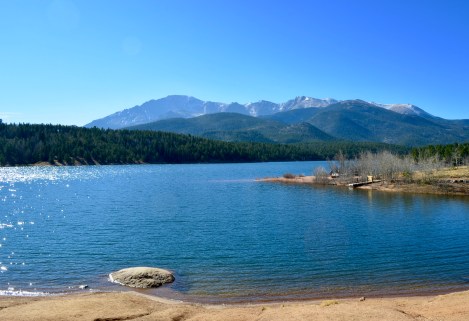
First stop is at mile six, elevation 9,000 feet, where we find the Crystal Reservoir: to secure clean mountain water, Colorado Springs began its development of water collection and storage on Pikes Peak in 1891. As the region’s population grew, the city purchased water rights from resources deeper in the Colorado mountains.

In 1935, the Crystal Dam was built, storing 1.1 billion gallons of Blue River water from the Breckenridge area. The water is pumped through more than 70 miles of pipe to get here.

There are three reservoirs on Pikes Peak – Crystal, North and South Catamount – which are open to the public. The reservoirs are annually stocked with trout and visitors and locals can enjoy fishing and non-motorized boating, from early May to mid-October each year.

fullsizeoutput_1157

The majestic Pikes Peak the morning after our first snow!
fullsizeoutput_1165

Crystal Reservoir with Pikes Peak in the background (far left).

fullsizeoutput_1168

Looking down on Crystal Reservoir as we head to the summit!

Miss Poppy! 

We are staying at the Mountaindale Cabins and RV park about 15 miles from Colorado Springs, which has spectacular views of the mountains and is far enough outside of town to make you feel that you are in the wilderness. The park is very pretty and beautifully maintained, and the people are really friendly with some 60 families or so who are staying here over the winter, or as is common in these parks, they live here permanently.

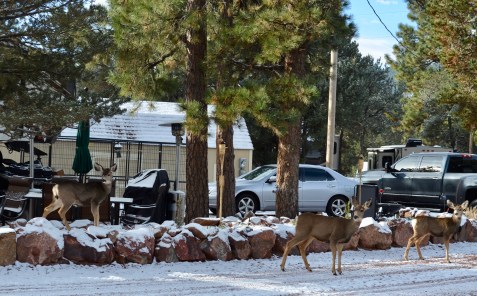
In the RV park, we have wild turkeys roaming around and although I have seen them when walking Poppy in the morning, I now take my camera with me to see if I can get a picture of them to share with you. We have fat, black squirrels who are driving Poppy crazy, and deer – whom at first I didn’t recognize – as they are completely different to the ones we feed at home. These deer are larger and fatter with heavy coats to keep them warm through the winter, and they have much bigger ears that are slightly wavy at the edges and I am not sure if they are just hungry, but they seem to have little fear of human beings as we have seen deer wandering around in very urban parts of town!

Snow has fallen during the past two nights, and other than being mystified as to the meaning of the white stuff on the ground, Poppy is having fun and is certainly enjoying herself in the cooler climate.

Left: Miss Poppy in our RV park yesterday morning. Top Right: at the Manitou Springs Brewing Company where a black squirrel was driving her nuts; enjoying at walk in the Garden of the Gods.

fullsizeoutput_1159

On the hunt for breakfast! Deer in our RV park!

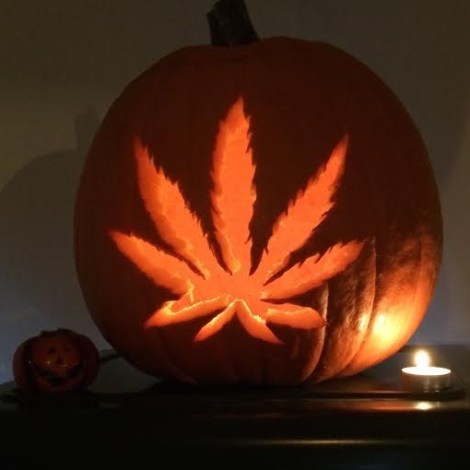
Happy Halloweed!

In November 2000, Colorado voters approved an amendment to the State Constitution to allow the use of marijuana for approved patients with written medical consent. Under the law, patients can possess up to two ounces of medical marijuana and may cultivate no more than six marijuana plants.

Fast forward to November 2012, and the State’s Constitution was further amended outlining a state-wide drug policy for cannabis. The amendment addressed the personal use and regulation of marijuana for adults 21 and over, as well as commercial cultivation, manufacture and sale. The commercial sale of marijuana to the general public began on January 1, 2014, at establishments licensed under a regulatory framework.

By April 2016, 62 of Colorado’s 271 cities and towns have adopted some form of recreational marijuana regulation with one notable absence – the state’s second most populous county and city of Colorado Springs where we are currently staying.

Visitors and tourists to Colorado can use and purchase marijuana, but face prosecution if found in possession in any adjacent state. Colorado’s biggest airport in Denver has banned all possession of marijuana but admits it has not charged a single person with possession nor has the airport seized any marijuana since the ban went into effect.

autumn-roast-a-high-class-event-portland-marijuana1

In the first year of implementation, Colorado’s legal marijuana sales reached $700 million.


Elevated Pumpkins!

The Arkansas River is the sixth longest river in America, weaving its way from Leadville in Colorado to Napoleon in Arkansas where it joins the Mississippi River. Geologists estimate that the river cuts its course one foot deeper every 2,500 years, eventually forming the Royal Gorge as it is known today.

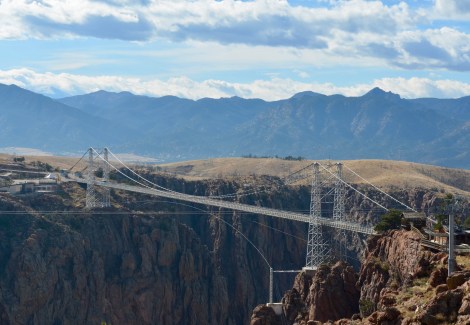
Originally built in 1929 at a cost of $350,000, the Royal Gorge Bridge is a tourist attraction near Cañon City in Colorado. The bridge crosses the gorge 955 feet (291 m) above the Arkansas River and is the highest bridge in the US.

In 2013, most of the park structures on both sides of the gorge were devastated by a man-made wildfire; the fire jumped from the south to the north side of the gorge just west of the bridge and burned over 3,000 acres of the park. The bridge itself sustained only minimal damage and a grand re-opening ceremony took place in May 2015 after the completion of $30 million in repairs and the addition of a gondola lift and the installation of a new zip-line crossing.

The “bridge” experience is outstanding. First one takes a gondola lift across the gorge which gives you a really great opportunity to appreciate the height of the bridge. After that you walk down to the level of the bridge and start walking across. Believe me, it is scary (well, I was scared)! The wind is blowing, the bridge is moving in the breeze, and there are small gaps in the wooden planks where one can see the Arkansas River below! I had to hold on to the railings when I was taking pictures but the experience was great when you are back on terra firma!!

fullsizeoutput_114c

The main span of the bridge between the towers is 880 feet (268 m) and the total length is 1,260 feet (384 m).

In celebration of Halloween, Pumpkins decorate the central section of the bridge which sits at an elevation of over 6,600 feet!

The rapids under the bridge help make the Arkansas River one of the most popular rafting rivers in the US.


Shorty!

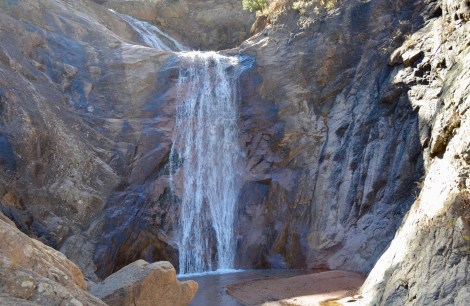
The Seven Falls in Colorado Springs is a series of seven cascading waterfalls, reaching a total height of 181 feet!

Back in 1872, Nathaniel Colby owned 160 acres of land that included the present day Seven Falls and South Cheyenne Canon. He sold the land to the Colorado Land Company who sold it on to a James Hull. Hull was an environmentalist who was disturbed to find the scenic grandeur of the canyon being threatened by people chopping down the surrounding forest for its lumber.

Hull was also a businessman, and he understood the value of the property as a scenic destination and began to improve the site by constructing a road through the canyon to the Seven Falls and building a stairway along the side of the Falls. He installed a toll gate at the foot of the canyon and proceeded to do business. Back then, a local entrepreneur paid Hull $500 for the privilege of taking passengers by carriages to the Falls for 25 cents each. Business flourished and the Seven Falls park became a prominent tourist attraction.

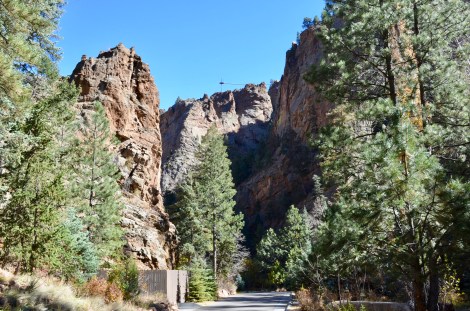
Today, Poppy and I took a complimentary shuttle to the entrance of the park where you walk 0.8 miles to the base of the Falls, or there is the opportunity of taking a tram if you don’t wish to walk. Then the big climb begins – 254 steps in total to the top of the Falls.

In the middle of November, the park and the Falls are lit in colour to mark the Thanksgiving and Christmas holidays. As Poppy and I walked the route today, you could already see the lights in the trees which I can only imagine would be magical to experience at night! Note to self: come back next year when the Falls are lit!

fullsizeoutput_1133

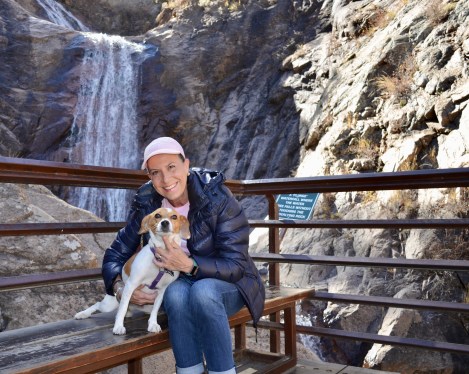
Poppy and I made it up the first 185 steps to view the sixth waterfall (named Shorty) but I didn’t press her to go any further as the one thing Poppy hates in life is water! Bless her, she was such a trooper and made so many new friends as we caught our breath before descending to terra firma!

fullsizeoutput_113b

The Falls are named in alphabetical order (not top to bottom): Bridal Veil, Feather, Hill, Hull, Ramona, Shorty, and Weimer.

fullsizeoutput_113d

If you look at the top of the centre rock formation, you’ll see a base for a zip-line experience that you can take at the Seven Falls – what fun that would be!

How Did Those Red Rocks Get There?

The Garden of the Gods is a 1,300-acre park in Colorado Springs which has a range of incredible rock formations. There are more than 15 miles of trails with a 1 1/2-mile walk running through the heart of the park that is paved. The distinctive formations attract more than two million visitors a year who come to enjoy the beauty of the Park and learn the secrets of this amazing place.

Cast your mind back to about 65 million years ago when there was an intense period of geological upheaval along a natural fault line caused by the old Pacific plate slamming into the North American plate! Sedimentary rocks, which were lying horizontal at the time, were tilted vertically and faulted into “fins” by the immense mountain-building forces caused by the uplift of the surrounding Rocky Mountains. The Ice Age that followed caused weathering and glaciation of the rock, the softer rocks eroded and valleys were created leaving harder rocks standing as the tall ridges. The resulting rocks had different shapes – toppled, overturned, stood-up, pushed around and slanted – and are simply magnificent to see up close!

Archaeological evidence shows that prehistoric people visited Garden of the Gods about 1330 BC. At about 250 BC, Native American people camped in the park; they are believed to have been attracted to wildlife and plant life in the area and used overhangs created by the rocks for shelter.

The red colour of the outcrops is due to the presence of iron oxide or hematite. Exposure to the elements causes iron minerals to oxidize or “rust,” resulting in red, orange and brown-coloured rocks.

Many of the rock formations have names! Top Left: two camels kissing! Top Right: the three graces!


Spiraling Skywards!

As aviation advanced following the Wright Brothers’ first flight, so did discussions about the establishment of a separate aeronautical academy within the military system. Fast forward to June 1959, and the first class of 207 cadets graduated from the US Air Force Academy built in Colorado Springs.

Nestled into the base of the Rocky Mountains, the Air Force campus covers some 18,000 acres of breath-taking scenery. And, soaring 150 feet towards the Colorado sky is the US Air Force Academy Chapel, an all-faith house of worship designed to meet the spiritual needs of cadets and the most visited man-made tourist attraction in the state.

The chapel has two main levels, with the Protestant nave on the upper level and the Catholic, Jewish and Buddhist chapels are located beneath. This is also another level housing a large all-faiths room and two meeting rooms. Each chapel has its own entrance, and services can be held simultaneously without interfering with one another.

We were only able to visit the Protestant Chapel which is designed to seat 1,200 individuals. Stained glass windows provide ribbons of colour, progressing from darker to lighter as they reach the altar. The chancel is set off by a crescent-shaped, multi-coloured altar-piece containing semi-precious stones from Colorado and marble from Italy.

The pews are made of American walnut and African mahogany, with the ends being sculpted to resemble World War I airplane propellers. The backs of the pews are capped by a strip of aluminum similar to the trailing edge of a fighter aircraft wing.

fullsizeoutput_1124

The aluminum, glass and steel structure features 17 spires and was designed by Walter Netsch, an American architect based in Chicago. Completed in 1962, the Chapel has become a classic and highly regarded example of modernist architecture. In 2004, it was named an US National Historic Landmark and is stunningly beautiful inside and out!

Bottom Left: in the rear of the Protestant nave, reaching the uppermost heights of the chapel, is the classical pipe organ and a 100-seat choir loft.

In 1975, President Gerald Ford signed legislation allowing women to attend the nation’s military academies. In 1976, the first female students enrolled in the Air Force Academy; today, women make up about 19 percent of the US Air Force.


Best Hometown in the Army!

We have now moved onto Colorado Springs where the temperature is scheduled to drop to 20 degrees Farenheit tonight (minus six Centigrade)! Brrrrrrrrrrrrrgh!

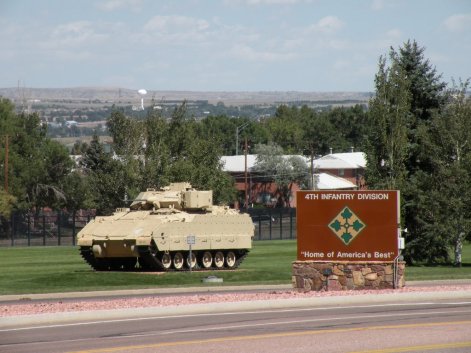
Down the road from us is Fort Carson, an American Army base which was first established in 1942, following Japan’s attack on Pearl Harbour. The city of Colorado Springs purchased land south of the city and donated it to the War Department to enable the base to be built.

During World War II, over 100,000 soldiers trained at Fort Carson and more than 100 units were transferred to the mountain post from other installations. Starting in 1943, it was also home to nearly 9,000 prisoners of war – mainly Italians and Germans. The POWs helped to alleviate the manpower shortage in Colorado by doing general farm work such as canning tomatoes, cutting corn and aiding in logging operations on Colorado’s Western Slope.

Today, Fort Carson covers 137,000 acres and has a military population of over 21,000 soldiers who are served by nearly 5,000 civilian employees. There is an additional training area located approximately 150 miles to the southeast of base which is used for large force-on-force maneuver training.

Colin Powell, a retired four-star General, who became Chairman of the Joint Chiefs of Staff and US Secretary of State under President George W. Bush, served as Assistant Division Commander of the 4th Infantry Division at Fort Carson in the early 1980s.


DSCN5493

The beautiful scenery around Fort Carson has made it one of the most requested duty stations in the US Army. In 2007, it adopted “Best Hometown in the Army” as its motto!

Pueblo, CO

We are staying just outside Pueblo in Colorado which has an elevation of over 4,600 feet above sea level. The area has four distinct seasons, yet is a semi-arid desert land, with an annual rainfall of about 12 inches. Summers are hot and dry, winters are usually mild, and snowfall is light. Due to the high altitude and the accompanying stronger sun, snow rarely remains on the ground for long.

Pueblo and its metropolitan area is a sizeable town of over 200,000 people. The Arkansas River slices through Pueblo’s downtown area is a recreation rock star, offering everything from fly-fishing and rafting to world-class bird watching and fishing.

For nearly a century, the main industry and the largest employer in Pueblo, was the Colorado Fuel and Iron Steel Mill. It attracted large numbers of immigrant labourers and led to Pueblo becoming the most ethnically and culturally diverse city in Colorado and the West. At one point, more than 40 languages were spoken in the steel mill and more than two-dozen foreign language newspapers were published in the city.

Not only is the city culturally diverse, but for some unknown reason, it produces heroes! The Medal of Honor is America’s highest and most prestigious personal military decoration that recognizes US military service members who distinguish themselves by acts of valor. Pueblo is the hometown to four Medal of Honor recipients – more than any other city in the US. President Dwight D. Eisenhower on presenting Raymond G. Murphy with his medal in 1953 commented, “What is it… something in the water out there in Pueblo? All you guys turn out to be heroes!”

fullsizeoutput_1123

The view from our motor home camp site.

fullsizeoutput_111d

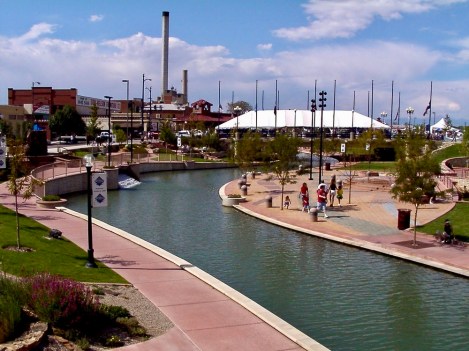
Pueblo’s river walk – a mile-long walk through the centre of downtown with shops, restaurants and bars lining the route. 

Supermax!

Nestled into a valley some fifty miles from where we are staying, with the magnificent Rocky Mountains rising up on the horizon, sits the US Penitentiary, Administrative Maximum Facility in Florence, Colorado – a federal supermax prison for male inmates! It is nicknamed the “Alcatraz of the Rockies!”

The prison has four separate units each with its own security classification, the supermax being the highest. Over 400 occupants are housed in the supermax facility who are deemed to be too dangerous, too high-profile or too great a national security risk for even a maximum-security prison.

Inmates are confined in specially designed single-person cells for 23 hours a day. Their one-hour time out of their cell, for showering or exercise, may occur at any time of the day or night and they are moved between places under restraint – handcuffed, shackled or both. The exercise location is a concrete pit resembling an empty swimming pool designed to prevent those using it from knowing their location in the facility.

Each cell has a concrete desk, stool and bed, plus a toilet, a shower and a sink lacking a potentially dangerous tap. Rooms may also be fitted with an electric light that can be shut off only remotely, a radio, and on rare occasions, a black-and-white television that shows recreational, educational, and religious programming. In addition, all cells are soundproofed to prevent prisoners from communicating with each other.

Cell windows are four inches high by four feet wide and are designed to prevent inmates from knowing their specific location within the complex because they can see only the sky and roof through them, making it virtually impossible to plan an escape.

article-0-1E07832A00000578-975_964x589

Officers in the prison’s control centre monitor inmates 24 hours-a-day and can activate a “panic button” that instantly closes every door in the facility should an escape attempt be suspected.

article-0-1E07829300000578-884_964x598

Pressure pads and 12-foot-tall razor wire fences surround the perimeter, which is patrolled by heavily armed officers with attack dogs. Mike and I were somewhat nervous at stopping the car to take a couple of pics of the facility from the roadside!