The Gifted Family Nose!

From birth, Johann Maria Farina, an Italian perfumer, was fascinated by the different smells that tickled his nostrils on visits to Rome and Venice. Farina was driven to follow his nose and was always swirling glass vessels of fragrant liquids and trying out new scents and essences!

In 1709, Farina made his new fragrance world-famous by naming it Eau de Cologne, meaning “Cologne Water”, in honour of his new German home-town of Cologne.

Farina’s Eau de Cologne was used only as a perfume and was delivered to nearly all the royal houses in Europe. His ability to produce a consistent fragrance utilizing dozens of essences was seen as a sensation at the time resulting in a single vial costing half the annual salary of a civil servant.

Back in the eighteenth century, there was no trademark organization with which you could register your new product, and it was not long before “4711 Original Eau de Cologne”, named after the location where it was developed, appeared on the Cologne market, and remains today one of the oldest fragrances still produced. Nowadays, “cologne” is used as a generic term for perfumes for men or women, but it conventionally refers to those usually marketed towards men.

fullsizeoutput_123e

The Farina House is now run by the eight generation of the Farina family. Farina’s scent contains a secret combination of citrus oils such as lemon, orange, bergamot (an inedible lemon) and lime in addition to those of violet, jasmine, sandalwood and frankincense.
Museum Ludwig

In 1976, private collectors Peter and Irene Lud­wig, alongside representatives from the City of Cologne, signed an agreement to develop Museum Ludwig which would house a donation of some 350 works of art from their private collection of modern art. This was the kick-start the museum needed, and over the years it attracted other donations and sought works for purchase to build it collections.

After her husband’s death in 2001, Irene Lud­wig do­nat­ed an ad­di­tio­n­al 774 works by Picasso catapulting the Museum into the heady ranks of housing the third largest col­lec­tion of Picasso’s works in the world.

Today, the museum houses an impressive collection of the most significant trends of twentieth-century and contemporary art including a focus on “pop art” including important pieces by Andy Warhol. At the time of our visit, we enjoyed viewing a special exhibition of the works of American-born, Pop artist James Rosenquist. The ex­hi­bi­tion pre­sents the artist’s rich­ly col­oured works to­gether with col­lages and archi­val ma­te­rials which served as the ba­sis for his of­ten monu­men­tal works.

fullsizeoutput_123a

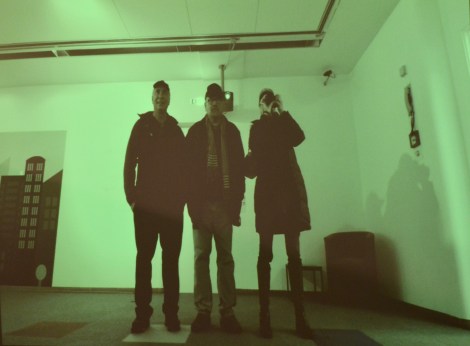
Us in the Andy Warhol exhibition. From Left: Mr. Bob making his blogging debut, Mike and me taking the photograph that you’re looking at!

Works by Pop artist James Rosenquist who died in March 2017.

Dom Cathedral

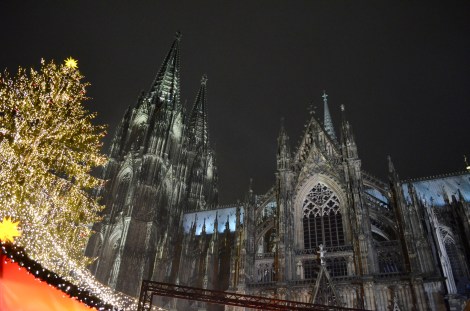
Rising over 500 feet into the sky, the twin spires of Cologne’s Dom Cathedral are Germany’s tallest and most visited landmark which is now a World Heritage Site attracting some 20,000 visitors a day!

Construction of this renowned monument began in the 13th century, was halted two centuries later due to lack of funds, re-started in the 19th century and completed, to plan, in 1880!

In World War II, the cathedral suffered fourteen hits during aerial bombing raids by the Allied Forces, and, although badly damaged, it remained standing in an otherwise completely flattened city; the twin spires provided an easily recognizable navigational landmark used by the pilots during missions. The cathedral and the immediate area surrounding it was also the site of intense tank combat between American and German forces in March 1945.

Post war renovations to the cathedral were completed in 1956. However, an emergency repair on the northwest tower’s base carried out in 1944 using poor-quality brick taken from a nearby ruined building remained visible until 2005 as a reminder of the war, when it was decided to restore the section to its original appearance.

Maintenance work is constantly on-going and the cathedral is rarely completely free of scaffolding, as wind, rain, and pollution slowly eat away at the stones.

Dom Cathedral, Cologne, Germany December 2017

Peskey scaffolding ruining my picture of the twin spires of the Dom Cathedral!

fullsizeoutput_1221

To the side of the Cathedral is the Dom Christmas market.

Welcome to Cologne, Germany!

It’s great to have you along for our latest adventure in Europe! Strap yourself in as I think this trip could be wild!

At the time of writing, we are a cast of three: “he, who must be obeyed,” HA, HA!……. aka, my Darling, Mike; Mr. Bob, one of our intrepid traveling companions, and me, the blogger!

We left Houston yesterday and flew to Chicago where we connected with a flight to Brussels, Belgium. From there, we hot-footed it by two trains to Cologne and are now ensconced in our Airbnb apartment………. smack in the middle of town and from where we can walk to all the city’s attractions.

Cologne is Germany’s oldest city, and remains an important trading hub, alongside its modern-day cultural attractions of the Cathedral, museums, beer, good German food, and cruises along the Rhine valley.

In May 1942, Cologne became a key target of the British Airforce during World War II. The Royal Air Force, or lovingly referred to as the RAF, sent over 1,000 planes to bomb the city and not only did they bomb it, but the city was razed to the ground. It was not the bombs that were the prime cause of devastation, but rather fire. Buildings were made of wood, they were very close to each other, and as the bombs hit so did fires start and spread across the city.

I’ll update you tomorrow with photographs, but we have had a nap and are just about to hit the town!

Back blogging December 12th!   

I will be back blogging on December 12th when we will hit three European cities!

The first stop is Cologne, Germany where we will enjoy the fabulous Christmas markets, the wonderful culture, the history, the food and likely some good German beer!

From Cologne, we will take the train to Amsterdam where we will be joined by other intrepid travelers for yet another adventure in a city steeped in avant-garde, modern-day living, incredible history and fantastic art. And, if that isn’t enough, three of us will then head to London to spend Christmas with the Hagerty clan and catch up with some friends too!

Get ready to buckle up and enjoy the winter scenes of some wonderful European cities – it will great to have you along for our next adventure!

fullsizeoutput_1198

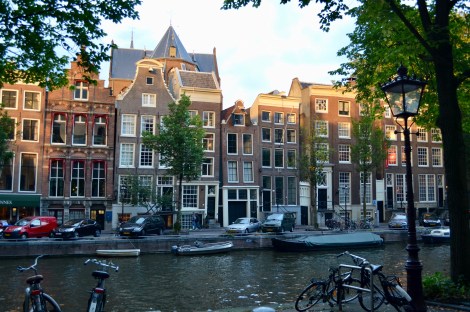
A typical street in Amsterdam where we visited in September 2016 and had such fun that we are returning to the great city in December. See you there!

Home James!

I have no idea where the expression “Homes James” comes from, but it is one that my Mum has always used when arriving home from a holiday or a big shopping expedition, and it seems to have stuck! And yes, we do have a James in the family, one of my nephews, but this expression has been in use long before he was even a twinkle in his parents’ eyes!

We arrived home on Monday night having driven some 475 miles from Lubbock to Magnolia. It was a long day of driving but we are beginning to land a motor home travel routine that works for us; I think that we prefer to have as few “driving” days as possible in order to maximize the exploring days.

En route to Colorado, we met a lovely couple in the Lubbock RV park who were in the site next to us. The gentleman was the sole driver and his travel mantra was that he wanted to be at least one-third of the way through the day’s journey by the time the sun came up! Mike and I are both completely stumped by this, as for us, the whole point of having a motor home is to see and explore the magnificent US of A. How can you do that in the dark! Hey ho, we are all different and if that works for him, good luck.

In line with our home owners’ association, and as our home is on the golf course, we are allowed to park the motor home for two nights at the beginning and the end of every road trip! This is really fantastic as it enables us to open the garage doors and simply load and unload the motor home each time we are preparing or returning from a trip.

We have also moved the motor home storage unit to somewhere that is within 15 minutes or our home. Not that we were unhappy with the first site, but it had minimal security and the new place has cameras everywhere recording everyone that comes and goes.

fullsizeoutput_1197

Roxanne parked in her new site and ready for the next adventure!

Prairie dogs!

Welcome to Lubbock where we are staying in a RV park that is home to a field of very vocal Prairie dogs which are driving Miss Poppy crazy!

Prairie dogs are a type of burrowing squirrel, native to the grasslands of North America. On average, these stout rodents grow to about 12 to 16 inches long, which includes a short tail and they weigh-in at around one to three pounds.

Prairie dogs are highly social and live in large colonies and collections of prairie dog families that can span hundreds of acres. Members of a family group interact through oral contact or “kissing” and grooming one another, but they do not perform these behaviours with prairie dogs from other family groups.

They are mainly herbivores feeding on grasses and small seeds, though they do eat some insects. They live below ground in burrows which help control their body temperature and enable them to watch for predators from the burrow’s entrance. Their burrows are highly organized and have nursery chambers for their young, chambers for night, and chambers for the winter. They also contain air chambers that may function to protect the burrow from flooding and a listening post for predators!

fullsizeoutput_1192

Prairie dogs watching out for Poppy!

Capulin Volcano

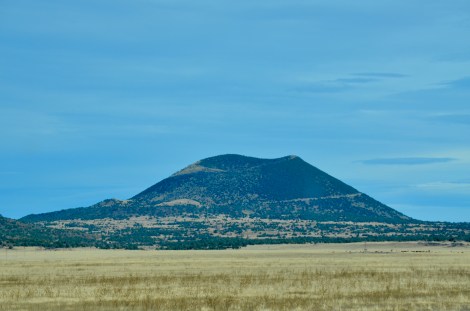
Capulin Volcano is one of the outstanding landmarks located in the northeast corner of New Mexico, where the rolling grasslands meet the foothills of the Sangre de Cristo Mountains, and it was an unexpected surprise as we drove past it on the first leg of our journey home!

Approximately 60,000 years ago, firework-like explosions of molten rock erupted thousands of feet into the air. As the cinders cooled, four lava flows formed the volcano, a near perfectly shaped symmetrical cinder cone, rising to an elevation of over 8,000 feet above sea level.

What makes visiting this extinct volcano so special is that you can you drive all the way around it, hike its mile-long circumference and follow a trail down into the 400 feet deep crater.

Surrounding the Capulin Volcano is a large volcanic field containing at least 100 recognizable volcanoes. Volcanic fields consist of clusters of many small volcanoes, each up to two miles across. Thousands of years may separate the eruption of each small volcano, but they all occur within the space of a hundred miles or so, and are restricted to several hundred thousand to a million years in time.

fullsizeoutput_1187

The volcano’s highest point provides unobstructed, panoramic views of the volcanic field, distant snow-capped mountains, and portions of five states – Colorado, Kansas, New Mexico, Oklahoma and Texas!


Seeking Presidential Pardon!

Starting in 1947, a new custom of presenting the White House with a turkey for Thanksgiving (the last Thursday in November) began under President Harry Truman.

George H.W. Bush instituted the turkey pardon as a permanent part of the presentation beginning in his first year in office – 1989 – in response to protests from animal rights activists! Since then, at least one of the turkeys presented to the President has been taken to a farm where it will live out the rest of its natural life.

From 2005 – 2009, the pardoned turkeys were sent to the Walt Disney World Resort in Florida, where they served as the honorary grand marshals of Disney’s Thanksgiving Day Parade! Last year, Virginia Polytechnic Institute received the 2016 pardoned turkey!

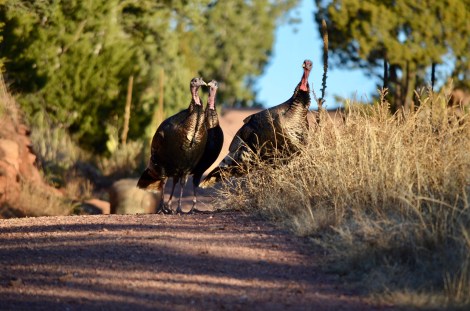
Eventually, I managed to capture on camera the wild turkeys strutting around our RV park in Colorado Springs. I saw nine of them together but was unable to get them to pose for a group picture! My beloved former neighbor, Ron, who knows all things turkey, tells me that “Tryone” is a young bird and that he will get bigger in size and weight, but that right now, he would make for some good eating!

fullsizeoutput_116d

Tryone is seeking the 2017 Presidential Pardon to live out the rest of his natural life as a “ward” of the Krywanio Family!

fullsizeoutput_1188

Tryone and his buddies strutting around our RV park in Colorado Springs!


Fountaneer – Part II

With history, it sometimes takes a few iterations of a name before one becomes permanent, as is the case with Pikes Peak.

Initially, the Ute Indians called the Rocky Mountains eastern-most peak the “Sun Mountain” because it catches the early morning rays. In the late 1700s, Spaniards referred to the peak as El Capitan.

In 1806 Lieutenant Zebulon Montgomery Pike was dispatched to survey the area. Pike kept a journal detailing his travels and wrote about a mountain of “blue cloud” in the distance that he called Grand Peak. Pike and his men attempted to reach the summit in November of 1806 but were beaten back by a severe blizzard. Fourteen years later the first ascent was recorded and in the 1950s, Pikes Peak became the mountain’s official name.

At mile seven on Pikes Peak highway, the climb to the summit really begins and for the next 12 miles, the road winds up and around and around and up, seemingly never to end! Mike is driving and I have Miss Poppy on my lap and it begins to get really scary sitting on the passenger side as you glance down where there is nothing but a sheer drop, especially when bad-boy husband drives close to the edge to scare the two of us!

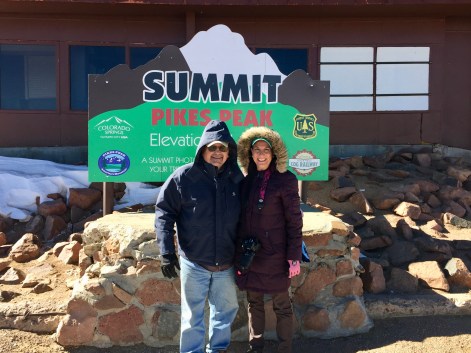
And, then you are there, at an elevation of 14,115 feet (4,302 m), the wind is howling, it is 35 degrees F, and it is magnificent!

fullsizeoutput_117d

Perched on top of the mountain is the Summit House where you can buy souvenirs and enjoy a coffee and a donut, which is the tradition!

fullsizeoutput_1177

Mike and Poppy – we checked to ensure that it was OK to take Poppy to such a high elevation and immediately after the picture she returned to a warm blanket in the car!

fullsizeoutput_1183

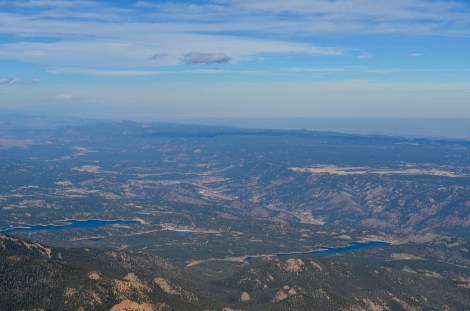
The two other reservoirs on Pikes Peak. Views from the summit are amazing but you have to take pictures quickly because the wind is so strong that you’re fighting to stay upright! 

fullsizeoutput_1173

It’s difficult to see, but above the firm outline of the mountains is a second, white outline of the Rocky Mountain range in the distance!