Happy Valentine’s Day!

On this special day of Love, I hope that no one has been disappointed!

I hope that your card(s) were well received; that you swallowed your Scrooge inclinations and paid the exorbitantly inflated prices for Roses; that the chocolate-covered strawberries are eaten; and that at some stage today your hearts beat just a little faster because of LOVE …

Oh my! It’s good to be back and by that introduction I need to re-hone my writing skills to once more amaze and amuse you with tales from our latest road trip!

And what an adventure we have ahead of us! We set off this morning on a really fun trip that will see us cover some 3,000 miles over a five-week period. We are heading to Tucson, Arizona where we will participate in our first-ever Tiffin Motor Home rally where we have both volunteered our services to do who knows not; from there we go to Bullhead City, Arizona to check-out the area; onto St. George and Moab in Utah, Durango in Colorado, Albuquerque in New Mexico, Lubbock in Texas and back home!

On-board are the usual suspects: he who must be obeyed (ha, ha, ha!), Miss Poppy-dog and kitties Abigail, Archer and Artie. Very sadly we lost Miss Holly on New Year’s Day and even though she was with us for such a short space of time, she has left a void for everyone! We are searching for a replacement, but that said, I am a firm believer that pets find you and not the other way around!
 

file2

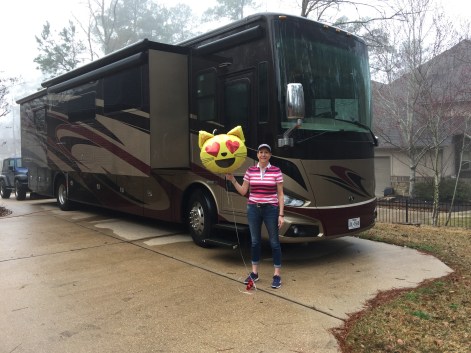
Off to the Races:  me holding the best-ever Kitty Valentine balloon and in the fridge is strawberry-cream cake and my favourite wine! Well done Mr. Valentine!
 

Back Blogging February 12, 2018

Happy New Year to you and I hope that it is a healthy and happy one for all.

We are gearing up for our first road trip of 2018 which promises to be “interesting” as we Brits say! Leaving on February 12th we will head to Tuscon, Arizona to participate in our first ever Tiffin Motor Home rally where we will be one of three hundred motor homes to arrive at the Pima County Fairgrounds for a five-day event. Mike and I have signed up to be volunteers so we are definitely starting the year in un-chartered waters!

What fun we will have and I am in the midst of planning how to decorate the motor home to reflect the “Old Wild West” which is the rally’s theme … just how one turns a 40-foot stationery beast into the wild west is still vexing the grey cells but I’ll keep plugging away at it until some kind of brain wave happens! I am not even sure if we have to dress up too but Miss Poppy has already requested being dressed as the sheriff!

After Tuscon, we will further explore Arizona before heading to Utah to check-out a couple of places, onto Colorado, New Mexico and back into Texas and homeward bound. We plan on being on the road for around five to six weeks, so a long trip with much to see.

We look forward to having on aboard! See you next month!

Vincent Van Gogh!

Born on March 30, 1853, Vincent Van Gogh would be tormented by severe mental instability for the majority of his life, die from his own hands, and ultimately change the outlook on art for the rest of history.

In 1886 Van Gogh moved to Paris where his art began to take on the style that would make him famous. He was using more color, applying the paint with thick, bold brushstrokes, and painted all that surrounded him. Van Gogh arranged to show his work, to positive reviews, but was still unable to sell any pieces.

Van Gogh moved to Arles in the south of France where he entered the most productive and creative period of his life painting his famous Sunflowers. However, it also was a time of great turmoil for him beginning a period of hospital stays for mental illness and physical decline.

After just ten years of painting and producing some 900 paintings, Van Gogh took his own life in 1890. Never fully appreciated in his own time, it wouldn’t take long for the art world to recognize the genius they lost. Within twenty years of his death, there were memorial shows of his works all over the world – influencing generations of artists to come.

IMG_1439

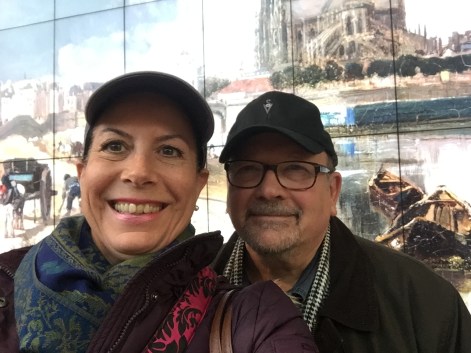
Michael and i at the Van Gogh museum in Amsterdam.

Herr Herring!

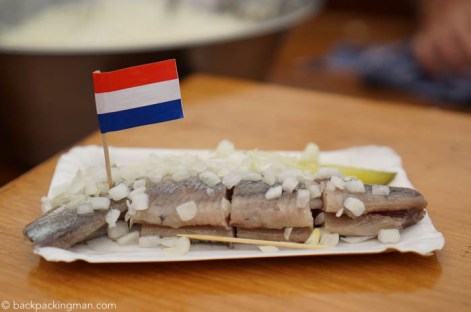
One of the most popular snack foods to eat in Amsterdam is “raw” herring which you traditionally grab by its tail, throw back your head and lower the fish into your mouth while biting off tasty morsels!

In reality, the fish is not really “raw.” First of all, it is partially gutted on board the fishing vessel, it is then salted, and frozen for a minimum of two days which affects the taste of the fish and its tenderness: the freezing process ensures that no parasites remain alive as the fish is not cooked before it is served.

After the fish is defrosted, the herring is further cleaned and prepared at stalls when customers order it. The fish stands will slice the herring into small pieces and place it on a card dish with raw onions, pickles and a tooth pick sporting the national flag which serves as the utensil to eat the herring. As to the taste, well, if you like sushi, you’ll love it and it’s also good for you as it has cholesterol-lowering properties!

Herring fishing occurs all year round, but the fat content, which impacts the taste of the fish, varies with the season. The best herring is called “Holland New” which indicates that fish has been caught between the middle of May and the end of June. Earlier in the year and the fish is too thin, and later it is too fat. By law, “Holland New” must have at least 16% fat.

fullsizeoutput_12d3

Mike and I had lunch here yesterday – herring, smoked salmon, cooked flounder and shrimp! Great family-owned fish shop right by a very busy market.

herring-albert-cuyp-market-amsterdam

National delicacy: sliced herring served with onions, pickles and a tooth pick which doubles as a utensil!

Master Rembrandt!

Today, four of our intrepid travelers spent a number of glorious hours at the magnificent Hermitage Museum in central Amsterdam. With a number of exhibitions on display, we were able to gaze at masterpieces until our non-artistic brains froze in appreciative overload!

Rembrandt was born in 1606 in Leiden, a town in the southern province of The Netherlands. He died some sixty year later, an alcoholic and a pauper but leaving behind a legacy that still dazzles anyone who is lucky enough to view his works.

Following a number of years at a Latin school, Rembrandt is enrolled at Leiden University at the age of 13. However, this is not a good fit, and after only a few months, he leaves to pursue his true love of painting and becomes apprenticed to an artist.

In 1624, Rembrandt relocates to Amsterdam to work with Pieter Lastman, a painter of biblical, mythological and historical scenes with an eye for a landscape. From Lastman, Rembrandt learns how to paint faces, hands and feet………. this is his real introduction to portraits and what he is best known for as an artist.

When you stand six inches from the canvas, the brush strokes he uses to create a depth to the subject matter is mind-blowing; his painting technique introduces light and movement which so many of his contemporaries are unable to do; and he somehow conjures up a three-dimensional effect with the colours he selects.

fullsizeoutput_12ce

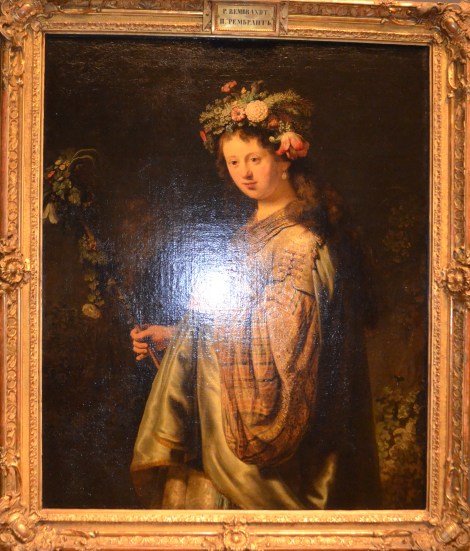
In 1934, Rembrandt paints his young wife Saskia as Flora, the Roman goddess of spring, youth, flourishing nature and fertility. With her left hand, she gathers the heavy folds of her cloak around her stomach intimating to the viewer that she is pregnant. When you look really closely at Saskia’s left hand and pearl earring, you can see that Rembrandt has in fact moved both, yet the outline of where her hand and earring were originally located remain visible at close quarters!

 fullsizeoutput_12c2

A selfie with Rembrandt! From left: Mr. Bob, Uncle Mike, the blogger and Chris!

The World’s most famous Anne!

Anne Frank was born on June 12th, 1929 in Germany to parents Otto and Edith Frank, and an older sister, Margot.

With Hitler’s rise to power, and a growing level of anti-Semitism, Otto decides that it’s time to leave his home town and take his family to somewhere safer – Amsterdam, The Netherlands. Otto sets up a business in Amsterdam, the family finds a new home and the girls attend school.

On September 1st, 1939 Germany invades Poland and it is the start of World War II. For a while there is hope that The Netherlands will remain neutral, but on May 10th, 1940 German troops invade the country and five days later The Netherlands surrenders and is occupied.

Anti-Jewish regulations soon follow. Jews are allowed into fewer and fewer areas of the city, their bicycles and cars are confiscated, they are forced to re-locate and live in dedicated Jewish areas, display a Star of David on their outer clothing and live by ever-increasing laws and restrictions. Otto’s business is confiscated.

Together with his Jewish business partner, Otto and his family go into hiding on July 6th, 1942 in the rear annex of his business premises. One week later they are joined by another three-member Jewish family and an eighth person joins them later in the year.

Shortly before going into hiding Anne receives a diary for her birthday. She starts writing straightaway and during her time in hiding she writes about events in the secret annex and about herself. Her diary is a great support to her.

Tragically, after more than two years in hiding, the Frank family and their friends are discovered and deported to concentration camps. Anne’s father, Otto Frank, is the only one of the eight people in hiding to survive.

After her death, Anne becomes world-famous because her father ensures that the diary his daughter wrote while in the annex is published.

Let’s Talk about Sex, Baby!

Boulangerie: a shop where you buy bread!

Patisserie: a shop where you buy cakes!

Condomerie: a shop where you buy condoms!

Welcome to Amsterdam’s Red Light district!

The area is a network of alleys containing some three hundred small, one-room shop-fronts, rented by female prostitutes who offer their services from behind a window or glass door which is, typically, illuminated by red lights (or blue lights which indicate that the prostitute is a transvestite). The area also offers sex shops, theatres, peep shows, museums – one dedicated to sex, one to prostitution and one to erotism – plus a number of “coffee shops” that sell cannabis.

Amsterdam prides itself on its liberal and tolerant attitude, embracing the fact that people may be into prostitution, soft drugs and pornography – and that it is only human. So instead of criminalizing everything, they enjoy the honesty of it all, or so they say!

Prostitutes in the Netherlands are also taxpayers. As a legal profession, the government ensures that all prostitutes are able to access medical care and work in better conditions by regulating and monitoring working practices and standards. Help is also at hand in the district itself thanks to the prostitution information centre and, contrary to popular belief, the Red Light district is one of the safest areas in Amsterdam.

Top Left: a “condomerie”, Miss Vivienne makes her blogging debut, a view of the Red Light district and a “Sex Palace”. It is strictly forbidden to take pictures or film women behind their windows. 

IMG_1402

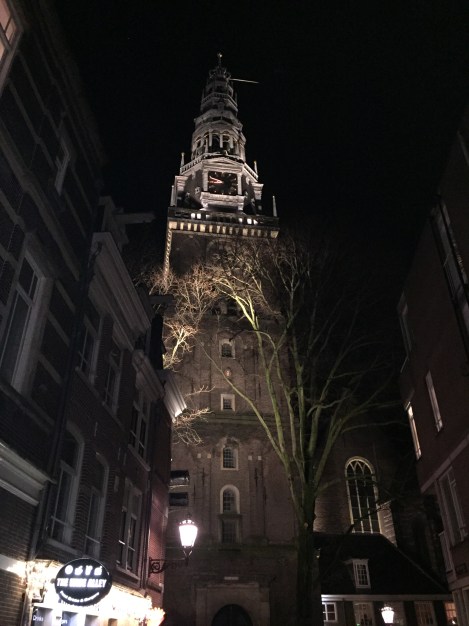
In the middle of the Red Light district is a magnificent 14th century building known as the Old Church.

Dutch Courage!

Yesterday, Mike, Mr. Bob and myself traveled by train from Cologne to Amsterdam in the Netherlands where we will be staying a week. We were joined by Uncle Mike who flew in from Chicago, and today, Chris, my stepson, arrived from Houston!

Bols is the oldest distillery in the world which has been brewing liqueurs in Amsterdam since 1575. Their first flavours were Cumin, Cardamom and Orange!

Fast forward about 100 years, and it was Lucas Bols, grandson of the Founder, who began to ship the family’s liqueurs all over the world. Not only that, but he was also a major shareholder of the Dutch East India trading company which gave him the privilege of first choice of newly arrived exotic herbs and spices. This helped him create over 300 liqueur and spirit recipes which turned the family business into a world-famous brand.

Lucas Bols must also be credited with leveraging the family’s experience in the process of distillation by producing genevers, or Dutch gin, made from long fermented Rye, Wheat and Corn. In 1820, Bols master distillers introduced a revolutionary new recipe based on malt spirit, neutral grain alcohol and botanicals which proved to be perfect for a new phenomenon in America, the cocktail!

The story goes that the expression “Dutch Courage” came to be after English soldiers fighting in the Anglo-Dutch wars (1652 to 1674) noted the bravery-inducing effects of genever on Dutch soldiers. The English set about making their own version, Gin, which would become popular in England thanks to King William of Orange who was also head of state of the Netherlands!

From left: Mr. Bob and Chris at the “House of Bols” exhibition and taste experience!

Cologne’s Christmas Markets

The Christmas markets in Cologne have to be the best we have visited in Europe, to date! They are beautifully laid out, each vendor with an individual, wooden “hut” from which to sell their products, and not touristy rubbish, but high-quality goods such as hand-crafted wooden tree decorations depicting scenes of Cologne, hand-made leather belts, intricately carved clocks, pure-butter biscuits in branded tins, candles, hats, scarves, gloves, and so on.

Each of the markets is heavily biased towards selling food and drinks such as hot Gluhwein to keep-out the cold; Gluhwein is a spiced red wine that is a popular drink in cold European countries which I remember enjoying on skiing holidays; hot eggnog laced with rum and served with a big dollop of cream on top; beer, of course; deep-fried potato cakes served with mustard; brats (sausages) of every description known to man served in buns with lashings of sauerkraut; hot smoked salmon sandwiches; and, cheese served every which way – hot and spread on rye bread, sliced thickly and wedged in rolls, in sauces covering ham, salami and whatever else comes to hand! It’s made my mouth water just writing about it!

Some of the markets have ice rinks and merry-go rounds for children; many have stages where bands and choirs entertain the crowds. And, all of the markets we visited were jam-packed with families, friends and workers all enjoying whatever was on offer and barely a tourist in sight, apart from us!

The experience really has been magical!

Pretty entrances to the markets!

Drinks stands and vendor units.

Mike and I enjoying an eggnog!

fullsizeoutput_1281

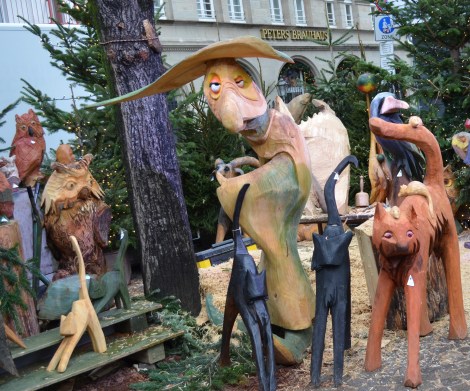
Magnificent hand-carved wooden animals for sale!