Rock solid!

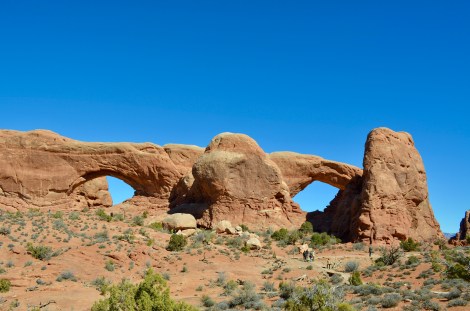
We are now in Moab, Utah and have spent the day at the magnificent Arches National Park where water and ice, extreme temperatures and underground salt movement are responsible for sculpting the landscape.

On clear, blue-sky days, like today, it is difficult to imagine such violent forces, or the 100 million years of erosion that have created this jaw-dropping vision that boasts one of the world’s greatest densities of naturally-created arches!

The arches are formed of Entrada Sandstone which was deposited in the area more than 150 million years ago. Over time it was buried by new layers, hardened into rock and shaped by the powerful forces of erosion.

A series of uplifts and collapses caused severe cracking in the 300-foot (91 metre) layer of buried Entrada Sandstone.

When overlying rock layers eroded away, the sandstone was exposed to weathering; cracks slowly widened and parallel rock walls were formed.

Rainwater continually dissolves the natural cement that holds sandstone together. This process combines with the pressure from water freezing in tiny cracks and causes the sandstone to flake and crumble. Eventually, enough rock falls out so that an opening is formed.
fullsizeoutput_250f

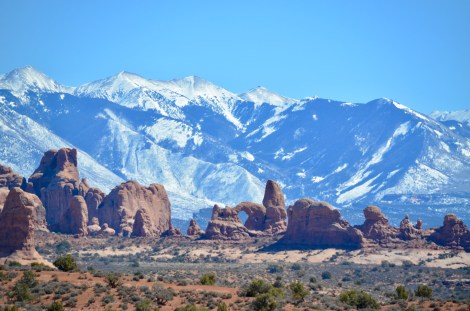
Turret Arch.

Arches National Park, Moab, Utah

Arches known as Windows North and South.

Arches National Park

This series of rock formations is known as Park Avenue as early park visitors thought that they looked like buildings of a big city!
fullsizeoutput_2511

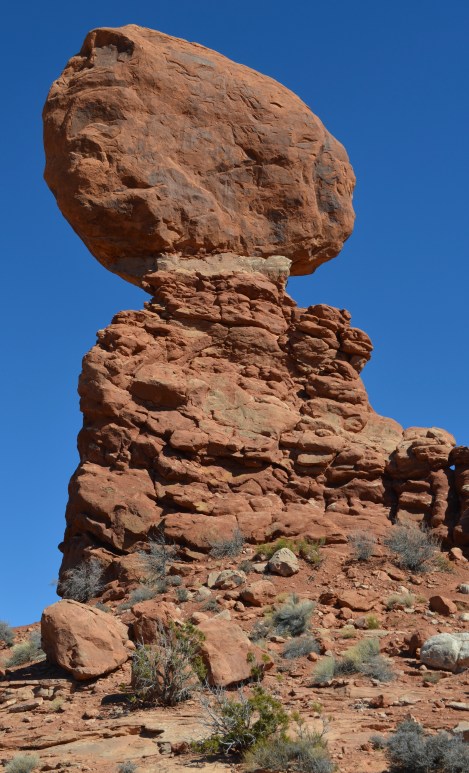
Balanced Rock: the forces of erosion are sculpting more than just arches. The caprock of the hard Slick Rock Member of the Entrada Sandstone is perched on a pedestal of mudstone.
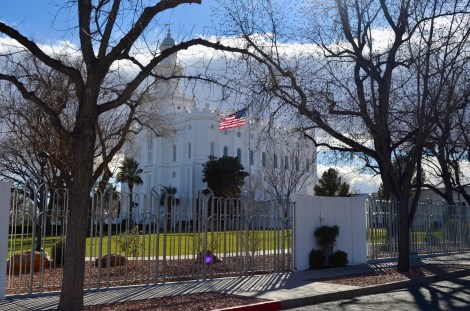


St. George Utah Temple

Mormons are a religious and cultural group related to Mormonism, the principal branch of the Latter-day Saint movement of Restorationist Christianity, developed by Joseph Smith in upstate New York in the 1820s. After Smith’s death in 1844, the Mormons followed pioneer Brigham Young to what would become the Utah Territory, today known as the State of Utah.

In 1871, Brigham Young announced the building of the first temple by The Church of Jesus Christ of Latter-day Saints in St. George, Utah. The project was dedicated in 1877 and was built to satisfy the church’s immediate need for an appropriate place for temple ceremonies and ordinances.

The walls of the temple were built of the red sandstone common to the area and then plastered for a white finish. Local church members worked for over five -and-a-half years to complete the temple. Workers opened new rock quarries, cut, hauled and planed timber and donated one day in ten as tithing labour. Some members donated half their wages to the temple, while others gave food, clothing and other goods to aid those who were working full-time on the building.

fullsizeoutput_2509

The St. George Utah Temple is the oldest temple still actively used by the Latter-day Saints Church. The temple currently has a total floor area of 110,000 square feet (10,200 square metres). After remodeling the interior, the temple was rededicated in 1975.

Sharpshooter Gunlock Will

Another day. Another state park. Another trail! Oh my, I guess we drew the short straw!

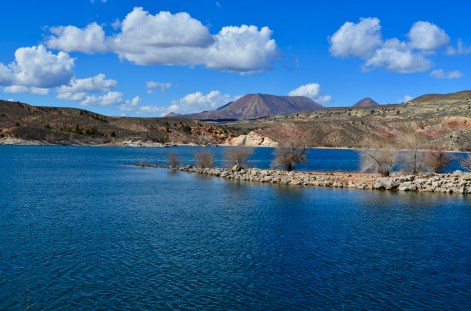
Today we head for the 266-acre Gunlock State Park and Reservoir, located some 15 miles northwest of St. George, Utah in scenic red rock country.

Residents of St. George really do enjoy an outdoor recreational lifestyle as they are blessed with so many state parks where they can hike, cycle, horse-ride, boat, swim and fish. Here at the park and reservoir, the catch of the day is bass and catfish.

The name Gunlock is the same as a small farming community one mile north of the park. William Hamblin (known as Will) was a Mormon pioneer born in Ohio who settled in the area of the lake in 1857. Gunlock Will, as he was known, was a good hunter and sharpshooter, and was skillful in repairing gunlocks, which are the firing mechanisms for muzzleloader guns.

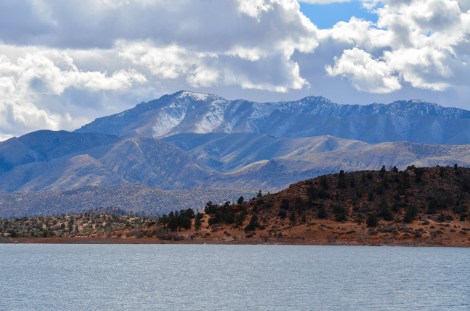
Construction of the Gunlock reservoir dam was completed in 1970 for irrigation water and flood control. The state park was opened to the public in 1970 and like the other parks we have visited since arriving, the scenery was stunningly beautiful. Even though the day was cold, the presence of water and the spectacular view of snow-capped mountains was simply breathtaking.

fullsizeoutput_2502

Gunlock State Park also has camping facilities; imagine waking up to this view!

fullsizeoutput_2503

A view across the reservoir to the snow-capped mountains.


Butch Cassidy and the Sundance Kid!

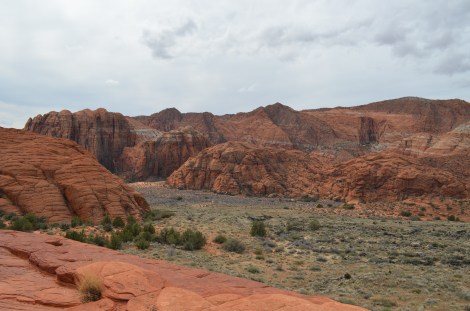
Snow Canyon State Park, where we spent our day, is a 7,400-acre scenic part tucked in between lava flows and soaring sandstone cliffs in a strikingly colourful desert environment just outside St. George, Utah.

Transported by wind more than 180 million years ago, tiny grains of quartzite sand covered much of what is now Utah. These sand dunes, up to 2,500 feet thick, eventually cemented into stone. Burnt orange to creamy white in colour, Navajo sandstone is the predominant rock, and what remains of the ancient desert sands.

Over time, water cut and shaped the sandstone to form canyons. Approximately 1.4 million years ago, and as recently as 27,000 years ago, nearby cinder cones erupted causing lava to flow down these canyons, filling them with basalt. The lava flows redirected ancient waterways which eventually began carving new canyons. As you look up, you can see lava-capped ridges that were once the floors of canyons!

Snow Canyon averages 7.5 inches of rainfall each year and vegetation includes desert adapted species such as creosote bush, narrow leaf yucca, sand sage and black brush.

fullsizeoutput_24de

Me and the intrepid explorer Miss Poppy sitting on one of the many petrified sand dunes.

DSC_0091

Where you see the light green on the photo is where lava once flowed!

fullsizeoutput_24ee

Snow Canyon State Park was the site of the Hollywood film Butch Cassidy and the Sundance Kid!

Outsized geology!

Located in southwestern Utah, near the Arizona and Nevada borders, the Zion National Park is a celebrated premier attraction. And, no wonder! We spend the day there enjoying the spectacular scenery!

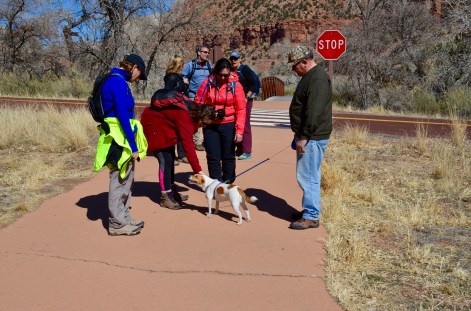
We hike the Pa’rus Trail, a 3.5 mile walk that is paved and is the only trail where dogs are permitted. Miss Poppy is in paradise, enjoying a long walk in the sunshine, checking out all the new aromas of the trail and making lots of new friends!

In contrast to the open vastness of The Grand Canyon, Zion’s vertical scenery is within touching distance. There are trails for every level of fitness, traversing eons of deposition and erosion that are creating the world’s outsized geology.

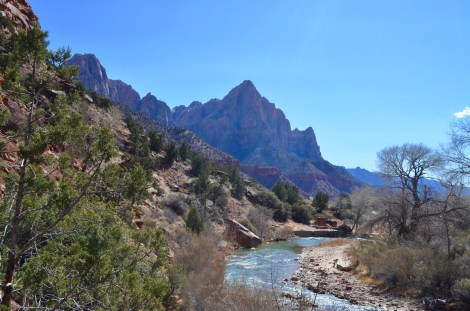
The Virgin River, which we are following, is a deceptively tranquil stream and also a relentless agent of change. During spring runoff or after a rainstorm, the waters fill with particles of sandstone. The current carries an average of 5,000 tonnes of rock fragments daily – evidence that the river not only carved Zion Canyon but continues to widen and transform the canyon scenery.

In off-season, visitors are allowed to drive their own cars through the park. The drive is stunning and without too many others around, we are able to stop and take pictures.

fullsizeoutput_24d2

Less than a mile from where we start, Bridge Mountain (far right) rises 2,800 feet above the canyon floor. 

fullsizeoutput_24d6

The Virgin River plays a dual role in this desert terrain. As a life-giver, this year-round flow promotes a rich community of water-loving plants and associated wildlife, from kingfisher to mountain lion.

fullsizeoutput_24d7

Stunning scenery in every direction!

fullsizeoutput_24d5

Miss Poppy-dog recruiting new members of her fan club!

Jurassic Park!

We are now in St. George, Utah where we visited the Dinosaur Discovery museum which was amazing!

Cast your mind back to the earliest Jurassic Period, about 198 million years ago, when southwestern Utah was home to the large, freshwater Lake Dixie. The lake hosted a vibrant ecosystem including dinosaurs and mammal ancestors who roamed along the lake shore amid a variety of plants.

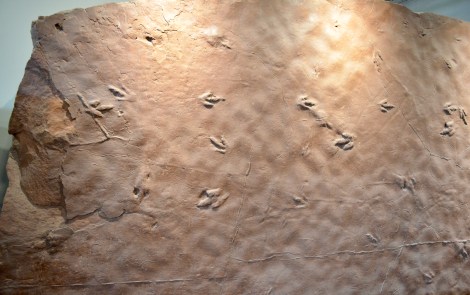
A dinosaur walking along the shores of the lake made natural mold footprints in the soft mud and silt. The sheer weight of the animal deformed not only the top layer of sediment but also soft layers beneath.

After the footprints were made, the sediment dried out, making the upper layers firm enough to resist relatively gentle weathering forces and protecting the underlying layers below.

Rising water levels deposited sand in and over the footprints, burying them and forming natural casts. Over the next 200 million years, the sediments were compacted and cemented together, becoming shale, mudstone, siltstone and sandstone.

When separated from the softer mudstone, siltstone and shale, the natural casts in sandstone appear to be “inverted” footprints. They are actual, naturally formed replicas of dinosaur feet made entirely from sediment!

fullsizeoutput_24c6

The first dinosaur tracks were discovered by Dr. Sheldon Johnson in February 2000. He went on to create the museum building it on the location of his initial discovery which was once the shoreline of Lake Dixie.

fullsizeoutput_24c9

The specimen above is the largest single block of dinosaur tracks ever collected. By measuring the length of each track in a trackway and the length of one stride, paleontologists can calculate how fast the dinosaur was moving when it made the tracks.

Snowbirds!

Bullhead in Arizona is a popular destination for Snowbirds – a north American term for those who leave their own cold climates in winter time in search of warmer weather. Once it is warm enough to return home, they do so.

The RV park where we are staying is focused on attracting Snowbirds by offering special three and four-month price packages. All around us you can see vehicle license plates  from cold states such as Minnesota, Wisconsin, Alaska, Kansas and Alberta in Canada. We were chatting to one couple from Toronto who leave their home each year in the middle of November and return in the middle of April, likely to still see some snow on the ground!

At this time of year in Bullhead, the daily temperature reaches some 60 degrees Fahrenheit (around 15 degrees Centigrade), with cool air in the mornings and evenings. Bullhead citizens enjoy this kind of temperature for five months of the year, November through to the end of March, and then for the remaining seven months of the year the temperatures soar, and they have 100 + degrees Fahrenheit every day. It’s an arid heat, making it feel even hotter, and in July and August it can hit 120 degrees plus.

For those residents of Bullhead and other similar cities in Arizona, who are are able to do so, they do a reverse Snowbird and leave in the summer months in search of cooler air.

fullsizeoutput_24b7

The view from our motor home site in Bullhead, Arizona. To accommodate for the migration of Snowbirds each year, there are RV parks everywhere!

Grapevine Canyon!

We went off-roading again today, which, to our amazement, was Miss Poppy-dog’s favourite pastime! She is a true explorer! We couldn’t keep her on the agreed paths, she was off sniffing, climbing and having the time of her life! Who knew!

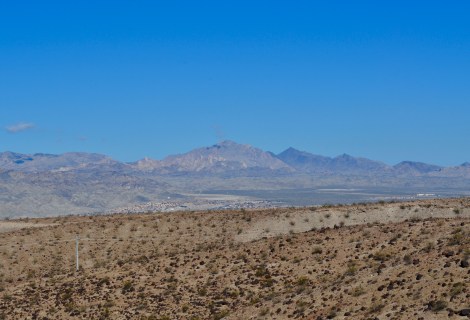
Grapevine Canyon is located in Spirit Mountain, some eight miles from our RV park, and is one of the earliest and largest sites for petroglyphs – images carved or scratched onto rocks in Southern Nevada.

The remote canyon is sacred to the Yuman and Numic speaking tribes, indigenous to the area. The springs and plants in the canyon attract people and many animals including bighorn sheep which are an integral part of this unique landscape.
fullsizeoutput_24af

The native rocks are darkened by desert varnish and are covered with hundreds of petroglyphs and, even though the day was cold, overcast and rainey, the canyon was truly amazing and we are so glad that we visited!


Chasing Cacti!

We took the Jeep today and went off-roading across the Newberry Mountains in southern Nevada!

About seven miles west of Laughlin, Nevada is the entrance to Christmas Tree Pass. The 12-mile graded, dirt road of the pass, winds up and through a ruggedly beautiful canyon rich with flora and fauna.

The scenery is breathtakingly beautiful. The rock formations rise majestically into the blue sky, forming shapes which, with a little imagination, can look like animals or Disney characters!

We park the Jeep, and conscious that the snake population will be out sunning themselves on the rocks, we leave Miss Poppy in the comfort of the car while Mike and I head into the wilderness chasing Cacti, a favourite plant species of ours.

The canyon is part of the Lake Mead National Recreation Area and the dirt road ends south of a tiny town called Searchlight, Nevada.

fullsizeoutput_24aa

Mike and I with prickly Peter!

The magnificent scenery of Christmas Tree Pass.

DSC_0163

Miss Poppy: comfortable and safe in the Jeep while Mike and I explore our surroundings!

Laughlin’s Classic Car Collection

In 1931, Don Laughlin is born in Minnesota and works winters during his youth as a fur trapper. With the profits he buys slot machines for installation in hunting lodges.

Laughlin moves to Las Vegas, Nevada in the 1950s, and buys his first casino, the “101 Club.” While flying his private plane over the California/Arizona/Nevada tri-state area near the Colorado River, he sees the potential for a resort destination. Soon after his flight, he buys an eight-room riverfront motel on 6 ½ acres for $250,000.

In less than two years, the Riverside Resort is entertaining guests with gambling and all-you-can-eat chicken dinners for 98 cents. Play at the casino is on twelve slot machines and two live gaming tables and accommodations are available in only four of the motel’s eight rooms; Laughlin’s family occupies the remaining four.

A US Postal Service inspector asks Laughlin to give a name to the area post office in order to receive mail. Laughlin suggests Riverside and Casino but the inspector suggests Laughlin because of their common irish heritage!

Today, Laughlin’s original site has developed into the Riverside Resort Hotel & Casino in Laughlin, Nevada with over 1400 rooms, a bowling centre, restaurants, shops and an exhibition of the Classic Cars he collected over the years. Mr. Laughlin lives in the Penthouse Suite on the top floor of his hotel.

fullsizeoutput_1516

Above: a rare 1955 Ford Thunderbird. This car is considered an almost perfect Thunderbird and in 1982 its appraised value was $100,000!

 fullsizeoutput_1518

A 1955 Buick Century, four-door Riviera. The cost of it new was $3,175.