Silent Wings

In late 1940, news of a series of spectacular successes by German glider troops reached military commanders in Washington, D.C. and Great Britain. The news was a wake-up call in both countries for an all-out effort to develop an effective glider force.

The U.S. combat glider programme was an integral part of the airborne strategy that led the Allies to victory in World War II. In every major Allied Airborne operation, combat gliders successfully delivered infantry, heavy weapons, ammunition, construction equipment, fuel and medical supplies by landing on rough fields behind enemy lines, often at night.

Between October 1942 and January 1945, the U.S. Army Air Forces trained nearly 6,000 men who volunteered to be glider pilots. Eighty percent of these men trained five miles north of Lubbock in Texas at the South Plains Army Air Field, opposite the RV park where we are staying!

On June 5th, 1944, on the eve of the Normandy invasion, airborne forces are dropped behind enemy lines by glider and parachute to protect the Allies’ flanks and to capture key exits from the beach head. By August, over 9,000 American and British troops had been delivered to Southern France by glider and parachute.
fullsizeoutput_2743

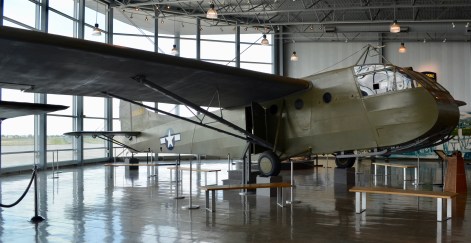
The American CG-4A Glider featured a tubular metal fuselage frame with a wood support structure covered by a fabric skin. The wing structure was constructed entirely of wood and fabric. 

The ride into battle in a glider is a one-way trip as once the tow rope is released, there is no turning back!


Gobi-coloured Toad!

This is not some unusual wild animal that we have sighted in Lubbock, Texas where we are now staying, but rather a motor homer’s slang for the towable vehicle that you hope stays behind you as you head off down the road! Other than Toads, they can also be called Dinghies and let’s not get into a great British debate on how you state that your Dinghy has a Dinghy on its roof!

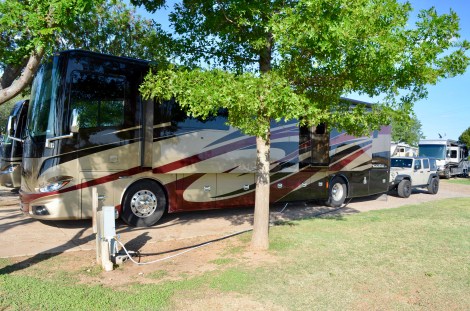
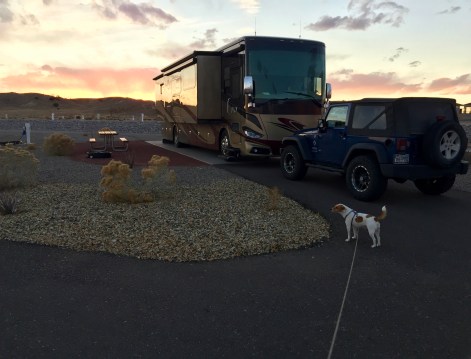
On this road trip, we are pulling a new Toad in the form of a 2017 Jeep Wrangler, colour Gobi which, in reality, is Mushroom-coloured and co-ordinates much better with the exterior paint scheme of the motor home!

The new Jeep has five doors, versus three of our last Jeep, the doors lock automatically whereas on the old Jeep they were manual. This Jeep has a solid roof and sides where the last one was soft top and sides providing a much nicer ride for everyone inside, including Miss Poppy-dog who hated the last Jeep as it was so noisy as the soft sides flapped about while driving.

Mike has already begun to customize the new Jeep, as is the popular thing to do here in the U.S. Thus far he has installed new, bigger tyres, an aluminium bumper, steps on the side of the car and camouflage seat covers!

fullsizeoutput_273e

The new Toad!

fullsizeoutput_273f

Co-ordinating colours! I will provide a better photo at another site when I am not competing with trees and can get a better angle.

Anyone for Cricket?

Introducing the new addition to our fur-baby family, Miss Cricket!

Cricket is a four-month old, short-haired Tortoiseshell kitty we adopted from a local sanctuary when she was ten weeks of age. As is the nature of “Torties” as they are known, she is fearless!

She has some very cute habits, which fortunately for us, are not wreaking havoc in the furry environment! Her favourite tricks are to tap Miss Poppy-dog on the nose or her tail! This, she does repeatedly driving poor Poppy nuts. Poppy is being super tolerant of the young whippersnapper and is now barking to get our attention if any of the other kitties try to beat her up!

Her other trick is that she has taken a real liking to grumpy, bad-boy, kitty Archer. She loves to jump on his back, chase his tail and him, and even run under his body to try to get him to chase her. We were quite concerned about how bad-boy Archer would behave as he is so grumpy, but he now has a renewed lease of life playing with her, sharing his food with her, and only landing the occasional punch when he thinks she needs to be brought into line.

fullsizeoutput_273c

As Cricket is very young, and so quick when you open a door, we are locking her in a kitty carrier when we stop for fuel to prevent her from venturing outside! Other than that, she has taken to motor home life like a duck to water.

Watt’s Up!

Live from Sweetwater, Texas about 300 miles from home on our first stop of a five-week road trip. It’s great to be back blogging and to have you along for a fun-filled adventure!

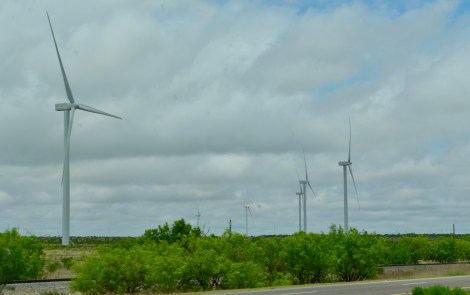
As you drive through Sweetwater, the fields are full of a new kind of crop – wind turbines – mile after mile after mile of them. Across Texas, where the wind always blows, farmers and ranchers are finally able to cash-in on the benefit of a breeze that never ceases.

With over 12,000 wind turbines sited in the state of Texas, it ranks number one in the US for the amount of renewable energy it produces. Soaring over 260 feet into the air (around 80 meters), a tubular steel tower supports a hub with three blades, each measuring over 100 feet in length (@ 30 meters) made from unsaturated polyester or fiber-reinforced epoxy, and a nacelle which houses the shaft, gearbox, generator and controls.

As the wind blows, the blades capture the kinetic energy and rotate, turning it into mechanical energy. This rotation turns an internal shaft connected to a gearbox which increases the speed of rotation by a factor of 100. That spins a generator and, hey presto, electrical power is produced.

fullsizeoutput_2737

In areas where cattle are raised, the animals use the shadow created by the turbine blades to stay cool in the heat of the day – as the shadow moves, so do the cattle!

Sorry for delay, back blogging May 20

Hi All,

Sorry for the delay in hitting the road on our latest adventure, but we completely forgot that it is graduation season and were unable to find any available RV parks for our first few nights in Texas!

Instead, we have delayed our departure until Saturday, May 19 – Royal Wedding Day and F.A. Cup Final – and I will be back in full blogging mode on the 20th!

Thanks for your patience and I look forward to having you along for a spectacular trip. Did I mention that we will be visiting Carhenge!!!!!!!! For all the Brits, yes, those pesky Yanks have mimicked Stonehenge but using cars. HA, HA, and yes, it’s true. I can’t wait to share those photos with you!

See you Sunday!

The Blogging Brit

Back blogging May 14

Hi Everyone,

I will be back blogging on May 14th when we will hit the road once again.

This time our road trip will journey into Colorado, Wyoming and South Dakota, taking in a number of National Forests and monuments many of which you will recognize.

We will also have a new crew member aboard, Miss Cricket, who, at the time of writing is an eleven week-old kitty. She is currently undergoing fur-baby socialization to get to know the other members of the gang … which is always an interesting time, for everyone!

Cricket looks forward to making her blogging debut and meeting all of you!

See you next month!


The campus at Texas Tech

We are en-route home, and arrived in Lubbock, Texas last night to check-in with Chris, my stepson, and ensure all is going well with him.

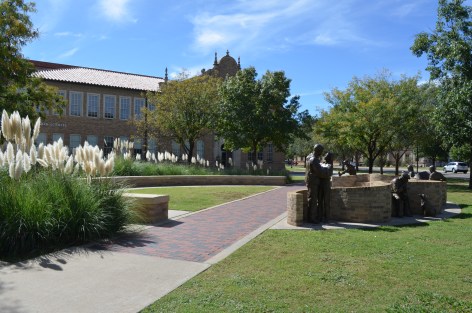
I have to say, that I am not too familiar with U.S. University Campuses, but the site on which Texas Tech sits, where Chris is at school, is really beautiful.

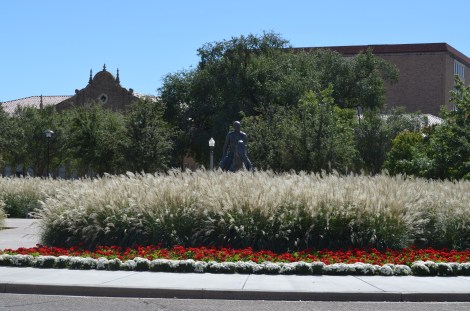
The campus boasts Spanish Renaissance architecture and has been described as one of the most beautiful campuses in the U.S. Walking around the campus, one immediately feels a sense of calm. The light colour of the stone, the gorgeous Spanish-tile roofs, the thoughtful landscaping and of course, the space………………real space to walk, to sit, to think.

In 1998, the Board of Regents of the Texas Tech University System created the University Public Art Collection to enliven the campus environment and extend the education mission of the university. It is funded by using one percent of the estimated total cost of each new building on the campus. It is now ranked among the ten best university public art collections in the U.S.

I am not sure how many students appreciate what they have, but as a visitor, it is just a really stress-free environment in which to wander. I love coming here and walking around the campus.

DSC_0925

The campus at Texas Tech above, and the three photos below.

DSC_0920


Tin, Aluminium or Diamonds!

Today is our tenth wedding anniversary … oh my, was it all a dream or a nightmare! HA!

Seriously, what does one say? I remember Mike arriving in London and the next thing I knew was that I woke up in Las Vegas with a wedding ring on my finger. I know that he drugged and kidnapped me, flew me to Las Vegas and arranged for Elvis to place a ring on my finger and I opened my eyes to see all the smiling faces of our families and loved ones!

Were you all in on it? Is this one of life’s unexplained mysteries?

The traditional gift for a tenth anniversary is either tin or aluminium (with an extra “i” for my American readers) with the modern-day alternative being diamonds!

Bless my Darling’s heart, and in spite of a seriously consolidated effort by Mr. Bob to ensure Mike does not end up in the dog house today, Mr. Bob has reminded my Darling, repeatedly, that our anniversary is on the horizon.

Last Sunday, my Beloved wished me a Happy Anniversary. He knows that the day was approaching and was hedging his bets to ensure he didn’t mess up. He has wished me a Happy Anniversary every day since as he knows that one day he’ll get it right. Cute!

Happy Anniversary to my Darling and I know that the next ten years will be filled with as much love, fun and happiness as the last ten!

C0045

Mike and Elvis with Mike Neary looking on!

C&A0036

Ten years ago, today!

Fat Boy!

In 1942, U.S. President Roosevelt authorized a secret programme to create an atomic bomb. Major General Leslie R. Groves was put in charge with physicist J. Robert Oppenheimer designing and building the bomb in a Laboratory, code-named Project Y.

Project Y scientists began the development of two bombs – one using uranium and one using plutonium. In the Spring of 1944, the scientists found that a plutonium bomb would not work – it would blow itself apart before the two pieces of plutonium could fully unite to create the supercritical mass required for a successful explosion.

Confronted with this problem, Oppenheimer requested the team pursue the development of a plutonium bomb based on the concept of implosion: conventional explosives would be detonated around a sub-critical core of plutonium, compressing it into a supercritical mass.

On July 16, 1945, members of Project Y and other observers gathered at a remote location in New Mexico some 200 miles south of Los Alamos, near Alamogordo. Some three weeks later, a U.S. Army Air Force B-29 dropped a uranium bomb known as Little Boy (named after Roosevelt) over the Japanese City of Hiroshima. Three days later, another B-29 dropped a plutonium bomb know as Fat Boy (named after Winston Churchill) over Nagasaki. Detonated in the air, the bombs caused immense destruction and killed well over a hundred thousands people.

Two days after Fat Boy was detonated, Japan agreed to surrender and World War II came to an end.

fullsizeoutput_2722

A replica of the Fat Boy atomic bomb shell at the Bradbury Science Museum in Los Alamos, New Mexico.


U.S. Route 66

U.S. Route 66 was one of the original highways established in November 1926. The highway, became one of the most famous roads in the United States, originally running from Chicago in Illinois to Santa Monica in California and covering nearly 2,500 miles (4,000 km).

In the 1930s, Route 66 served as a major carrier for those migrating west, especially during what’s known as the Dust Bowl, which saw farming families from Oklahoma, Arkansas, Kansas and Texas, in search of agricultural jobs in California. The route passed through numerous small towns and with the growing traffic on the highway, helped create the rise of “mom and pop” businesses such as service stations and restaurants all readily accessible to passing motorists.

During World War II, more migration west took place because of war-related industries in California. Already popular, and fully paved, Route 66 was used for moving military equipment.

In the 1950s, it became the main highway for holiday-makers heading to Los Angeles. The road passed near tourist destinations such as the Grand Canyon and marked the birth of the fast-food industry: the first McDonald’s in San Bernardino, California.

Over its lifetime, the road underwent many improvements and was removed from the US Highway System in 1985 following the development of the new Interstate Highway System. Some sections of the road have now been designated a National Scenic Byway named Historic Route 66.

fullsizeoutput_2704

We are staying at the Route 66 RV Resort just outside Albuquerque in New Mexico. It is a new resort, having opened last year, and attached to Route 66 Casino and Hotel.