Petoskey Stones

Searching for Petoskey Stones is a national pastime in this neck of Michigan!

They can be found on various beaches and inland locations, with many of the most popular being those surrounding Petoskey and Charlevoix where we have been hanging out daily … and we have yet to find one!

A Petoskey stone is a rock and a fossil, often pebble-shaped, that is composed of a fossilized rugose coral. Such stones were formed as a result of glaciation, in which sheets of ice plucked stones from the bedrock, grinding off their rough edges and depositing them in the northwestern portion of Michigan’s lower peninsula. In these same areas complete fossilized coral colony heads can be found in the source rocks for the Petoskey stones.

In September 2015, a 93-pound Petoskey stone was removed from the shallow waters of Lake Michigan, near the city of Northport. Some three months later, the Michigan Department of Natural Resources confiscated the stone under a state law that disallows removing more than 25 pounds (11 kg) of materials from state lands. The stone is now on permanent display at an Outdoor Adventure Centre in Detroit.

fullsizeoutput_3f69

Petoskey stone is the state stone of Michigan and it’s quite common to see them incorporated into decorative items. The garden stones pictured above are rather cute as they are made with Petoskey stones depicting the shape of the lower peninsula of Michigan (nearest the plants) and the elongated stones are shaped for the upper peninsula of the state!
Hot Air!

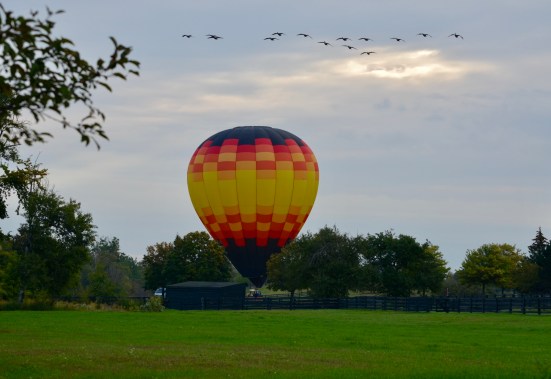
Our RV park is adjacent to the Petoskey Equestrian Centre in Michigan and it was with much amazement that when I took Poppy out for her first walk, some folks were filling a hot air balloon in the grounds of the centre!

We rushed back to the motorhome to retrieve my camera and my first cup of coffee and back to the fence to watch what was going on.

It was on Poppy’s second walk, and this time I was already armed with my camera, that the hot air balloon was floating up and down above our campsite. It was a magical sight … something so serene and beautiful.

Needless to say, the sight of the balloon led me once again to review information about the annual Albuquerque International Balloon Fiesta which takes place in New Mexico sometime early to mid-October.

Recognized as the largest balloon festival in the world, and one of the top 20 hot air balloon events in the US, the nine-day event features more than 750 balloons originating from over 50 countries. There are a number of popular special events including the Dawn Patrol showcasing balloon launches before sunrise, and the Mass Ascension when all the participating balloons float up in two or three carefully coordinated waves. The festival is also the most photographed event in the world due to the geographic landscape and the ideal weather patterns which allow the balloonists unwarranted control over their “crafts”.

fullsizeoutput_3f5a

A herd of Canadian Geese managed to get in on the act!

fullsizeoutput_3f57

Flying high over our RV park in Petoskey, Michigan!


Chicago Mobsters …

There are as many tall tales and legends tied to the notorious American gangster Al Capone as there are dead bodies and missing persons!

However, historians believe that Capone and his gang often escaped the heat of Chicago, both from the temperature and the law, by heading into Michigan, taking with them a haul of illegal alcohol as it was the era of prohibition!

In the 1920s, the Twin Gables Hotel and Restaurant, hosted vaudeville banjo player Tom Carey who invited his musician friends from Chicago to perform for guests. Capone’s gang frequented the joint to enjoy the music and food and to peddle their alcohol. Local lore tells of a bullet hole in the wall of the bar made by one of Capone’s men after another guest made a pass at his girlfriend, who worked in the kitchen.

Today, the Twin Gables Hotel and Restaurant has been renamed to the Hotel Frankfort located on the corner of Main and Third Street in the lovely town of Frankfort, where Mike and I have visited twice since we have been in the area. The current hotel owners believe that in the basement of their hotel there was once a tunnel to enable the movement of alcohol during the prohibition years from Frankfort’s bay into the hotel and onwards.

fullsizeoutput_3f51

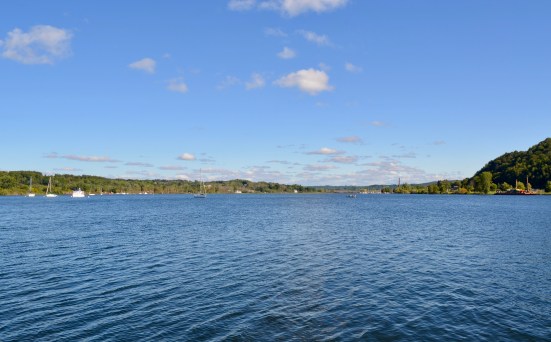
The next time Mike and I are here in Michigan we will revisit Frankfort and try and find the bullet hole in the bar wall! Above is a picture of Frankfort’s bay which leads out into Lake Michigan. The town of Frankfort and the whole area is really lovely!

Green Credentials

The predominant supermarket chain in Michigan is “Meijer” and like everything else in the US, it’s huge. It sells everything from fresh fruit and vegetables, from meat to milk and everything in between plus fishing rods, car oil, clothing, garden plants and furniture, to name a few items!

Attached to the shop is a bottle return. Here, registered shoppers deposit plastic bottles, fizzy drink cans or wine/beer bottles for recycling. One by one, the shopper places their items in the respective shoot. The machine takes the item and as long as it is a product sold in the shop, the item continues downwards being crushed as it goes. When shoppers have completed their recycling they receive a receipt for the items they have recycled which is redeemable at the checkout. Isn’t that just so cool?

In 1978, Michigan became the first big industrialized state to implement a deposit law for bottles and cans. The ten-cent deposit was meant to keep the containers from going to landfills or rolling along the streets.

05oTkLzzQH6MnGhKskWGtA

Retailers charge a ten cent deposit on every beer, soft drink, carbonated & mineral water container as an incentive for consumers to recycle. Grocery stores that sell those items are required to pay back that ten cent deposit when those containers are returned for recycling. Michigan has one of the highest deposits in the country.

Sweet in every Sense …

Founded in 1947 by Don and Katy Kilwin, and based in Petoskey, Michigan, where Mike and I are now staying, Kilwins is an American company specializing in the production and sale of fudge, chocolates and ice cream.

The original owners sold out long ago, but today, and still utilizing the decade-old recipes, the company has 120 franchise stores nationwide in 23 states. About half of these locations are in popular tourist destinations near resorts and beaches specifically Florida and Michigan.

At the HQ building in Petoskey, Mike and I participated in a free tour of the chocolate making facility which was great fun. Led by our intrepid tour-host Dave, it was the last tour of the day and we were the only participants which was even better for our never-ending stream of questions.

fullsizeoutput_3f4f

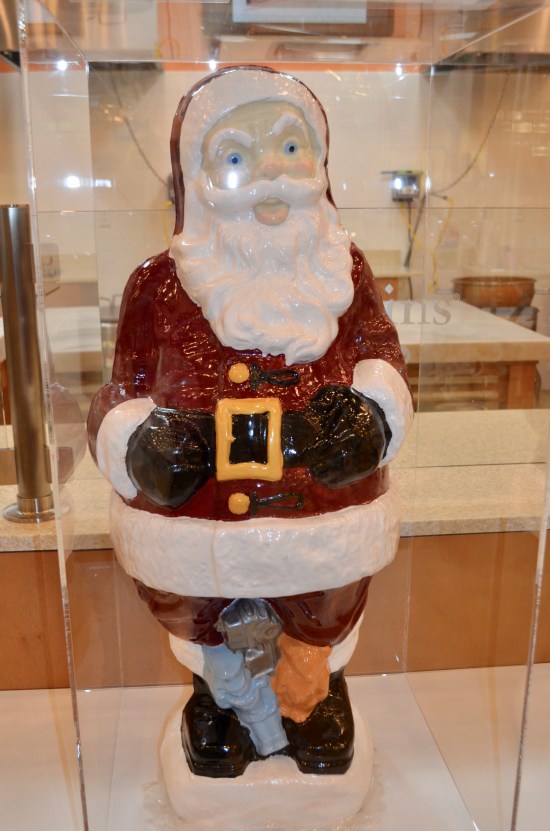
A three-foot Father Christmas is made with 23 lbs of Kilwins own heritage dark and white chocolate. Its costs is in excess of $450.00.

  DSC_0082

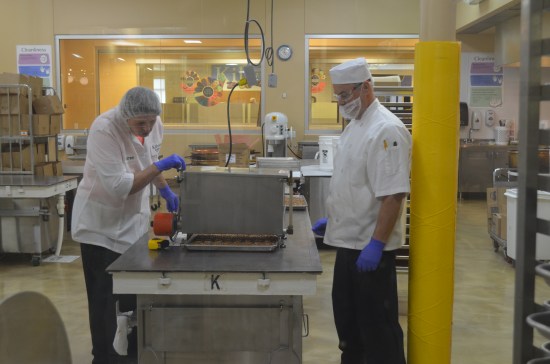
Making Tuttles: Tuttles are “blobs” of caramel, shaped in the form of a turtle, and covered with chocolate and sometimes nuts. The word “turtle” has been trade-marked by Nestle hence Kilwins’ word that sounds like turtle!

DSC_0092

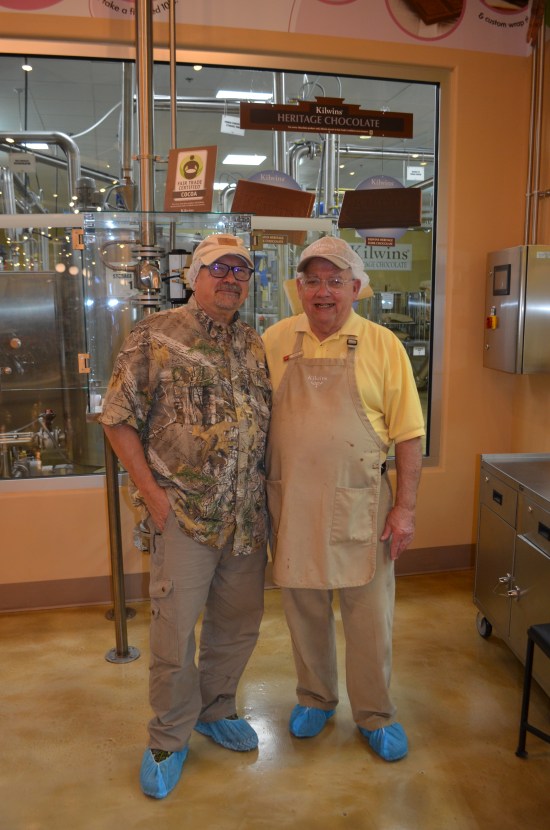
Mike and our tour-host Dave pictured behind the chocolate-tasting tap where we enjoyed samples of both milk and dark chocolate. Kilwins buys its cocoa nibs from South Africa and sweetens it as American chocolate is sweeter than that enjoyed in Europe. Mike and Dave had a seriously good tour together as both are Vietnam vets … it was tough at times to keep them focused on the tour!

Gnome Homes!

Over a span of 52 years, Earl Young, a self-taught architectural designer, built some 31 structures in Charlevoix, Michigan.

Working mainly in stone, much of which he collected from the beaches and shores of the area, his designs were distinct because of his use of curved lines.

Young developed some bad habits which continued throughout his career. He never made blueprints; workers were lucky to get a rough sketch; he never thought about practicality, making very short doorways and kitchens like hallways; and, he was an on-the-spot designer and said the stones spoke to him!

fullsizeoutput_3f46

Half House. This unique house gets its name for the unusual manner in which the house appears to be cut in half.

M. Sucher home

M. Sucher House – so called because William Sucher headed “Speedway 79”, a chain of petrol stations, commissioned Young to build the home. Today it’s on the market for $2.75 million! 

fullsizeoutput_3f45.jpeg 

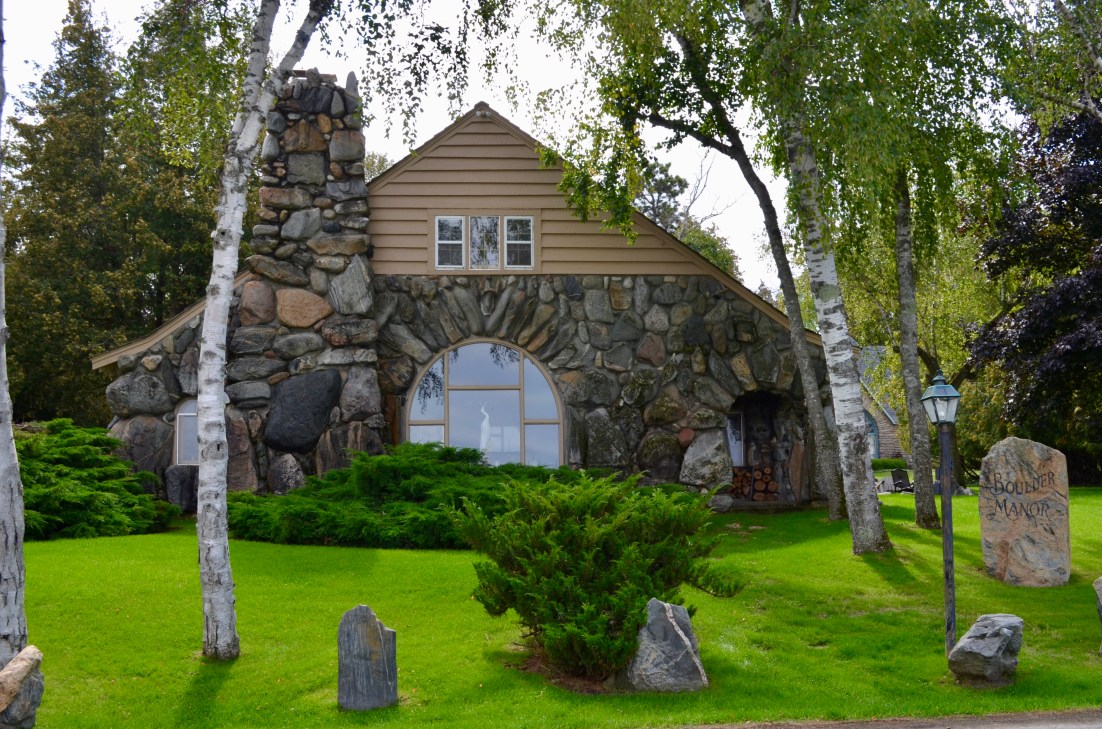
Boulder Manor is considered to be the turning point in Young’s architectural career. For years Young saved boulders, both physically and mentally. He had the ability to remember the dimension and colours of hundreds of boulders at the same time. He dug up the boulders he liked and hid them underground, deep in the woods or in Lake Michigan. Many of these boulders came together when he started building Boulder Manor for his family in the autumn of 1928. However, the Great Depression hit in 1929 and Young had to sell the unfinished house to the bank. In 1937 he regained possession of Boulder Manor completing it two years later.  

Mushroom House

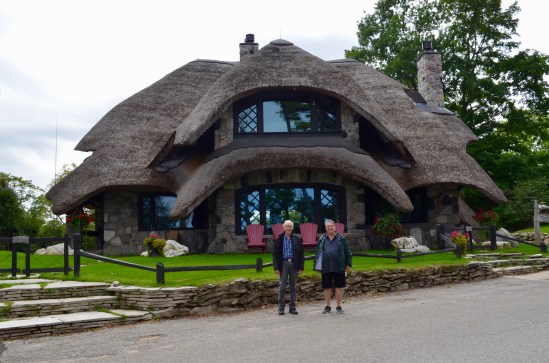
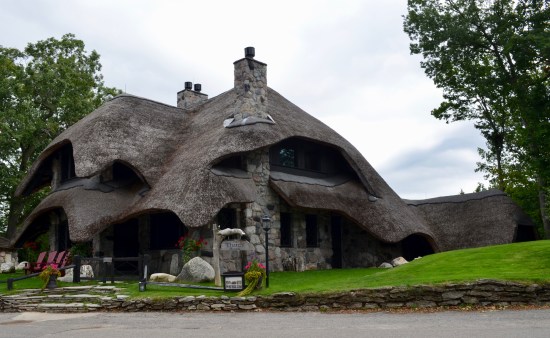
Named The Thatch House but referred to locally as the Mushroom House, it was built from the original stone walls set by Charlevoix-based architect Earl Young.

Built as his first home in 1919, the house did not feature Young’s developing unique hobbit-home style, but in a dramatic re-design, The Thatch House showcases the storybook magic of the Young houses which I will share with you tomorrow.

The new “mushroom house design” took nearly two years to finalize. The beautifully flowing roof is crafted from the finest natural thatch hand-reaped in Europe and shipped to the US. During one of the coldest winters, a master thatcher painstakingly worked to ensure that the new house was ready to greet the new spring.

fullsizeoutput_3f3d

As Michael stayed in the motor home to watch football, I went to view Charlevoix’s mushroom houses. Some 5-minutes’ drive past the Mushroom House and two gentlemen flagged me down asking if I knew where the Mushroom House was located! The long and short of it was that these gentlemen had rented the house and had gone out walking, got lost and couldn’t find their way back home! I gave them a lift back to the house where they eagerly posed for a photograph for my blog! Such nice gentlemen – they even tried to give me money for taking them home!

Mushroom House

Available for rent throughout the year, The Thatch House has six bedrooms, five-and-a-half bathrooms, a media room and a lounge on the top floor where guests can enjoy sunsets over Lake Michigan.

Big Mac!

Known locally as Big Mac, the Mackinac Bridge joins the lower and upper peninsulas of Michigan across the Straits of Mackinac where two of the Great Lakes meet.

Spanning nearly five miles in length (around 8 km), the bridge opened in 1957 and today is a toll bridge – costing $4.00 each way for a car to cross.

Some individuals have difficulty crossing bridges, a phenomenon known as gephyrophobia. The Mackinac Bridge Authority has a Drivers’ Assistance Programme that provides drivers with gephyrophobia or anyone who is more comfortable having someone else drive them across. More than a thousand people use this service every year at no additional cost.

Bicycles and pedestrians are not normally permitted on the bridge with the exception of riders participating in two, annual bicycle tours. On an everyday basis, for a fee of $5.00, the Authority will transport cyclists and their bicycles across the bridge.

fullsizeoutput_3f3b

Greetings from the Upper Peninsula of Michigan where I took this photo! As you look at the bridge from here, Lake Michigan is to the right and Lake Huron is to the left.

As we crossed the bridge I wanted to take pictures! As is so customary in the US, hey presto, there is a bridge viewing area, immaculately kept with benches from which to sit and enjoy the view, picnic tables, restrooms and a telescope in front of which groups can gather and remotely take a poloroid-like picture that prints out then and there with the bridge in the background!

Having crossed the bridge, if we were to drive 50 miles to the North, we would hit the border with Canada!

Charlevoix the Beautiful

We have spent a glorious day wandering around the gorgeous little town of Charlevoix, Michigan. It is a pretty, relaxed place, located on the edge of Lake Charlevoix which leads out to Lake Michigan. There is money here, you can tell from the boats in the marina, the manicured lawns and the homes that dot the bay.

The town is named in honour of Father Piere Francis Xavier De Charlevoix, born in 1682 during the reign of Louis XIV. At the age of 16 he joined the “Society of Jesus,” known more familiarly as the Jesuits, and while a deacon at the age of 23 was sent to Quebec in Canada where for four years he taught grammar. He returned to France in 1709 to study theology.

Through his historical writings and pulpit eloquence, Father Charlevoix attracted considerable attention in Europe and was appointed by the king of France to a double mission, that of determining the exact extent of the English possessions in Canada and the discovery of an overland northern route to the sea at the West, now known as the Pacific Ocean.

How little did this modest priest dream as he sailed past these shores that his name would one day be written upon this city, “Charlevoix the Beautiful.”


fullsizeoutput_3f30

The picturesque bay of Charlevoix.

fullsizeoutput_3f32

To the right of this picture is a concert dome where in summer the town hosts musical events on the green over-looking the bay.

fullsizeoutput_3f36

One of the many, seriously gorgeous homes dotting the bay.

Cat Head Lighthouse!

In 1850, Congress appropriated $4,000 for a lighthouse on the northern tip of Leelanau Peninsula in Michigan. The president signed an executive order reserving some 60 acres of public land for Grand Traverse Lighthouse, known early on as Cat Head Lighthouse due to its proximity to Cat Head Point.

During Philo Beers four years as keeper of the lighthouse, it was visited by pirates from nearby Beaver Island. James Strang had established himself as king of a Mormon splinter group on the island, and his followers were accused of night-time raids on the Michigan mainland. The pirates made off with all of keeper Beers’ fishing nets and their contents on one occasion and valuable lighthouse supplies on another.

Shortly after being placed in service, Grand Traverse Lighthouse was found to be poorly built and situated. Located near the eastern side of the tip of the peninsula, the lighthouse was useful for vessels entering and leaving Grand Traverse Bay but was of little use to vessels on Lake Michigan. The original lighthouse was torn down and replaced in 1858.

Philo Beers was no longer serving as keeper when the new lighthouse was built, but he and his son Henry, who would serve as keeper of the lighthouse from 1859 to 1861, used some of the material from the original keeper’s dwelling to build a house in the nearby town of Northport.

After various modifications through the decades as technology developed, the lighthouse was closed in 1972 and an automatic light tower erected.

fullsizeoutput_3f26

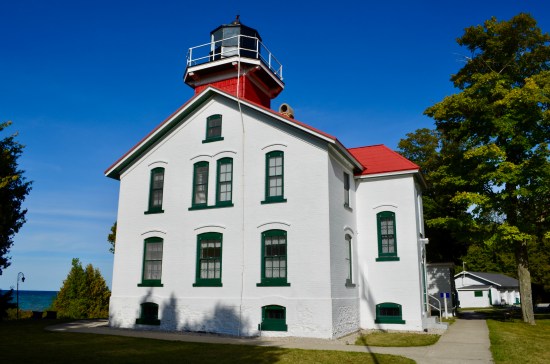
Grand Traverse Bay Lighthouse.

fullsizeoutput_3f27

Picturesque gardens in front of the lighthouse overlooking Lake Michigan.