Plains to Politics

Jimmy Carter’s rise to the presidency was one of the most remarkable ascents in American political history. He was all but unknown to the public through much of 1975. Less than a year later, he was the Democratic Party’s candidate for president.

In January 1977, President Carter inherited an economy with sluggish employment and rising inflation. Americans felt betrayed and discouraged by the Watergate scandal, the resignation of President Richard Nixon and the dismal end of the Vietnam War in 1975.

His vision was to take the country in a new direction. He undertook a sweeping reform agenda that included restoring accountability in government, creating the first national energy plan, supporting human rights around the world, encouraging peace among nations and keeping the United States strong and secure. He served only one term as President.

In 1981, after leaving office, Jimmy Carter conceived the idea of combining his presidential library with an international centre for conflict resolution which Mike and I visited today. It supports programmes advancing peace and health throughout the developing world.

The Bill and Melinda Gates Foundation honoured the Carter Centre with the 2006 Gates Award for Global Health and a $1 million contribution to the Centre’s work.

fullsizeoutput_34e6

Born in Plains, Georgia, Carter was an enterprising youngster growing, packing and selling peanuts. While President he negotiated the Camp David Accords – the first step in the peace process between Israel and Egypt. Pictured at the signing in 1979, from Left: Egyptian President Anwar Sadat, President Carter and Israeli Prime Minister Menachem Begin.


Big Oak …

As you know, I really like trees … oh, and Miss Poppy does too!

We like them for different reasons. Miss Poppy equates trees with squirrels, her number one mission in life is to eliminate the world of them; and me, well, I just like them, they absorb CO2, they provide shade, they are beautiful.

In taking a ride out across the border into Georgia, we checked out Thomasville, an area that possibly might be of interest to us.

Thomasville is famous for its “Big Oak” … a tree that is a 338-year old live oak that has a spread of 169 feet, a height of 72 feet and trunk circumference of some 30 feet!

Various measures have been put in place to preserve this magnificent tree. An underground watering system and an above-ground sprinkler system have been installed; support cables are intertwined about the tree in order to provide strength to the limbs, some of which are only feet above the ground; and, an “on call” tree surgeon is available 24/7 should the need arise.

In 2005, the tree produced acorns for the first time in decades. The acorns were collected by relatives of the family who originally lived in the house where the tree is located. The acorns were cared for during their germination process and until they became seedlings. One such seedling has been planted in a nearby plantation and is known as The Baby Big Oak! Cute!

fullsizeoutput_34b5

The Big Oak dates back to around 1680 making it one of the older live oaks in the US.


Tallahassee, Florida  

We are now in Tallahassee, the state capitol of Florida and once presided over by Jeb Bush, the Governor, brother of the 43rd President and son of the 41st President of the USA!

Visiting Tallahassee was not to check out the sights and experiences, as there aren’t too many of those, but really to experience the city as we had viewed some properties on line before we left home.

As a state, Florida is very good for retirees; indeed, it has set in place policies to attract those who are no longer working. There is no state income tax, property taxes are low and the weather year-round is good, although some parts of the state can be impacted by hurricanes, Tallahassee’s location means its safe from a direct hit.

As a state capitol there is a well-educated population working in the government, state agencies or as lobbyists. There is a low crime rate, hundreds of good restaurants, all the shopping you could desire and good medical facilities.

It is a nice city and we could have a nice life here with access to all we want. That said, we are not quite sure what one would do here if this was to form part of a two-home lifestyle – Tallahassee being for winter. Aesthetically there is nothing to look at – and I think that’s what we are seeking!

fullsizeoutput_3492

Tallahassee’s state capitol building which I snapped while Mike drove around the block!

fullsizeoutput_3495

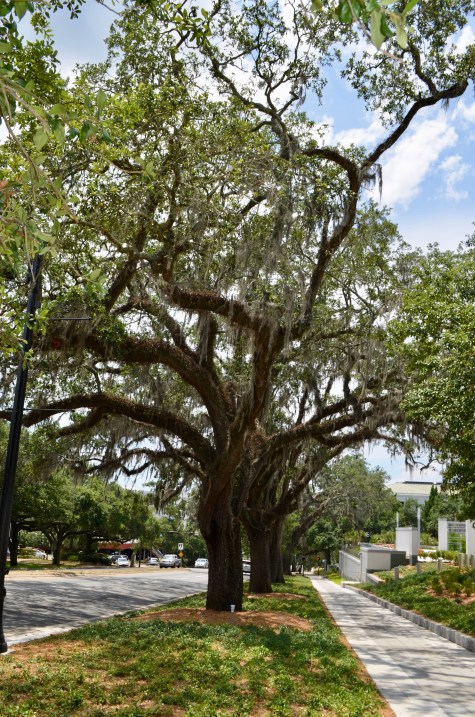
For Miss Poppy-dog, there are thousands of live Oaks laden with Spanish moss everywhere across the city – and, trees mean squirrels!

Fort Barrancas, Florida

Situated on the bluffs overlooking Pensacola Bay, Florida, Fort Barrancas was built to protect the US from foreign invaders. Once considered vital to national defense, today it is preserved and managed by the National Park Service and is an excellent illustration of the evolution of military technology.

Built between 1839 and 1844, Fort Barrancas was the third fort established on the Pensacola bay. It was constructed over the ruins of a 1798 Spanish fort named Fort San Carlos de Barrancas and built by enslaved men.

Situated below the barrancas, which is Spanish for bluffs, was a 1797 water battery where in active days, cannon projectiles ricocheted off of the surface of the bay to hit ships at the water line.

When Abraham Lincoln became president-elect in November 1860, Southern slaveholding states began seceding or talked of seceding from the Union. A national crisis had began and the fort changed from Union to Confederate hands. During this time, it was used to organize and train Confederate soldiers until their evacuation in 1862.

Fort Barrancas was declared surplus in 1947 and on the afternoon when Mike, Chris and I visited, where outside temperatures peaked at 94 degrees Fahrenheit, it was certainly a delightfully cool environment to explore!

fullsizeoutput_3408

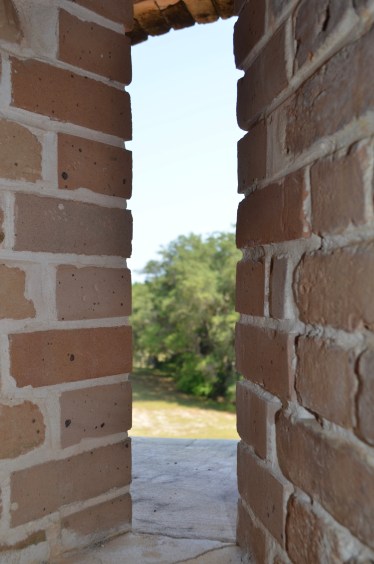
A dry ditch covered two sides of the fort. Assaulting infantrymen who entered the ditch suffered heavy casualties from musket and cannon fire through the openings in the wall, pictured below. This photograph was taken from the drawbridge which could be raised to isolate the fort’s main walls from land-based attack.

fullsizeoutput_340b


A view from the top …

We are staying in Pensacola to enable us to catch up with my stepson, Chris, who is attending Navy school.

Being busy, Chris has not had any opportunity to check out the town and so we headed out to visit the Pensacola Lighthouse.

In 1858, this lighthouse was built on the North side of the Pensacola bay entrance. The tower stands 150 feet (46 m) tall and also sits on a 40-foot (12 m) bluff on the Pensacola Naval Air Station, placing the light some 190 feet (58 m) above sea level.

At the start of the Civil War, Pensacola was controlled by Confederate forces who removed the lens from the lighthouse and requisitioned most of the lighthouse supplies for the war effort. An artillery duel between Confederate and Union forces damaged the lighthouse tower in 1861.

Once Pensacola was back in Union hands, a new lens was placed in the tower and once again it was able to function to keep mariners safe. The upper two-thirds of the tower were painted black to enhance the brightness of the light at night.

fullsizeoutput_3405

Electricity was introduced to the lighthouse in 1939, eliminating the need to rewind the light rotation clockworks every 4.5 hours. The light was automated in 1965.

fullsizeoutput_3401

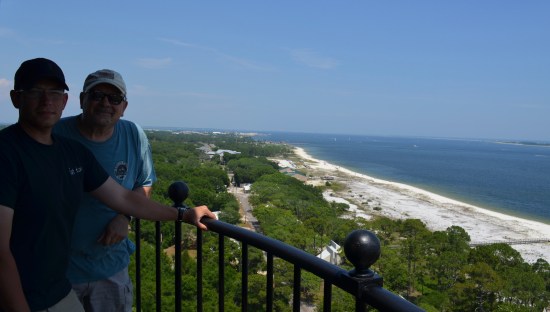
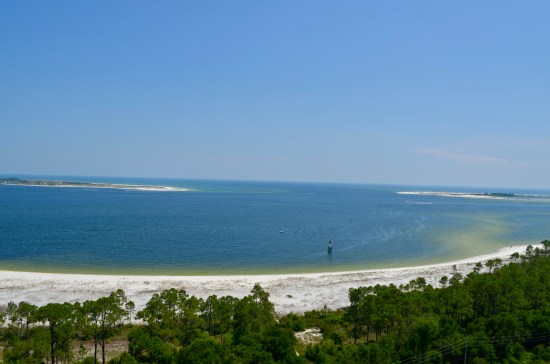
From Left: Chris & Mike Krywanio. There are 177 steps to the top and it is so worth the climb for the magnificent views. Today, the light flashes white every minute and can be seen 27 miles out to sea!


City of Five Flags!

A Spanish fleet, under the command of Don Tristan de Luna y Arellano, arrived in the area of present-day Pensacola in 1559. The expedition was to establish an outpost, but the colony was decimated by a hurricane which killed an unknown number of sailors, sank six ships and ruined supplies.

The survivors struggled, most moving inland to what is now central Alabama before returning to the coast. They abandoned their efforts in 1561.

The first settlement did not take root until 1698 with the founding of Presidio Santa Maria de Galve on what is now Naval Air Station Pensacola and the city became dependent on Spanish colonial rulers until 1719.

The French took the keys to the city in 1719, but they gave it back to the Spain in 1722. (The wine was bad, no croissants, no cafes…)

The British tried their hand at holding the city from 1763 until they were forced to leave in 1781. Spain allied itself with France and the fledgling American Colonies and took the city with forces from Cuba. This was payback. Britain got Florida from Spain by capturing and holding Havana hostage.

Spain gave up Pensacola and Florida in 1821 to the United States. Florida became a state on July 4, 1845, but decided it was a bad idea in 1861 and seceded.

In May 1862 Pensacola was again under the control of the United States, and has remained under the American flag since.

fullsizeoutput_33fa

Pensacola is known for its pristine beaches of white sand and blue waters.


A String of Pearls …

In 1825 recognizing the advantages of Florida’s Pensacola harbour and the large timber reserves nearby for shipbuilding, President John Quincy Adams authorized the building of a navy yard on the southern tip of Escambia County, where the Navy Air Station is located today.

As the nations of the world moved towards World War II, Navy Air Station Pensacola became the hub of air training activities. After the fall of France in 1939, President Franklin D. Roosevelt called for 126,000 planes and the air station went into overdrive by training over 1,000 cadets a month.

With crowds of uniformed servicemen on the city’s streets and the seemingly ever-present drone of training aircraft in the skies overhead, the realities of wartime were never far removed from the lives of Pensacolians. Its citizens did their best to support the war effort by salvaging all they could:

  • The steel in 30,000 razor blades was enough to make fifty 30-caliber machine guns.
  • Thirty old lipstick tubes contained enough brass to make 20 cartridges.
  • Over 2,000 used pairs of stockings went into the production of one parachute!


fullsizeoutput_33f0

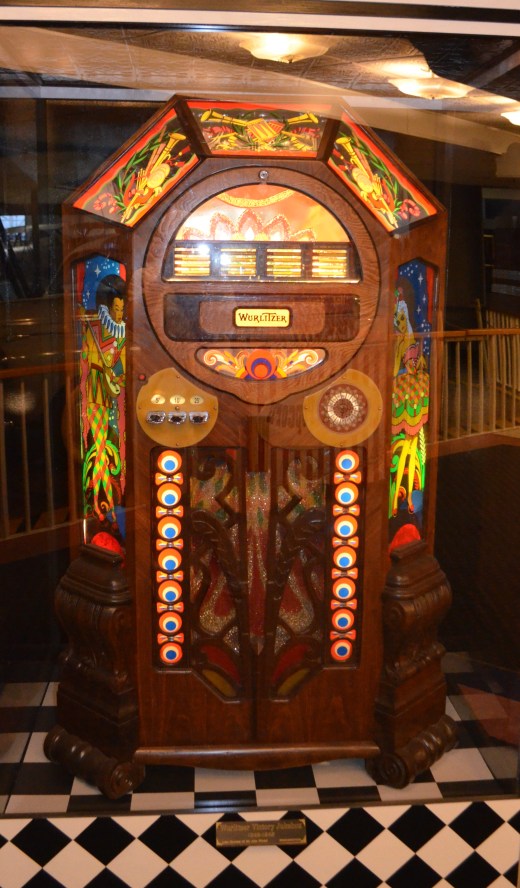
On display at the National Naval Air Museum, where Mike and I visited today, is a rare Wurlitzer jukebox. In 1942, Wurlitzer ceased producing new jukeboxes composed of metal and plastic, substituting recycled wood and glass (like this rare model, pictured above) due to rationing. Perhaps it once played Glenn Miller’s “A String of Pearls” which reached number 1 in the US in 1942!

Higgins Boats

Andrew Jackson Higgins was born in 1886 in Columbus, Nebraska, US. From the start he had a passion for boats and forestry, building his first boat in his mother’s basement at age twelve.

Determined, strong-willed and innovative, Higgins moved to the southern US in 1906 to work in the lumber industry until its decline when he realized that cut logs built into motor boats would fetch a higher price than the raw lumber.

In 1930, he started Higgins Industries, a New Orleans-based company, building boats that could operate in the shallow waters and swamps of Louisiana, US.

A decade later he modified the design to include a ramp on the bow that could be lowered to make the deployment of troops, vehicles and equipment easier – it revolutionized amphibious warfare. The new vessel, the Landing Craft, Vehicle, Personnel was capable of carrying 36 men and made it possible to rapidly land a well-equipped invasion force on a defended shore. It was commonly referred to as a “Higgins boat” and was used extensively by the Allied forces in the D-Day landings at Normandy in France on June 6, 1944.

US President Eisenhower who was the supreme commander of Allied Expeditionary Forces in World War II said, “without Higgins designed boats that could land over open beaches the whole strategy of the war would have to be rethought.”

fullsizeoutput_33c1

Pictured: Andrew Higgins.

The National WWII Museum in New Orleans, Louisiana is located in the city because by 1943 some 92% of the entire US Navy vessels were designed and built by Higgins Industries, New Orleans!