With its intriguing mix of history, geology and nature, Hot Springs, Arkansas holds a unique place among America’s national parks. The smallest of the parks, Hot Springs National Park wraps around a modern urban area set within a valley of the rugged Ouachita Mountains. The park and city, both named Hot Springs, developed side by side and remain intimately linked.
The US government created the Hot Springs Reservation in 1832 to protect thermal springs that had become renowned for their supposed therapeutic properties. By the time it was made an official national park in 1921, Hot Springs had grown into a popular spa, attracting holiday makers and patients seeking a cure for all sorts of illnesses.
It also became a spring training home for several major-league baseball teams, whose players used the thermal baths to relax after work-out and training sessions.
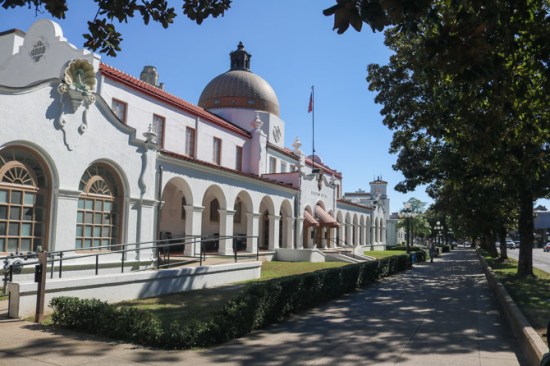
Water that fell as rain more than 4,000 years ago flows from the Earth here at an average temperature of 143 degrees Fahrenheit (around 62 degrees Centigrade), having been heated at a depth of about a mile below ground before rising back to the surface. Today most of the natural hot springs have been diverted into pipes flowing to hotels and to a line of spa buildings known as Bathhouse Row, pictured above.
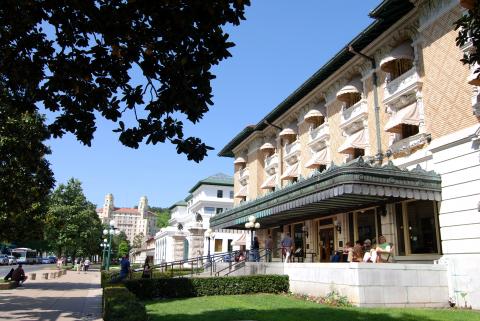
The eight remaining bathhouses on the row were built between 1892 and 1923 and display a rich diversity of architectural styles.
 The Blogging Brit