Poppy’s Paradise!

For the past two nights we have been staying in beautiful Rhinebeck, New York. This historic little town is nestled into the Northern New York Hudson Valley region with majestic views of the Catskill Mountains and the Hudson River. The area is so green and lush, simply gorgeous!

Rhinebeck is a sophisticated, wealthy town that takes pride in its Dutch History, scenic beauty, support for the Arts and accessibility to New York City and rural upstate New York.

The town centre boasts tree lined-streets with unique specialty shops and a thriving restaurant scene.

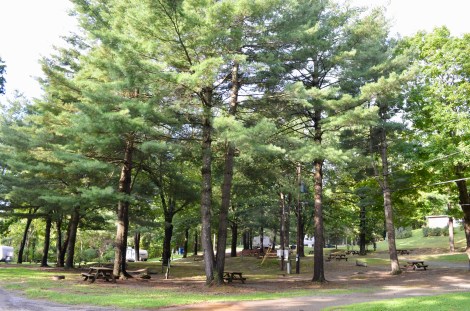
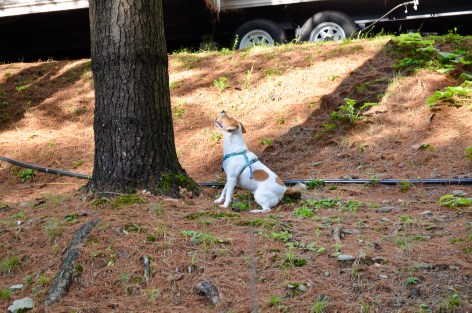
At our RV park, Poppy has been in paradise! Magnificent old trees are everywhere and a population of squirrels and chipmunks that any upstanding Jack-a-Bee would take pride in chasing!

And, oh my, has she chased each one that she has seen! At one stage this morning she was hyper-ventilating with excitement as a chipmunk almost ran over her foot and a big, fat squirrel took to the trees to avoid her. It was such fun watching her having such a good time!

fullsizeoutput_2ad6

Miss Poppy keeping guard for when the pesky squirrel comes down!
fullsizeoutput_2ad5

Poppy’s play pen – our lovely RV park in Rhinebeck.
fullsizeoutput_2ad4

Still waiting!

Fireside Chats

Franklin D. Roosevelt was born in 1882 at Springwood, the family estate, located in Hyde Park, New York.

He was educated at the finest schools and made remarkable early advances in politics. At age 38, he was the Democratic nominee for Vice President.

But early success was followed by a devastating personal setback. In 1921, Roosevelt contracted polio, which left him paralyzed from below the waist. His political career seemed over yet Roosevelt would wage a courageous battle to come to terms with his disability and make a triumphant return to politics.

In 1932, he was elected President of the United States. As President, he led America out of the greatest economic depression in its history and guided the Allied Powers to victory in World War II.

Roosevelt served three full terms as President but died suddenly three months after his fourth-term inauguration! He is buried in the rose garden at Springwood.

fullsizeoutput_2acb

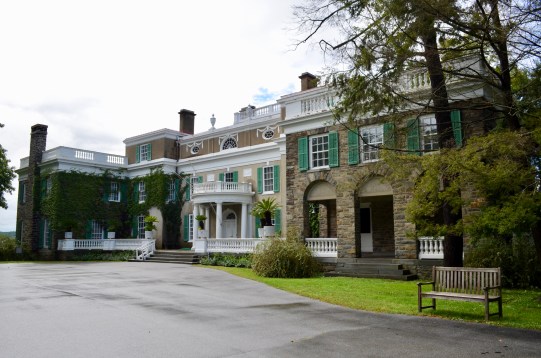
Springwood, pictured above, served as the “Summer White House.” King George VI and Queen Elizabeth (the Queen Mother) stayed here as did Winston Churchill!

fullsizeoutput_2ad1

 The Franklin D. Roosevelt Library is the only Presidential library ever used by a sitting president. Pictured above is his office which he used as a place to conduct government business and from where he made several of his famous radio speeches, or “Fireside Chats.” 

Note the wheelchair. This was designed by Roosevelt himself where he used a basic chair welded to a framework which enabled him to move around easily – he had them located all over the Springwood property.


I Like Ike!

Ike and Mamie Eisenhower owned only one home, a 700-acre Gettysburg Farm that runs adjacent to the battlefield.

They purchased the property in 1950 after a 30-year military career that took them around the world. As Supreme Commander of the Allied Forces in Europe during World War II, Eisenhower led the Allies to victory against Hitler’s Germany.

In 1952 Eisenhower won the election as the 34thpresident of the United States with a campaign slogan of “I Like Ike.” During his two terms as president, Eisenhower used the farm as a weekend retreat and temporary White House. World-renowned leaders such as English prime minister Winston Churchill, French prime minister Charles de Gaulle and Premier of the Soviet Union Nikita Khrushchev visited him at his Gettysburg retreat. Eisenhower loved to take his visitors on tours of the battlefield!

As John F. Kennedy’s inauguration drew to a close on January 20, 1961, the departing president and first lady quietly left Capitol Hill. After a farewell luncheon they headed north from Washington on snow-covered roads to their farm home where they would spend the rest of their lives.

fullsizeoutput_2ab8

The Eisenhowers made a gift of their farm to the US government in 1967, with the agreement that Dwight and Mamie would live there for life. Dwight Eisenhower died in March 1969 and Mamie some ten years later.

fullsizeoutput_2ab5

A photo of Ike and Mamie which sits in their porch at the back of the home, their favourite room. Here Ike and Mamie watched TV, played cards with friends and the General pursued his hobby of oil painting. 

Pickett’s Charge

Day three.

After a two-hour cannon attack by the Confederates on the Union army’s central flank on Cemetery Ridge and Cemetery Hill, more than 12,000 men commanded by Confederate Major Generals George Pickett, Pettigrew and Trimble emerged three-quarters of a mile in-front of the Union Line.

Exploding shells tore holes in their ranks, but, as the dead and wounded fell, others took their place. When the Confederate forces began to cross Emmitsburg Road nearing the Union force, the Union defenders decimated them with cannon shot and volleys of musket fire.

Despite staggering losses, Confederate Brigadier General Lewis Armistead led several hundred men to breach the Union ranks. A fierce hand-to-hand combat continued until Armistead fell mortally wounded and the exhausted Confederates, out-numbered and now out of ammunition, retreated.

For the three days of fighting, casualties on both sides (killed, wounded, captured and missing) were staggering:  23,000 for the Union army; and, 28,000 for the Confederate army.

fullsizeoutput_2ab0

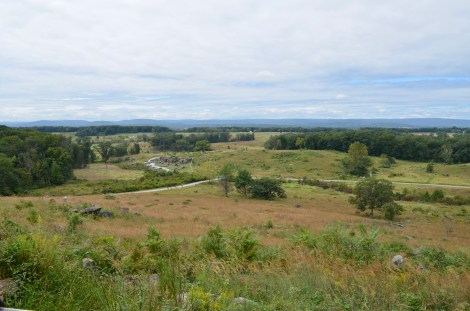
See the white “blob” in the distance? That’s where the Confederate army started. If you can make out the wooden fence in the middle of the picture, that’s where they crossed Emmitsburg Road heading straight for the Union line where the photograph was taken.

fullsizeoutput_2aae

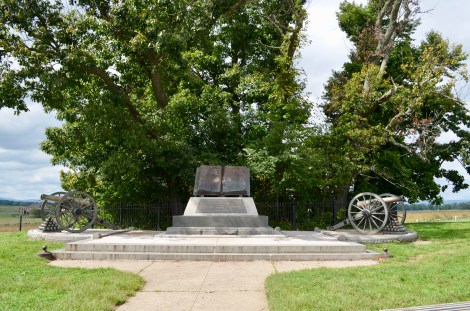
Years after the battle, Pickett’s Charge and its failure came to be known as the “High Water Mark of the Confederacy” represented by a memorial of an open book flanked by two cannon. The war would continue for the best part of two more years.

fullsizeoutput_2ab1

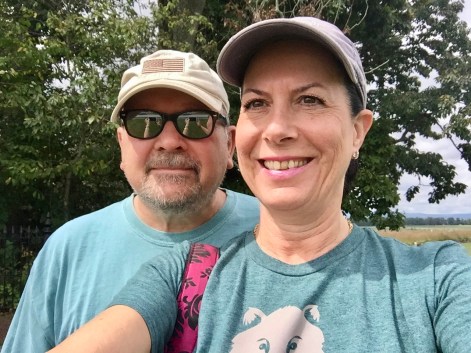
Mike and I at the High Water Mark.

An Uphill Fight …

On the afternoon of Day two of the Gettysburg battle, Union General Gouverneur Warren found Little Round Top undefended. He quickly sent his staff to find troops to defend this vital position.

Without waiting for approval from his commanding officer, Colonel Strong Vincent ascended the hill ahead of his troops and selected the ground where his brigade would make its defense. Within minutes of forming his line, Vincent’s brigade was assaulted by Confederate regiments. A desperate battle ensued across the entire brigade line.

Just when the Union position seemed doomed, over the hill poured the Union’s 140th New York Infantry. The New Yorkers, who had no time to load their muskets, swept down the hill into the surging Confederates. After a bloody struggle, the exhausted Confederate army fell back, leaving Little Round Top in Union Hands. The line held, but the cost was high, including Vincent who was mortally wounded.

What happened at Little Round Top, was happening at other locations around Gettysburg such as Culp Hill and East Cemetery Hill where fierce battles were taking place with the Confederates attacking uphill Union positions, the casualties for both sides was heavy.

At the end of day two, Confederate Robert Lee’s hopes of crushing the Union army was dashed, but undaunted, he began to plan for the third day of fighting.

The left photograph shows the position the Union army held looking down from Little Round Top. The photograph on the right shows the view the advancing Confederates faced.

Valley of Death as viewed from Little Round Top

Looking down from Little Round Top towards Devil’s Den where the Confederate army over-ran a Union position. 

Three Days in July

Day one of the Gettysburg battle began around 8 a.m. on July 1, 1863 as Union cavalry confronted Confederate infantry along Chambersburg Pike. Heavy fighting spread north and south along the ridge as additional forces arrived.

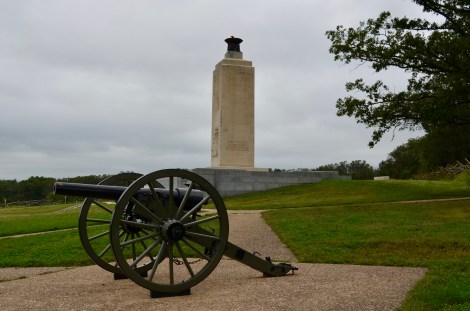
At midday, Confederate Major General Robert Rodes took position on a hill where the Eternal Light Peace Memorial now sits with some 8,000 troops. The closest Union troops were on Oak Ridge about a third of a mile down the hill.

The thunder of Confederate cannon signaled the beginning of the attack. They advanced against Oak Ridge and as they moved forward, Union troops concealed behind a stone wall rose up and unleashed fierce fire against the Confederate army.

Rodes re-grouped and renewed the attack bringing more Confederate troops into battle. By 4 p.m. despite heavy losses, a Confederate tide swept through the area, scooping up 3,000 Union prisoners on the way.

The fleeing Union army retreated through the streets of Gettysburg to Cemetery and Culp’s Hills just south and east of town. Despite their defeat on the first day, they held strong defensive positions from which to renew the fight the following day.

On Day one, 9,000 union soldiers and 6,800 Confederate soldiers were killed, wounded or missing. Both sides paid a heavy price but Confederate commander, General Robert E. Lee, believed his gains gave hope for victory …

fullsizeoutput_2aa0

Veterans of the Union and Confederate armies converged on Gettysburg in 1938 to dedicate the Eternal Light Peace Memorial, pictured above. The majority of the veterans were in their 90s, and many were over 100!

fullsizeoutput_2aa3

The view from Oak Ridge – all buildings on the battlefield are preserved.


The Turning Point …            

We are in Gettysburg, Pennsylvania to visit the battlefields of the Civil War’s bloodiest battle which is widely believed to be the war’s turning point!

The election of Abraham Lincoln in November 1860 was the final blow to what had been an age-old smoking gun – the fate of slavery – as the Republicans were determined to prevent slavery extending into the western territories.

Efforts at a compromise failed as Southern leaders feared that Lincoln would stop the expansion of slavery and put it on a course towards extinction. Before Lincoln took office in March 1861, seven states declared their intention to leave the Union and join together to form the Confederate States of America. The states were: South Carolina, Mississippi, Florida, Alabama, Georgia, Louisiana and Texas.

The re-supply of Fort Sumter, Charleston, South Carolina became the first crisis of newly inaugurated President Lincoln. In April, 1861, Lincoln notified the Governor of South Carolina that he was sending supply ships to the Fort. The response he received was an ultimatum to the immediate evacuation of the Fort. The first shots were fired by the Confederates on April 12, 1861 and 36 hours later the Union Major agreed to evacuate. The Civil War had begun.

By the end of June, 1863, after two years of brutal war, both the Union and Confederate armies arrived in the area surrounding the town of Gettysburg. It was just a matter of time before the two armies collided. The only question was where!

IMG_2447

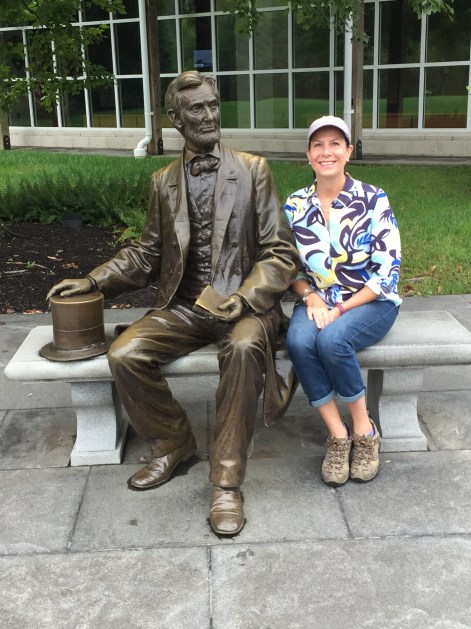
Me and a beautiful bronze statue of Abraham Lincoln. The film “Lincoln” starring Daniel Day-Lewis and Sally Field is an incredible visual depiction of the time around the Civil War!

Sweet Kisses …

For all you “choc-a-holics” out there, a visit to Hershey, Pennsylvania is a must! Home to one of the largest chocolate manufacturers in the world – The Hershey Company – which produces some 80 million of its famous Hershey kisses each day, and a tour of “Chocolate World” is fun, especially for the free samples given out at the end!

But we were visiting for what is promoted as America’s Largest RV (recreational vehicle) Show and it goes without saying that our favourite motor home just happened to be this year’s most expensive one at the event! The Newmar London Aire motor home has a jaw-dropping, show-reduced, price tag of $546,000 (some 418,000 pounds sterling!).

Oh my, it was stunningly luxurious. That it can actually travel down the road is beyond belief with all its over-the-top luxury on board! As you can see from the photograph of the interior below, the view from the driver’s seat is incredible – with the four sides open – it looks like a five-star hotel!

Special features include a two-person sized shower, a walk-in wardrobe that is made of cedar wood, a pull-out pantry with each shelf having high sides to prevent things flying around if you take a corner too sharply (as my beloved is apt to do), under-floor heating, a freezer built into the exterior storage space and all the necessary electronics required to put a man on the moon!

fullsizeoutput_2a95

The London Aire made by Newmar which had a pre-show listing price of $696,000!

DSC_0045

The interior of the five-star motor home!

Take Me Home, Country Roads

John Denver’s immortal song about West Virginia, a state that we have spent the day crossing!

Day four of driving and I have to give a shout out to my Darling husband for spending four solid days behind the wheel covering over 1,500 miles to get us to our first, real destination of Gettysburg, Pennsylvania.

We are out of harm’s way of Hurricane Florence, although we may get some rain and winds once the storm makes landfall and, of course, we will monitor the storm’s impact to ensure our future plans do not need to be tweaked!

West Virginia is a beautiful state, located in the Appalachian region in the Southern United States which has an unrealistic, long-term future with its main natural resource, coal!

The state is blessed with an extremely high-quality coal that was first discovered in 1742, yet in recent times, as with all coal-producers around the world, the energy source is not in high demand and it’s long-term prospects, until they can find a way of economically cleaning-up its climatic impact, it’s an industry that will not see the light of day down the road.

These days, even though a starting salary in the coal industry is $60,000 a year, the state has expanded it outputs to include broilers (young chickens), beef, chicken, eggs, dairy produce plus turkeys, sheep, lambs and farm-raised fish!


0

A typical view of West Virginia. 


Finger Lickin’ Good!

We have spent the entire day driving across the green rolling hills of Kentucky, admiring the immaculately manicured lawns and gardens, the spotlessly clean and perfectly kept roads, and even witnessed an Amish gentleman driving a horse-drawn buggy!

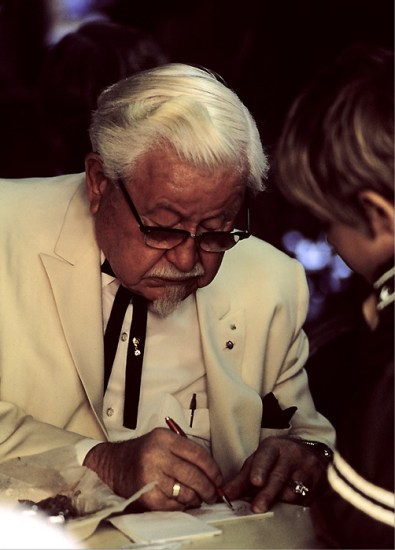
Back in the 1930s, one Colonel Harland Sanders began selling his fried chicken from a roadside restaurant in Corbin, Kentucky. He identified the potential of the restaurant franchising concept, and the first “Kentucky Fried Chicken” franchise was opened in Utah in 1952. Today, KFC is one of the largest restaurant companies in the world with its headquarters still in the state.

We drove through Lexington, known as the “horse capital of the world” as the city is surrounded by over 400 horse farms! It is also famous for its annual horse race, the Kentucky Derby, which is preceded by two weeks of fun-filled activities. As legends go, the state rears fine race horses because the hills are filled with limestone and as water seeps through the stone it accumulates minerals, enriching the bluegrass that grows and building unusually strong bones in horses!

And, I cannot describe Kentucky without chatting about Bourbon! Bourbon is an american whiskey which is a barrel-aged distilled spirit made primarily from corn. It is produced mainly in the southern part of the state and some 95% of the world’s bourbon is made here!

Colonel_Harland_Sanders_in_character

The real Colonel Sanders in his iconic outfit around 1974!


The chicken was so notable that Sanders was