Day three.
After a two-hour cannon attack by the Confederates on the Union army’s central flank on Cemetery Ridge and Cemetery Hill, more than 12,000 men commanded by Confederate Major Generals George Pickett, Pettigrew and Trimble emerged three-quarters of a mile in-front of the Union Line.
Exploding shells tore holes in their ranks, but, as the dead and wounded fell, others took their place. When the Confederate forces began to cross Emmitsburg Road nearing the Union force, the Union defenders decimated them with cannon shot and volleys of musket fire.
Despite staggering losses, Confederate Brigadier General Lewis Armistead led several hundred men to breach the Union ranks. A fierce hand-to-hand combat continued until Armistead fell mortally wounded and the exhausted Confederates, out-numbered and now out of ammunition, retreated.
For the three days of fighting, casualties on both sides (killed, wounded, captured and missing) were staggering: 23,000 for the Union army; and, 28,000 for the Confederate army.

See the white “blob” in the distance? That’s where the Confederate army started. If you can make out the wooden fence in the middle of the picture, that’s where they crossed Emmitsburg Road heading straight for the Union line where the photograph was taken.
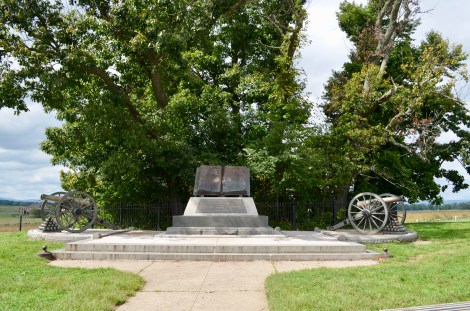
Years after the battle, Pickett’s Charge and its failure came to be known as the “High Water Mark of the Confederacy” represented by a memorial of an open book flanked by two cannon. The war would continue for the best part of two more years.
Mike and I at the High Water Mark.
 The Blogging Brit