Trailing Behind!

Welcome to Essex Junction, Vermont where we will be staying for the next six nights! We are here to attend a Tiffin Motor Home rally (Tiffin is the manufacturer) which starts on Monday. As Mike and I have volunteered to help at the event, we came in today to attend a mandatory orientation meeting.

These events are great fun as there are dinners and social events every day where you get to meet lots of new friends, but they are also interesting as there are seminars and talks on technical aspects of the motor home plus general “life” sessions as many folks who will be here live full-time in their motor home.

I was completely intrigued when I spied this rig arriving, pictured below. The owners have a 37-foot motor home and are towing a 26-foot trailer! Not only that, but the trailer is split-level! On the lower level, sits a truck which, when traveling, is strapped tightly in place and there is tonnes of work and storage space behind the truck. On the upper level sits a Polaris Slingshot (a two-seater, fun, off-roading kind of vehicle). Again, on the upper level there is more storage space. There is an built-in lift (elevator) which enables the owners to retrieve anything they need.

fullsizeoutput_2b1a

The big upside of the trailer is that you can reverse the motor home while it is attached! None of this un-hooking malarkey that we so enjoy!
Oh, What A Day!

Today’s mission was to drive from Harrington, Maine to Randolph Center, Vermont, a distance of some 320 miles. For our motor home travel, if you factor in stops to refuel and walks for Miss Poppy, on average, we cover about 50 miles in an hour.

We head out of Harrington at a decent hour. The weather is overcast, the rain is spotty and we are traveling on not so great roads. For some unknown reason, we decide to change routes and travel on interstate roads (motorways) in order to reach our destination. Usually, we travel city to city on non-interstate roads as it is a far more interesting way to see the country rather than heading along a boring freeway!

What an error we made! We add three hours to our journey and encounter an 11-foot high bridge in Brunswick as we try to find a rest area for Poppy! Our motor home needs a clearance of 13’ 2” minimum, so, we pull over, unhook the Jeep, Mike undertakes a three-point turn on a pinhead, re-hook the Jeep and re-trace our steps!

We arrive at our RV park at 8.30 at night, take a wrong turn in trying to find our parking slot and end up in a field! For the second time in a day, we unhook the Jeep, Mike undertakes a three-point turn, this time in a field, and we find our way to our site which has fantastic views over a lake but, at this stage who cares, as its pitch black and even Miss Poppy is asking for a large glass of Chardonnay!

Lobster Claw Town!

Bar Harbor, where we visited today, is a picturesque, seaside town with tonnes of restaurants, boutique shops and art galleries offering its many visitors a range of activities to enjoy.

Whale watching tours are popular as are boat trips to watch Puffins at a nearby colony, sadly, we are too late in the year to see them. A century ago, puffins were nearly eliminated from the state of Maine as the colourful birds were prized for their feathers and their eggs were gathered for the dinner table. In 1973, Puffin Project was established in an attempt to bring them back to their historical range. Although the project has been a resounding success, major threats such as overfishing, climate change and habitat elimination continue to offer challenges to these cuties. Puffin watching is already on my hit-list should we return to this area again!

The town of Bar Harbor also enjoys the benefits of having the Acadia National Park as a close neighbour. The Park is one of the most popular destinations in the US with over two million visitors descending on the area between May and October each year.

fullsizeoutput_2b17

The Town encompasses the entire northern section of Mount Desert Island. Its land makes-up 114 square miles and is, ironically, shaped like a lobster claw! 

fullsizeoutput_2b18

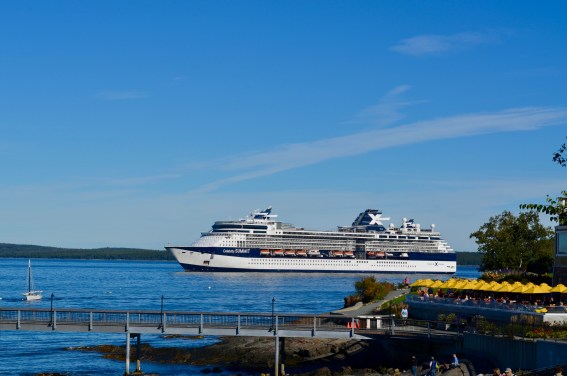
Hundreds of thousands of visitors come to Bar Harbor each year by sea – this is a prized cruise ship port destination for large and small cruise ships!

Dam It!

Beavers are, by nature, engineers and they are programmed to build dams to ensure the safety and security of their colonies.

After their re-introduction to Acadia National Park in 1920, the aquatic herbivores became so prolific so fast, that John D. Rockefeller, Jr. wrote letters of complaint about the beavers creating dams and ruining trees on his property and elsewhere within the park.

Today, beaver activity is pro-actively managed by the park service in order to maintain the balance of the park’s eco-system with the need of the beavers to build dams and live in the ponds they create.

fullsizeoutput_2b0c

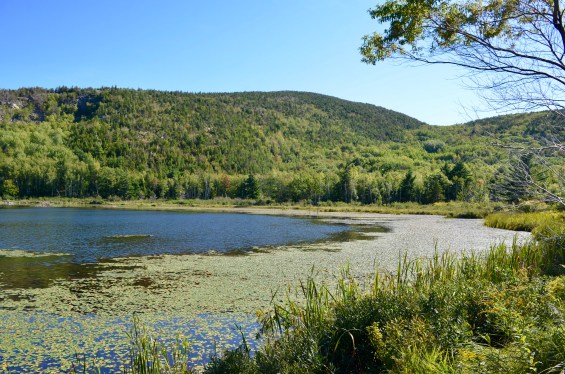
The Beaver Dam Pond sits on one of the nicest stretches of woods in the Park Loop Road. It only became a pond after the beaver’s made it so and on closer inspection pointed Birch tree stumps attest to their gnawing tendencies in the area. 

In 1947 a massive fire brought about a major change in the Mount Desert Island’s ecology. A Spruce-fir coniferous forest once dominated the island, but the fire created open areas that were colonized by faster-growing hardwood trees, such as birch, aspen and maple.

fullsizeoutput_2b07

Miss Poppy doing her part to support the Acadia National Park!

Bubbles, Ponds & Rocks!

Acadia National Park, day two, and I was traveling solo as Mike was working on his database back at the motor home. As you’ll see, it was seriously over-cast and I finally called it quits when fog and rain moved in!

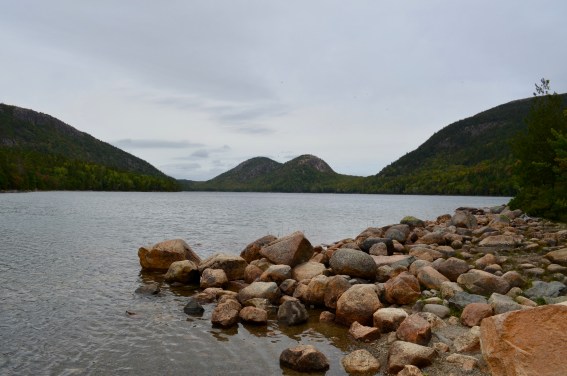
I started my day at Jordan Pond which has crystal clear water, a maximum depth of 150 feet (46 m) and supplies a local village with its water. It is very popular with park visitors as there is a restaurant serving tea and popovers! Popovers are effectively Yorkshire Puddings served with butter and strawberry jam! For my American friends, Yorkshire Puddings are a light, egg batter (the same as popovers) which are traditionally served with a Roast Beef dinner!

On the opposite end from the restaurant are two rounded hills known as The Bubbles. I hiked to the top of each of them, which nearly killed me, but once there it was so worth it for the views!

fullsizeoutput_2b05

In the distance are the twin hills called The Bubbles. On the left is North Bubble, the right is South Bubble.

fullsizeoutput_2b02

Arguably, Bubble Rock is the best-known boulder in the state of Maine! Perched precariously on the eastern edge of the summit of South Bubble, elevation 768 feet, this giant geological feature is an example of a glacial erratic – a huge rock which was moved here by the powerful action of ancient glaciers. Scientists estimate that the rock originated some 40 miles to the north. 

fullsizeoutput_2b01

The view of Jordan Pond from North Bubble, elevation 872 feet. 


The North Atlantic Coast’s Crown Jewel!

Acadia National Park includes 60 miles of rugged coastline primarily on Mount Desert Island and 19 other coastal islands. The landscape rises abruptly from sea level to over 1,500 feet with eight mountains above 1,000 feet!

Back in the 19th century, Mount Desert Island’s beauty and remoteness began attracting wealthy visitors looking for a retreat from bustling cities. They built magnificent mansions which they called “cottages” on the island’s northeast coast. The area became known as Millionaire’s Row.

As the 20th century arrived, dozens of hotels sprang up in the nearest town of Bar Harbor and people began to worry that Mount Desert was losing the qualities that had made it so attractive.

Some of the wealthy part-time residents began using their influence to push for a national park on the island. Among them was oil magnate John D. Rockefeller, Jr., who donated some 11,000 acres to what was to become Acadia National Park.

fullsizeoutput_2afa

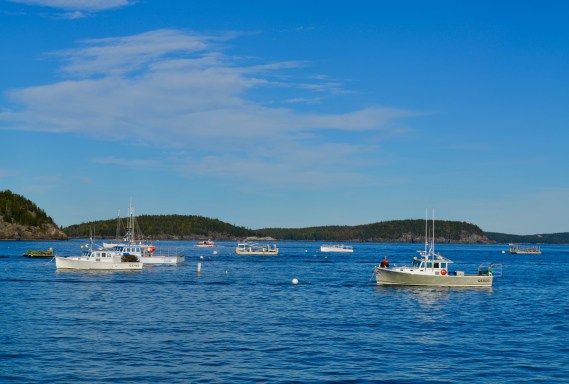
A view of Long Porcupine Island (managed by the park) from Mount Desert Island and the “Margaret Todd” schooner sailing past. The white and orange “flecks” you see in the water are lobster pots.

fullsizeoutput_2afe

Otter Cove where pink granite enhances the colour of the green spruce trees and the blue sea.

fullsizeoutput_2afd

Composed of a patchwork of public land surrounded by towns and villages, the park covers about 38,000 acres with a further 12,000+ acres of conservation easements. Here, the fence line depicts the boundary of the national park with a privately owned home sitting on a peninsula with a view to die for!

Tide’s Out!

We have travelled across the state today ending up in Harrington, Maine which is only some 60 miles from the Canadian border! The air is cool and crisp, the weather spectacular with the first blue sky we have seen in a week, and the Maine coastline which we have enjoyed on our drive, is simply breathtaking!

As the sky was blue, the Atlantic Ocean looked particularly inviting and offset by the gorgeous, white-coloured homes, hotels and inns that dot the landscape. Needless to say, there are signs advertising lobster restaurants at every town we passed through. They certainly have hundreds of ways of preparing it – on pizza, lobster mac and cheese, replacing meat in burgers, and even on top of a burger – really Mainers, is this necessary?

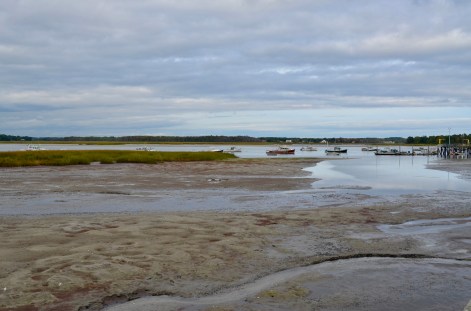
Our RV park is tucked away off the beaten track and is so quiet and peaceful. It is idyllic and I cannot wait to see what the views look like when the tide comes in.

fullsizeoutput_2af5

About sixty feet from where our motor home is parked, these are our views!

fullsizeoutput_2af6

Maine’s Largest Salt Marsh!

fullsizeoutput_2af4

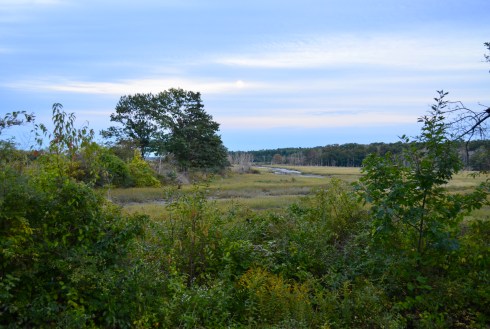
We are staying at the Wild Duck Adult Campground and RV Park in Scarborough, Maine which is adjacent to a 3,200-acre saltwater marsh owned by the state of Maine. It is managed by the Department of Inland Fisheries and Wildlife and this is my view for Miss Poppy’s first walk of the day – glorious!

fullsizeoutput_2af1

The marsh is fed by four rivers and several creeks that eventually find their way into the Gulf of Maine.

fullsizeoutput_2aef

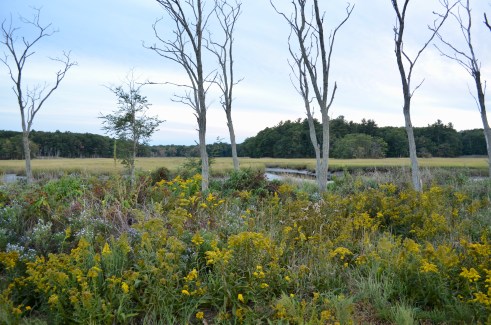
Salt marshes filter pollution from the water and provide food and shelter for numerous species of birds, fish and mammals. Given the wildlife productivity and habitat diversity in this area, Scarborough Marsh is considered by the state of Maine as the most significant of Maine’s coastal areas.

fullsizeoutput_2af0

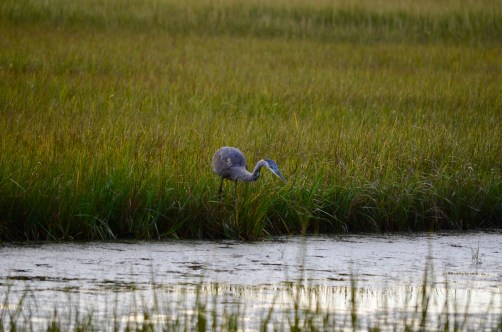
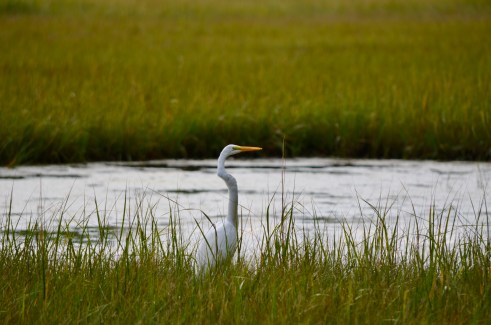
The marsh is a stopover for a myriad of waterfowl which can be spotted on the way to Canada in the spring and south to their wintering areas in the autumn. Seals and the occasional porpoise on the hunt for food can be seen in the Scarborough river.


Seeing Double!

The Portland Head Light located in Cape Elizabeth, Maine was first lit with 16 whale oil lamps in January 1791 and is Maine’s oldest lighthouse!

Construction of the original 72-foot tower began in 1787 at a cost of $750. It was completed in 1790 following an additional cash injection of $1,500 from the US Government who had taken over responsibility of all lighthouses.

Keeper’s Quarters, consisting of a one-story dwelling which included two rooms, a cellar and a porch in the back, were added in 1816.

Late on Christmas Eve in 1886, a three-mast sail ship struck the ledge at Portland Head. Keeper Joshua Strout, his son, wife and volunteers rigged an ordinary ladder as a gangplank between the shore and the ledge the ship had struck. Captain O’Neil, the ship’s master, his wife and 11 members of the crew clambered onto the ledge and safety. The cause of the wreck remains a mystery as visibility was not a problem and members of the crew reported that they plainly saw the Portland Light before disaster struck.

Following automation of the lighthouse in 1989, the property was leased and subsequently deeded to the Town of Cape Elizabeth. Today, the US Coast Guard maintains the actual light and the fog signal, and the Town of Cape Vincent takes care of everything else.

fullsizeoutput_2ae4

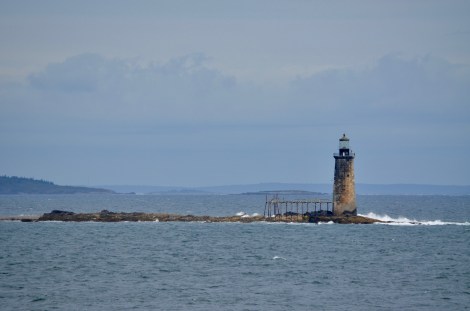
As I moved around the site to take this picture, I couldn’t believe that the distant “blob” to the right of Portland Head Light was a second lighthouse!

fullsizeoutput_2ae9

Swapping camera lenses and the Ram Island Ledge Light Station came into focus! Today, the lighthouse is privately owned and runs on solar power.


Lobsters Going to Pot!

We are now in Scarborough, Maine, the northeastern-most U.S. state. It has one border with Canada and is known for its lighthouses, the Acadia National Park and its beaches with the cool waters of the Atlantic Ocean.

Maine is also famed for its lobsters. One Maine lobster pound (a lobster pound is a very casual restaurant where you eat at harbour-side picnic tables) is using marijuana to try to make cooking the crustaceans a little more humane! The business, Charlotte’s Legendary Lobster Pound, is owned by a registered medical marijuana care-giver.

The owner, put a lobster in a box with a few inches of water before marijuana smoke was blown over it. According to the reporter, the crustacean was calmer for the next three weeks, and was released back into the ocean.

It’s really an unknown science as to whether pot smoke actually calms lobsters or has any effect on their meat.  Perhaps the calmness resonates with the customer ordering the lobster and makes them feel better, who knows!

fullsizeoutput_2ad8

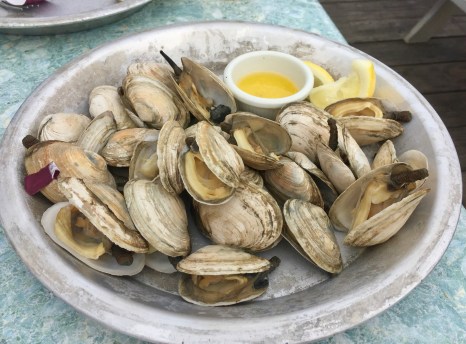
Here is our plate of “Steamers” – succulent clams that have been steamed and are served with quarters of lemon and a pot of dipping butter! The butter was not needed as the clams with just a squeeze of lemon were fantastic.

fullsizeoutput_2ad9

Mike orders the Lobster plate – the meat of two lobsters, covered with breadcrumbs and served hot with corn. 

fullsizeoutput_2adf

Our view at Bayley’s Lobster Pot restaurant in Scarborough, Maine. The tide is just starting to come in!