Devils Tower

We were on the move today, heading to Rapid City in South Dakota, but took a detour to view the Devils Tower National Monument near Sundance in northeastern Wyoming.

Although Devils Tower has long been a prominent landmark, the origin of the mammoth rock obelisk remains somewhat obscure. Geologists agree that Devils Tower consists of molten rock forced upwards from deep within the earth. Debate continues, however, as to whether Devils Tower is solidified lava from the neck of an ancient volcano, the walls of which eroded long ago, or whether it is a sheet of molten rock which was injected between rock layers. The characteristic furrowed columns are apparently the result of uniformly arranged cracks which appeared during the cooling of the volcanic magma.

Estimates have placed the age of Devils Tower at greater than fifty million years, although it is likely that erosion uncovered the rock formation only one or two million years ago!

Devils Tower rises dramatically 1,267 feet (386 m) above the Belle Fourche River, standing 867 feet (265 m) from base to summit. Each summer, hundreds of climbers descend upon the area to scale the sheer rock walls!

fullsizeoutput_2802

Steven Spielberg’s 1977 film “Close Encounters of the Third Kind” used Devils Tower as a plot element and as the location of its climatic scenes!
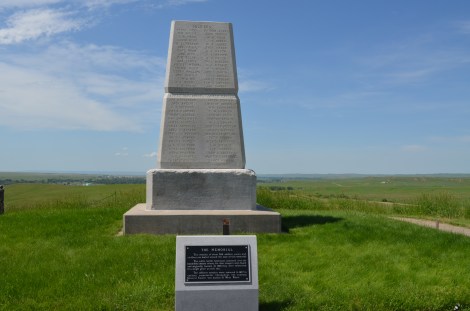
 

Custer’s Last Stand!

At dawn on June 25, 1876 two scouts working for Lt. Col. George Armstrong Custer, who commands the 7th Cavalry, see evidence of a Northern Plains Indian encampment they are searching for in the valley of the Little Bighorn River, Montana.

Convinced that they will be discovered, Custer divides his regiment into three under the command of Major Marcus Reno and Captain Frederick Benteen in order to strike the camp from separate directions before its occupants can scatter.

Custer, with some 210 men, heads to the northwest in pursuit of mounted warriors, probably underestimating the size and fighting power of the Lakota and Cheyenne forces. Custer and his men are surrounded and overwhelmed in fierce fighting

In the battle, the 7th Cavalry lose the five companies under Custer, about 210 men. Of the other companies of the regiment, under Reno and Benteen, 53 men were killed and 52 wounded. The Northern Plains Indians lose around 100 warriors.

 DSC_0141

The remains of some 220 soldiers, scouts and civilians are buried around the base of the memorial at the Little Bighorn Battlefield National Monument which we visited today. General Custer is buried at West Point Cemetery in New York.

fullsizeoutput_27fa

In the Spring of 1876, the U.S. Army enlisted 23 Crow Tribe scouts to help them find the Northern Plains Indians. When the Battle of the Little Bighorn came together, Curley, named for his wavy hair, was able to escape the fate of Custer and his command, as he was on the outside of the charging circle of warriors.

fullsizeoutput_27fe

A memorial to honour Native American participation in the Battle of the Little Bighorn.


Wild West Outlaws!

In the spring of 1967, work began to collect the historic buildings and artefacts that dotted the landscape of the Wyoming frontier, and relocate them to the town of Cody (where we are staying), where they would be preserved for future generations as part of an Old Trail Town exhibition.

From remote locations in Wyoming and Montana, the historic buildings were carefully disassembled, moved and reassembled by a local historian and his friends.

The Rivers Saloon built in 1888. It was frequented by Butch Cassidy, Blind Bill Hoolihan and many other outlaws, cowboys and colourful characters of the old west. Bullet holes dot the door!

fullsizeoutput_27df

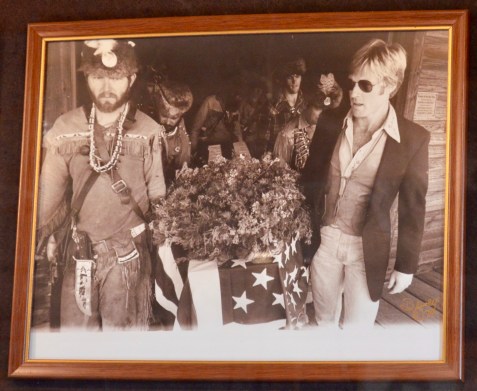
Jeremiah “Liver-Eating” Johnston’s remains were relocated to Old Trail Town in June 1974 where Hollywood actor and director Robert Redford was a pallbearer. Redford portrayed Jeremiah Johnson in the 1972 American western film. Historical records show Johnston’s surname spelt with and without the “t.”

Johnston acquired his nickname after pursuing a vendetta against the Crow Indian tribe who had killed his wife, a member of the Flathead American Indian tribe. Allegedly, he killed, scalped and cut out and ate the livers of over 300 Crow Indians!


fullsizeoutput_27e1

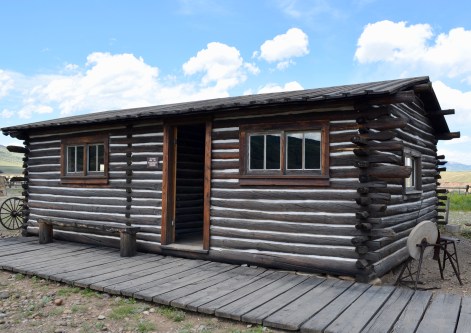
Mud Spring Cabin built in 1897. Used by Kid Curry and the Sundance Kid as a hide-out before they attempted to rob the Red Lodge Bank in Red Lodge, Montana.

Geological Wonderland!

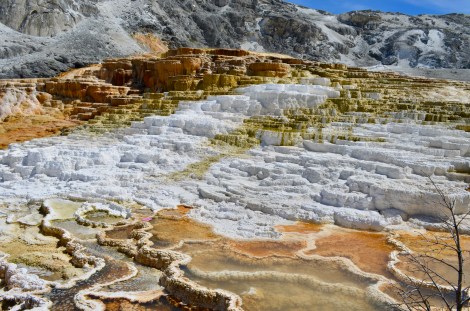
Limestone is a sedimentary rock composed of calcium carbonate that was deposited on the bed of an ancient inland sea, underlying an area in Yellowstone National Park known as Mammoth Hot Springs.

Heated by Yellowstone’s volcano, water travels through the buried limestone, dissolving it as it goes. The water becomes saturated with calcium carbonate and as it nears the surface, pressure and temperature decrease, allowing carbon dioxide gas to escape from the solution. The resulting deposits of calcium carbonate that form in and near the hot springs are called travertine terraces.

Some studies show that travertine builds up at an average rate of eight inches a day. For this reason, change is the only constant at Mammoth Hot Springs. Terraces that were active one year might be dry the next, and new areas become active and build terraces at the geologically stunning rate.

fullsizeoutput_27d6

Fresh travertine is bright white, but it turns grey as it weathers. Travertine is a soft rock, it both breaks down and builds up rapidly. Where there are holes in the travertine, birds are building nests and raising families!

fullsizeoutput_27d4

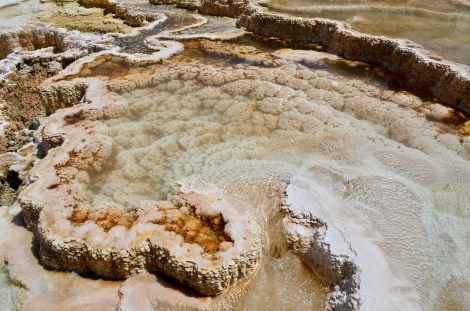
Mineral-laden hot water from deep beneath the Earth’s crust finds its way to the surface and builds tier upon tier of cascading, terraced stone.

fullsizeoutput_27d2

Areas that appear orange or yellow in colour contain thermophiles, heat-loving organisms such as bacteria and algae that thrive in the warm waters of hot springs.


Scenic Yellowstone

It is difficult to try and describe the sheer beauty of Yellowstone National Park. There is so much variety to fulfil any visitor’s preferences.

If you like to hike, there are over 1,000 miles of trails to follow. If fauna and flora is your thing then the park is home to over 60 species of mammals and some 300 species of birds; eighty percent of the 2.2 million acres of the park are forests, 15 percent are grasslands, and five percent is covered by water.

I enjoy all are of the above seen through the lens of my beloved camera with a blue sky thrown in to enhance the photographs! Here are some pictures to help share with you the magnificence of the park.

fullsizeoutput_27c4

Sylvan Lake.

fullsizeoutput_27c8

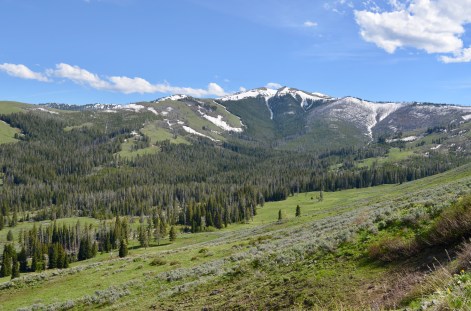
Dunraven Pass.

DSC_0156

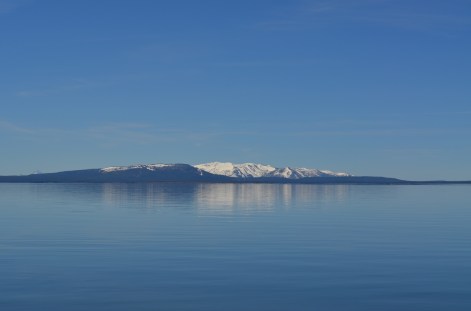
Lake Yellowstone.

fullsizeoutput_27ca

Hayden Valley.

Bubble, Gurgle, Rumble, Belch!

Yellowstone National Park in Wyoming covers more than two million acres of wild land and open spaces where animals roam, and biological, geological and hydrothermal processes each play a part in shaping a fascinating and constantly changing landscape. It is an incredible and wonderous place to visit.

fullsizeoutput_27bd

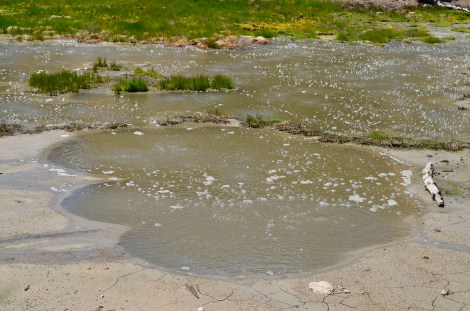
Mud pots are acidic features with limited water supply. Hydrogen sulfide, which rises deep from within the earth, is used by some micro-organisms as an energy source. They help convert the smelly gas to sulfuric acid which breaks down rock into clay. Various gases escape through the clay and cause it to bubble and plop!

fullsizeoutput_27be

An unknown park visitor named this feature Dragon’s Mouth Spring around 1912, perhaps due to the water that frequently surges from the cave like the lashing of a dragon’s tongue. The rumbling sounds are caused by steam and other gasses exploding through the water causing it to crash against the walls of the hidden caverns.

fullsizeoutput_27bf 

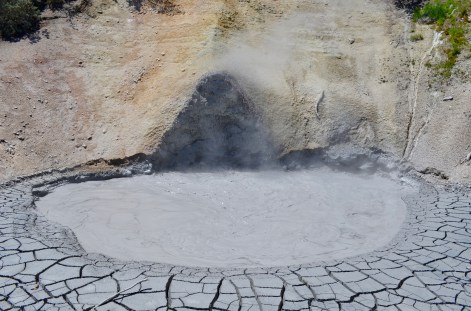
For many decades, visitors have been intrigued by Mud Volcano’s powerful odour and yellow sulphur that is most common in late summer. The smell comes from hydrogen sulfide gas rising from Yellowstone’s magma chambers causes the rotten-egg smell. Micro-organisms use the gas as a source of energy turn the gas into sulfuric acid which breaks down the rock and soil into mud. When iron mixes with sulphur to form iron sulfide, grey and black swirls sometimes appear in the mud.

Geezer Gazing!

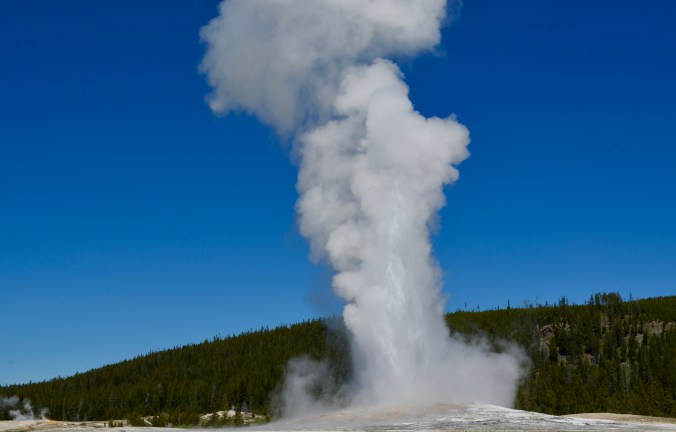
The Old Faithful geyser is Yellowstone National Park’s number one attraction, drawing upwards of some 30,000 visitors a day during the summer. Discovered in 1870 by the Washburn Expedition, Old Faithful geyser was named for its frequent and somewhat predictable eruptions, which number more than a million since Yellowstone became the world’s first national park in 1872.

Yet Old Faithful is not alone. It stands surrounded by hundreds of other geysers and hot springs, large and small, as a product of millions of years of geology at work. Much of Yellowstone sits inside an ancient volcanic caldera (the exploded crater of a volcano). Indeed, one half of the world’s hydrothermal features are located within the park.

Geysers are hot springs that erupt periodically. The eruptions are the result of super-heated water below-ground becoming trapped in channels leading to the surface. The hottest temperatures are at the bottom of these channels but the deep water cannot vaporize because of the weight of the water above. Instead, steam is sent upwards in bubbles, collecting in the channel’s tight spots until they essentially become clogged, leading to the point where the confined bubbles actually lift the water above, causing the geyser to overflow. This causes the pressure to decrease until suddenly violent boiling occurs throughout much the length of the column, producing a tremendous volume of stream which forces the water out of the vent in a superheated mass.

fullsizeoutput_27bb

Old Faithful geyser spouts between 4,000 and 8,000 gallons of hot water more than 100 feet into the air every 90 minutes or so. During an eruption, the water temperature at the vent has been measured at 204 degrees Fahrenheit (95.6 degrees Centigrade).


Wonderful Wyoming Wildlife!

We had a really big driving day yesterday, traveling over 500 miles from Estes Park in Colorado to Cody, Wyoming where we are now to visit both the Yellowstone National Park and the Grand Teton National Park.

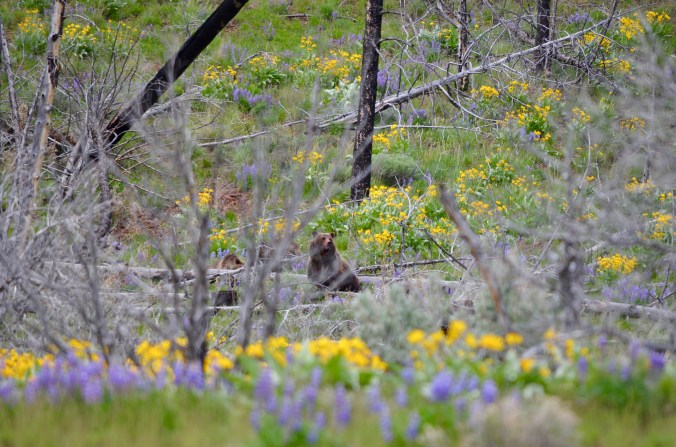
Needless to say, we did not have an early start this morning! We were on the road towards Yellowstone National Park when we came across a group of people standing on the side of the road all with seriously enormous camera lenses watching something. We stopped, I hopped out and some very kind gentleman brought me up-to-date. A Mummy Grizzly bear had just killed an Elk, and, together with her two cubs, the family was enjoying lunch! These are not great images, as the scene was too far in the distance for my camera lens, and I decided not to take-up Michael’s advice and wrap my head in bacon and move closer to get a better picture!


fullsizeoutput_27a9

fullsizeoutput_27a0

Driving into the Park, we came across a small herd of Bighorn Sheep grazing on the hillside. This is not the time of year when the sheep are really looking their best as they are shedding their winter coats. But they were very cute and kindly posed for photographs!

fullsizeoutput_27a3

fullsizeoutput_27a5

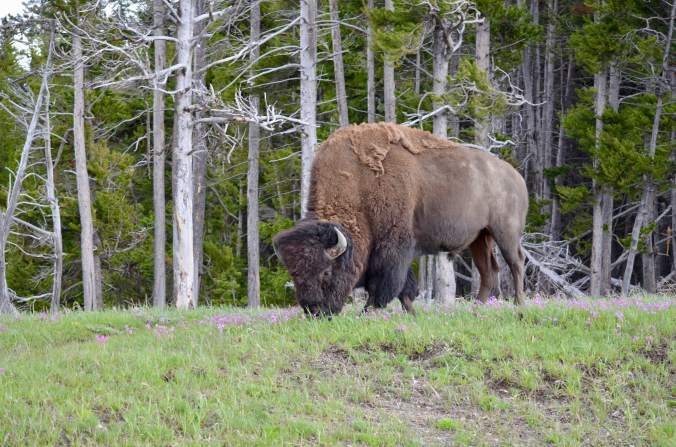
And, finally, the majestic Bison (also known as American Buffalo), who are grazing everywhere. They too are shedding their winter coats, but it was such a thrill to see and photograph them!

fullsizeoutput_27a8


Bear Lake


DSC_0108

Sitting at an elevation of nearly 9,500 feet, the alpine lake rests beneath the sheer flanks of Hallett Peak and the Continental Divide; it was formed during the ice age by a glacier.

fullsizeoutput_2797

Several trails, from easy strolls to strenuous hikes, start from the lake. The Bear Lake road is open year-round, although it may be temporarily closed due to adverse weather conditions. Mike and I meandered around the lake enjoying the views, the warmth on our backs and, in many areas, the snow under our feet!

fullsizeoutput_279a

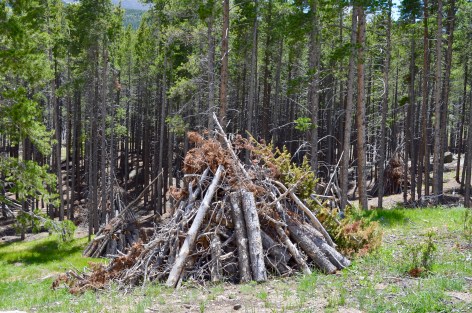
As you drive through the park, one notices that there are thousands of dead trees. Some are the result of avalanches, age, natural degeneration but in Colorado, specifically, millions of trees are being killed by native bark beetles. Burrowing through the outer bark of conifers, bark beetles lay eggs which hatch into hungry beetle larvae. Larvae consumer the living inner bark of trees. Recent warm winters and continued low rain/snowfall have combined to favour beetles and weaken many evergreen trees. These milder temperatures have aided a widespread outbreak of beetles during a time when trees are weakened by drought.

Material in these piles will be burned in winter when conditions are safest. To reduce the impact of smoke, fire management staff limit the number of piles burning at any one time. The piles are built-in a conical shape because as they burn, they collapse inwards ensuring that controlled burns don’t spread to the rest of the park.