In 1923, a proposal of a mountain carving in South Dakota’s Black Hills to attract tourists is met with skepticism and criticism. Yet, two years later, federal and state legislation authorizes a carving and Gutzon Borglum, a famed American sculptor, is approached to undertake the project.
Borglum immediately drops what he’s doing and heads to South Dakota. He selects Mount Rushmore as the site because of its size, orientation to morning and midday light, and the abundance of fine-grained granite.
To appeal to a national audience, Borglum proposes carving 60-foot faces of four U.S. presidents to commemorate the founding, growth, preservation and development of the United States. They symbolize the principles of liberty and freedom on which the nation was founded.
It was thought the project could be completed in five years for $500,000. Work began in 1927 and fourteen years and one million dollars later, carving ended with the death of its visionary sculptor Borglum and the onset of World War II.
The men who worked alongside Borglum were mainly drawn from the local area. Many were miners, lumber men or ranchers. Over the fourteen-year period of the carving almost 400 workers, men and women, laboured at the site.
Workers started at 7.30 a.m. but before they could begin, they had to climb a tortuous stairway of over 700 steps to the top of the mountain. There, far above the rocky chasm, they were strapped into swing seats and lowered over the face of the mountain while managing heavy drilling and blasting equipment.
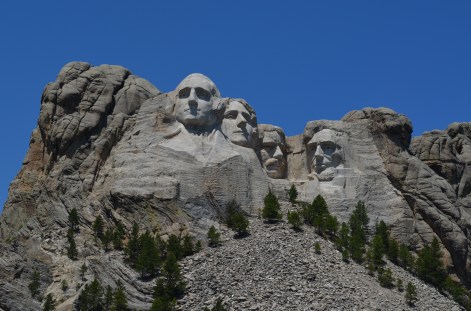
From Left: George Washington (served 1789 – 1797), Thomas Jefferson (served 1801 – 1809), Theodore Roosevelt (served 1801 – 1809), and Abraham Lincoln (served 1861 – 1865).
Mike and I at the monument.

Washington was the first figure to be completed in 1930. As Washington’s face is in higher relief than the others, it remains the most prominent.
 The Blogging Brit