The Old Faithful geyser is Yellowstone National Park’s number one attraction, drawing upwards of some 30,000 visitors a day during the summer. Discovered in 1870 by the Washburn Expedition, Old Faithful geyser was named for its frequent and somewhat predictable eruptions, which number more than a million since Yellowstone became the world’s first national park in 1872.
Yet Old Faithful is not alone. It stands surrounded by hundreds of other geysers and hot springs, large and small, as a product of millions of years of geology at work. Much of Yellowstone sits inside an ancient volcanic caldera (the exploded crater of a volcano). Indeed, one half of the world’s hydrothermal features are located within the park.
Geysers are hot springs that erupt periodically. The eruptions are the result of super-heated water below-ground becoming trapped in channels leading to the surface. The hottest temperatures are at the bottom of these channels but the deep water cannot vaporize because of the weight of the water above. Instead, steam is sent upwards in bubbles, collecting in the channel’s tight spots until they essentially become clogged, leading to the point where the confined bubbles actually lift the water above, causing the geyser to overflow. This causes the pressure to decrease until suddenly violent boiling occurs throughout much the length of the column, producing a tremendous volume of stream which forces the water out of the vent in a superheated mass.
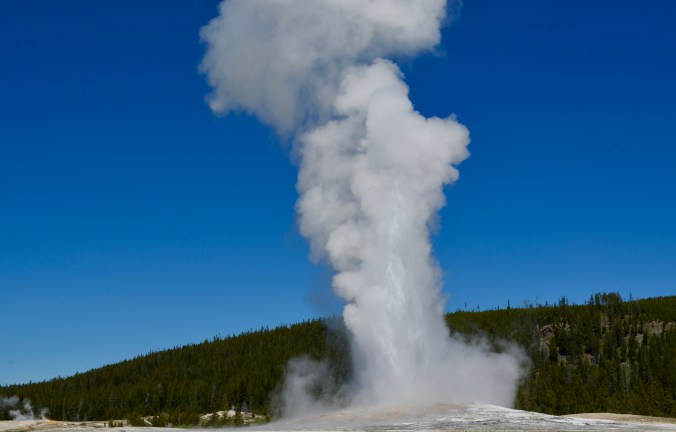
Old Faithful geyser spouts between 4,000 and 8,000 gallons of hot water more than 100 feet into the air every 90 minutes or so. During an eruption, the water temperature at the vent has been measured at 204 degrees Fahrenheit (95.6 degrees Centigrade).
 The Blogging Brit