Back blogging August 26, 2018

Hi Everyone,

We have yet to finalize the exact route of our next road trip, but likely we will be leaving sometime during the last week of August.

As Mike works out the route, I will update the blog to let you know, but right now, we plan on heading East on or around August 26.

Mark your calendars and get ready for a really fun and interesting trip!

thebloggingbritblog.com

Home, James!

We are home and motor home, Roxanne, has been emptied and cleaned and is safely back at the storage unit!

This last road trip has taken us away for five weeks covering over 4,000 miles! We have seen some magnificent sights in a number of National Parks, especially the wildlife, and enjoyed spectacular scenery in Colorado, Wyoming and South Dakota; we have witnessed the very unique monument “Carhenge;”  enjoyed visiting the big city of Tulsa and giggled that all the workers were is suits and us, retired bums, were in shorts; and Michael has re-stocked his wardrobe with T-shirts from all the parks and craft breweries we have visited – he has even diversified into purchasing merchandise that is neither green nor blue!

Miss Poppy-dog continues to be the finest example of doggy-kind, especially with a young kitty, who insisted on wrestling with her daily! That said, it is probably Miss Poppy who enjoys being home the most. She is out chasing her squirrels from morning to night and is not on any kind of lead! Poppy bliss!

We will be home for a couple of months and I will update the blog on exactly when we next leave – likely sometime around the last week of August. I am super excited about our next trip, even though Mike has yet to finalize the route, as we are heading East for the first time – Washington, D.C., Vermont and taking-in Niagara Falls, which happens to be on my bucket list!

Thank you for being such great traveling companions and I hope to see you next time!

fullsizeoutput_2974

Roxanne – ready and waiting for her next adventure!


Valley of the Vapors!

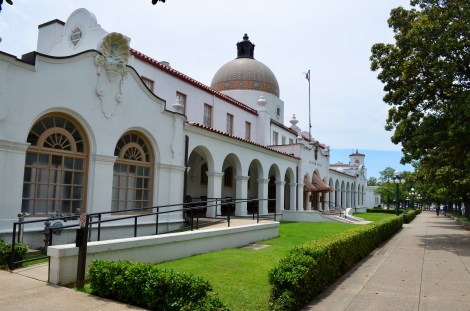
Water has attracted people to Hot Springs, Arkansas since before the 1700s. Some believe that the traces of minerals and an average temperature of 143 degrees Fahrenheit/62 degrees Centigrade give the waters whatever therapeutic properties they may have.

In 1803, the U.S. acquired the area around Hot Springs in Arkansas as part of the purchase of the Louisiana Territory from France. The first bathhouses were crude canvas and wood structures, little more than tents perched over individual springs or reservoirs carved out of the rock. By 1877, the government approved blueprints for private bathhouses ranging from simple to luxurious.

By 1921 the Hot Springs Reservation had become popular with vacationers and health remedy seekers.  By the 1960s traditional bathing was in decline and the bathhouses began to close their doors. Unused, the buildings fell into disrepair. Thankfully, in 2004 the park service received the first of several allocation of funds to restore the bathhouses to what they are today – a magnificent nod to the golden age of bathing!

fullsizeoutput_2970

At its peak of popularity, over a million visitors a year immersed themselves in the park’s hot waters which are believed to be 4,000 years old!

 fullsizeoutput_2972

Hot Springs National Park is not in a volcanic region. Outcroppings of regional rock absorb rainfall and pores and fractures in the rock conduct the water deep into the earth. As the water percolates downward, increasingly warmer rock heats it at a rate of about four degrees Fahrenheit every 300 feet. In the process the water dissolves minerals out of the rock. Eventually the water meets faults and joints leading up to the lower west slope of Hot Springs Mountain where it surfaces.

Ding, Dong the bells are gonna chime!

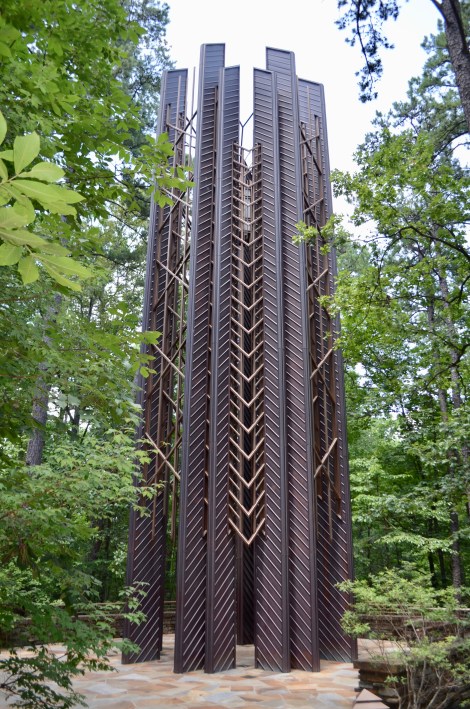
Like a sentry standing tall at an entrance gate, the Anthony Family Trust Carillon is the first structure visitors see as they meander down a winding path at the Garvan Woodland Gardens in Hot Springs, Arkansas.

The 57-foot electronic bell tower, is considered by many to be a piece of artwork as well as a musical instrument. Computerized chimes denote the time of day on the hour, followed by several minutes of popular tunes that can be heard throughout the Gardens.

fullsizeoutput_2954

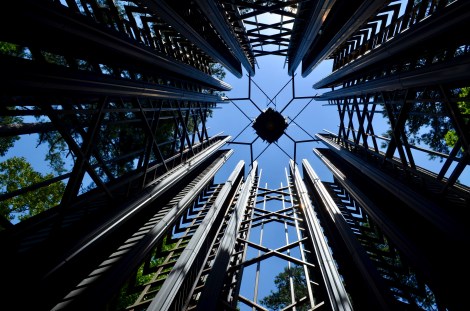
The remarkable vertical music box is made up of 16 copper-clad steel columns, strategically positioned to enable visitors to move around at the base of the structure.

fullsizeoutput_294d

Massive speakers resemble a lantern suspended from cables attached to an intricate cross-bracing system at the top of the structure.

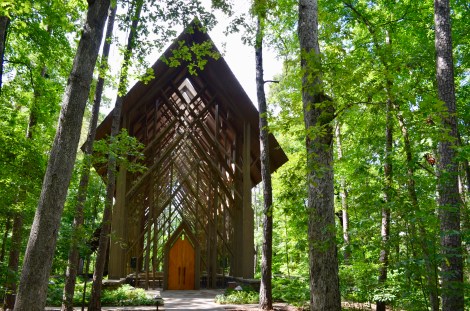
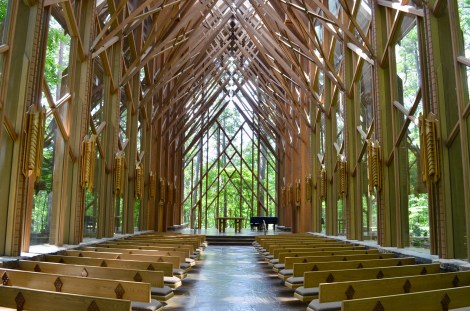
As you continue down the path, nestled under a thick canopy of southern pines and age-old oak trees, stands the incredible Anthony Chapel.

fullsizeoutput_295b

Standing nearly six stories tall, the amazing structure complements the surrounding wooded landscape and offers views of the changing seasons with floor-to-ceiling glass walls and multiple skylights.

fullsizeoutput_2955

The bell tower and chapel were designed by architects Maurice Jennings and David McKee of Fayetteville, Arkansas. The Chapel is available for private hire for concerts, memorial and christening services and some 175 weddings a year! Both the bell tower and chapel are named after the “Anthony” family whose generosity enabled the project to become a reality.

Home of the Tooth Fairy!

In the 1920s, a brick and timber businessman called Arthur Cook purchased a 210-acre site on a woodland peninsula some six miles from Hot Springs National Park in Arkansas. He thought that the site would be good as a future timber location for his company.

Sadly, he died in 1934 and his daughter, Verna Cook Garvan, assumed control of the family’s assets. A self-taught gardener, Verna began to develop the site as a garden and possible future homesite. Over the next 40 years, she planted thousands of specimens and laid out pathways.

On her death, Mrs. Garvan left the property to the Department of Landscape Architecture at the University of Arkansas which now manages the site as an education, research and public service for visitors.

The glorious botanical gardens feature floral landscapes, streams and waterfalls in a natural woodland setting. Its collections display hundreds of rare shrubs and trees and 160 different types of azaleas.

Today, the Garvan Woodland Gardens is the number one attraction in Hot Springs, Arkansas.

fullsizeoutput_2948

The Gardens have over four miles of shoreline on Lake Hamilton.

fullsizeoutput_2940

Well-fed Koi in the Gardens’ Koi pond.

fullsizeoutput_294b

A sweet nod for children of all ages, home of the Tooth Fairy!


Catherine’s Landing!

We are now staying in a lovely RV park called “Catherine’s Landing” in Hot Springs National Park, Arkansas.

The RV park is a part of a commercial venture that has 10 locations in its portfolio and, without doubt, it is the nicest site we have stayed at since starting our RV road trips! If you would like to check out their website, here’s the address: www.rvcoutdoors.com

There are a number of elements that make this site so good: they have 60-foot RV sites, all fully paved with full hook-up facilities (50-amp power, water, and sewer connection), plus pull-through capabilities, meaning we don’t have to disconnect the jeep to get into the site. Each pad is equipped with a picnic table, a fire pit and a bar-b-que plus its own green area where you can set out your chairs. With the capability of hosting nearly 300 RVs, it is the largest park we have visited and the wireless system is flawless!

The park also has cabins, cottages and Yurts (semi-permanent “glamping” tents) for hire. There is a family swimming pool and a super, smaller facility for kids, and, needless to say, there are toilet, shower and laundry locations throughout the park. They are also in the middle of building a zip-line facility to further attract visitors.

fullsizeoutput_2923

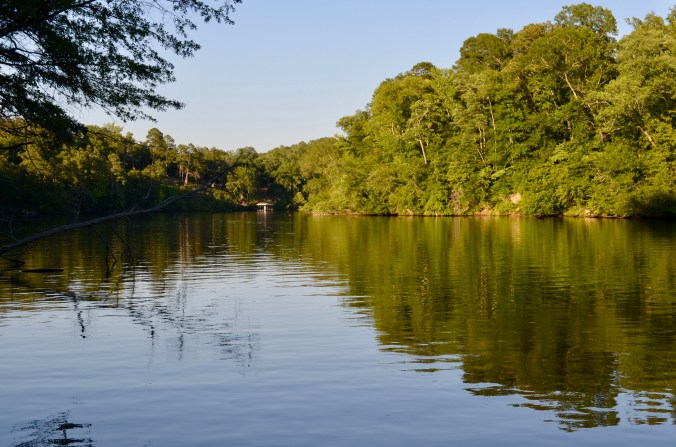
The magnificent Ouachita River runs through the park and guests can rent canoes or small boats or just take to the river’s banks to fish. 

From Barber to Businessman!

Like most high achievers, Frank Phillips was successful in more ways than one.

At the age of 14, Frank headed into Creston, Iowa, a small town near to the farm where he was raised, looking for work. The owner of the Climax Barber Shop, located in the basement of the bank in Creston took Frank on as an apprentice.

Frank’s career as a barber moved quickly. He was a fast learner and had a knack for impressing the right people. He wore fancy, striped trousers and offered fat cigars to his customers. He attracted an impressive range of clients, including the leading banker, John Gibson. Ten years after starting as an apprentice barber, Frank Phillips owned all three of Creston’s barber shops and had married the banker’s daughter, Jane Gibson!

In 1905 Frank and his brother L.E. Phillips were attracted to the Bartlesville, Oklahoma area, by the oil boom and working on their last chance to drill an “oil gusher.” The Anna Anderson oil well came through, as did the next 80 wells they drilled, and in 1917 Frank and L.E. Phillips founded the Phillips Petroleum Company.

Today the company is known as Conoco Phillips and has a headquarters office in Bartlesville and a delightful museum detailing the history of their company and what it has transformed into over the decades.

fullsizeoutput_291f

An exhibit in the Conoco Phillips museum in Bartlesville, near where we have been staying the last few days.


Decopolis!


Tulsa, Oklahoma and Art Deco came of age together. The young city was experiencing unprecedented growth and prosperity in the Roaring Twenties, just as the Art Deco movement came into vogue. Flush with oil money, prominent Tulsans started building skyscrapers that would spur one of the pre-eminent Art Deco collections in the U.S.

There are two major types of Art Deco, streamline and zigzag. Streamline uses simple curved geometry along with aerodynamic shapes, and zig-zag uses angular designs such as triangles and rectangles and highly stylized floral elements composed of simple geometry. As Tulsa boomed and the Art Deco aesthetic evolved through the thirties and into World War II, examples of streamline and zigzag buildings popped up all over town.

Art Deco is notable for creating designs using very basic geometry. The designs can be extremely simple, or when repeated and overlapped, quite intricate. Art Deco also happens to be my most favourite period in design history. I love it for the clean lines, simplicity of design and balance.

fullsizeoutput_291a

Art Deco began as a style that exemplified luxury and new notions of modernity and urban sophistication. Tulsa, where we visited yesterday, was rich and saw itself as a progressive modern city. An Art Deco heritage was born, and we took time out to visit the Art Deco museum which, although very small, was glorious.

fullsizeoutput_291b

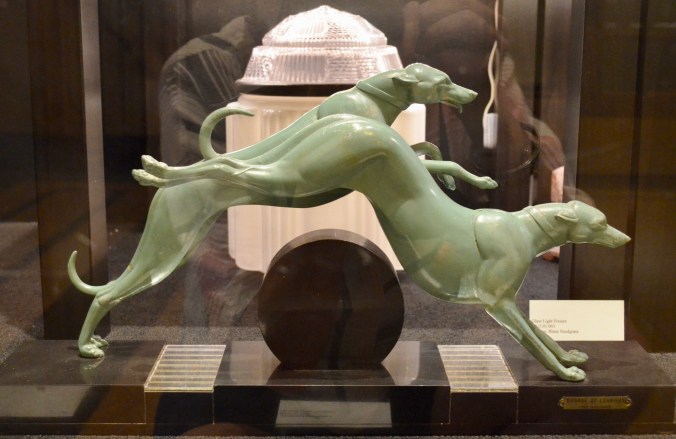
Apologies for the quality of the photograph. Greyhounds are common Art Deco symbols. Although Art Deco often portrayed ideas of modern and urban life, the depiction of animals often evoked a sense of grace, swiftness and speed.

Black Gold!

We are staying near Tulsa in Oklahoma which changed from a small frontier town in 1901 with a population of around 1,300, to a boomtown with the discovery of oil.

Four years later, the Glenn Pool oil field was discovered. The strike created such a large supply of crude oil that it forced Tulsans to develop storage tanks for the excess oil and gas and then pipelines. It also laid the foundation for Tulsa to become a leader in many businesses related to oil and gas and being the physical centre of the developing American petroleum industry.

A second surge of oil discoveries tool place between 1915 and 1930, firmly establishing Tulsa as “Oil Capital of the World.” Thousands of workers arrived from Pennsylvania, Ohio and New York heading to the “black gold” oil strikes. By 1930 the population had soared to over 140,000 with Tulsa’s airport becoming the busiest in the world, surpassing London and Paris. Wealthy oilmen such as J. Paul Getty built stately mansions and beautiful, modern company headquarters.

Following the downturn of the oil industry in 1982-84, the title “Oil Capital of the World” was relinquished to Houston, Texas. City leaders worked to diversify the region away from a largely petroleum-based economy, bringing in blue-collar factory jobs, internet and telecommunications companies and enhancing an already important aviation industry. During this time, customer-service and reservation call centres became an important part of the local economy that was bolstered by an abundant supply of natural gas.

fullsizeoutput_2909

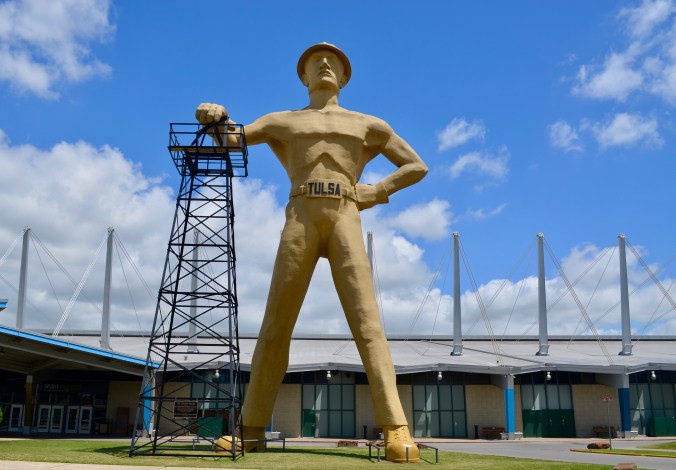
The Golden Driller – built for the International Petroleum Exposition of 1966. 


Wildlife Safari!

Down the road from where we were staying in Ashland, Nebraska, was a conservation park and wildlife safari that no keen photographer, of sound mind, would miss the opportunity to visit!

DSC_0134

American Bison are the largest and heaviest land animals in North America. Known for living in the Great Plains, they were hunted almost to the point of extinction during the 19thand 20thcenturies but have since recovered in population and are no longer as endangered.

Bison can stand five to six-and-a-half feet tall at the shoulder and can weigh over 2,000 pounds. Despite their massive size, bison are quick and are able to run up to 40 miles an hour.

fullsizeoutput_28df

All the American white pelicans at the conservation park are rehabilitated, non-releasable birds due to wing injuries restricting their flight.

Pelicans are colonial breeders, meaning they only breed if living in large numbers. A pelican’s wingspan is some nine feet and their fleshy bill pouch can hold three gallons of water! 

fullsizeoutput_28f6

Second largest of the deer family, exceeded only by moose, elk once roamed through Canada, the US (except Florida) and northern Mexico. They were first called “wapiti,” a Shawnee Indian term meaning “white rump.”

Male elk antlers can reach five feet across and five feet from front to back. Each year, elk shed their antlers to grow another pair.
fullsizeoutput_28f8

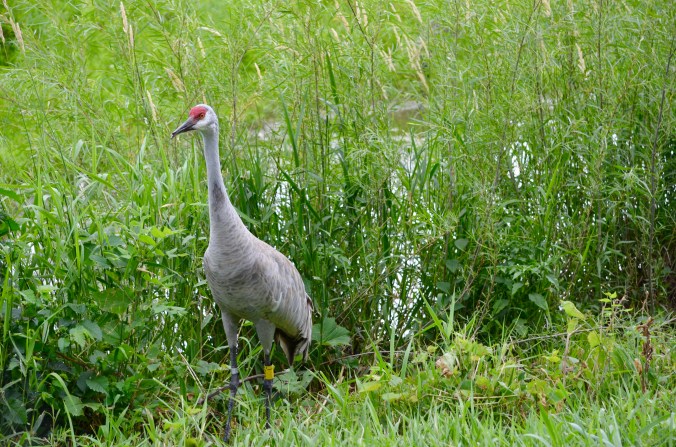
Sandhill cranes are a large and primarily grey bird with a red-skin forehead and white cheeks. They average from eight to 10 pounds, stand three to five feet tall and have a wingspan ranging from five to seven feet.