Happy Mother’s Day!

It is Mother’s Day in the UK, and so I would like to dedicate today’s blog to my Mum. Happy Mother’s Day, Mum!

SCAN0169

Mum around nine years of age!

From Left: Mum aged around 16 years; Mum working – standing in Trafalgar Square, London!

C0047

Mum at our wedding in 2008.

Here we are in Eastbourne, East Sussex last year.

Island in the Sky

The Canyonlands National Park near Moab, Utah is so vast that it is divided into four districts, each separated by the Green and Colorado rivers and with no roads in the park that directly link the distinct areas.

We opted to further explore the Island in the Sky district, where we were yesterday as we barely scratched the surface of what there is to see.

Without doubt, this is the perfect time of year to visit the park as the season really kicks off next week. The daytime temperatures have been a glorious 60 degrees Fahrenheit (15 1/2 degrees Centigrade) which is perfect for exploring; the schools are not on holiday, so the park is comparatively empty; and, one can easily park and get to see the sights and take photographs without having to deal with hordes of other people!

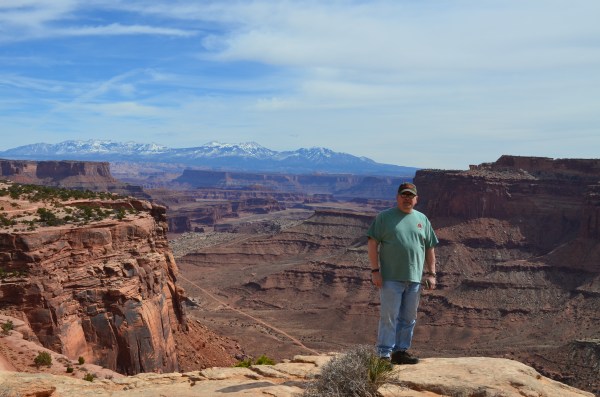
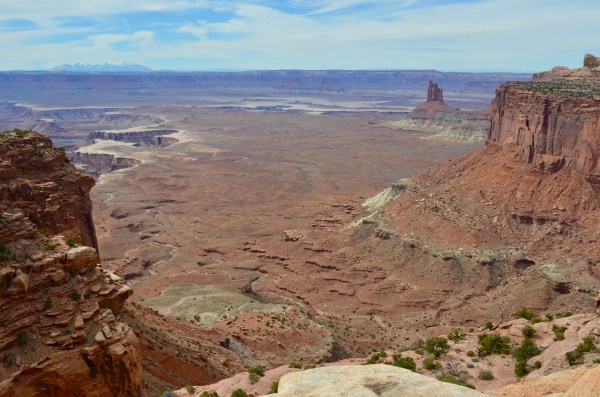
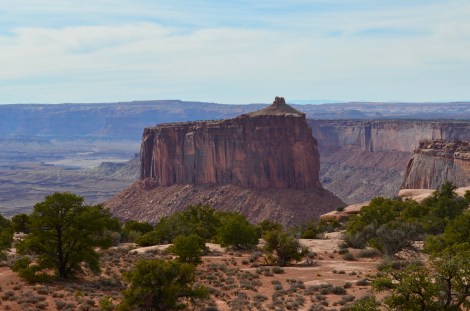
I am not going to bore you further with more geological history of the landscape, but share with you three photographs that I took today that, I believe, visually portray what a great park this is to visit, and this is only one of the sections. We’ll be back!

DSC_0080

Darling, take one more step backwards!

fullsizeoutput_25c9

This was not an official stop! We were driving by and had to take-in the view!

fullsizeoutput_25d2

Looking through Mesa Arch with La Sal Mountains in the background.

Violent meteorite!

We are in Canyonlands National Park today, a whopping 337,000-acre preserve of colourful canyons, mesas and buttes some thirty miles from where we are staying in Moab, Utah.

As with all the other parks we have recently visited, this one has magical scenery that seems to defy the laws of nature, and it is hard to comprehend that water and gravity have been the prime architects of this land, sculpting layers of rock into the rugged landscape seen today.

Our first port of call is Upheaval Dome, the formation of which remains a mystery to this day. However, recent findings support one theory put forward by the scientists.

About 200 million years ago, a meteor hurtled towards the earth. The meteor hit the ground with so much force, that it vaporized on impact. The force of the impact fractured the rock, creating a large crater more than two miles wide. Over time, the rock layers rebounded inward and upward to fill the void, and in due course erosion has exposed the tilted, broken core as a remnant of a meteor impact.

fullsizeoutput_2592

Upheaval Dome in Canyonlands National Park, Moab, Utah.

fullsizeoutput_258c

Mike and I trying not to fall over the unprotected rim of the crater!

fullsizeoutput_2595

A breathtaking butte in Canyonlands National Park!

Mustang Sally!

We spend our day at Dead Horse Point State Park, and, unlike its terrible name, we enjoy yet more magnificent scenery!

Starting from snowmelt over 9,000 feet above sea level in the Rock Mountains of Colorado, the Colorado River flows over level terrain taking on a winding and ever-changing course referred to as meandering. Uplift of the Colorado Plateau nearly 10 million years ago sped up the flow of the river and triggered rapid downward erosion of the river channel. Eventually the river had down-cut to a depth that would not allow a change of course known as an entrenched meander.

As water seeps into the rocks, it dissolves the cementing minerals that bind the sand grains, allowing them to be carried away. The sand grains then enter the flow of the Colorado River and turn the water into an abrasive solution like liquid sandpaper. The fast current of the gritty river carves through the rock, deepening the canyon. Today, the river is 2,000 feet below from where we are standing.

fullsizeoutput_2556

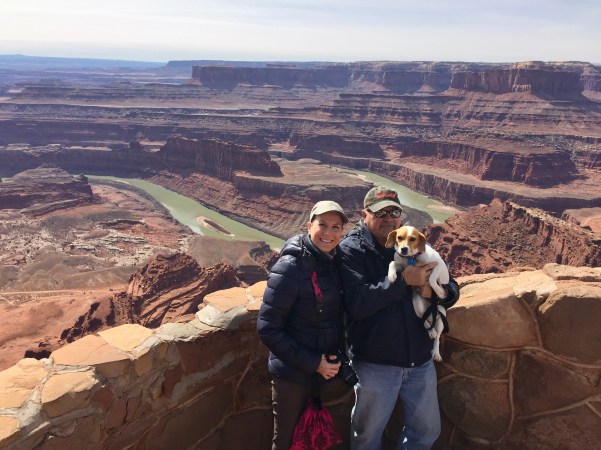
The Colorado River below us. According to legend, Dead Horse Point State Park is named for a ghost horse which can be seen imprinted, in white, on the rocks behind, and to the left of my shoulder. 

fullsizeoutput_2559

The bright blues on the desert floor are solar evaporation ponds for a potash mine. Potash is a potassium chloride, a salt deposited from ancient seas that was buried by other sediments. Water is pumped into the formation to dissolve the salt. The salt water is then deposited into shallow, vinyl-lined ponds where a blue dye is added to speed up evaporation. Once the dry salt is harvested, a local refinery transforms it into plant fertilizer!


Rock solid!

We are now in Moab, Utah and have spent the day at the magnificent Arches National Park where water and ice, extreme temperatures and underground salt movement are responsible for sculpting the landscape.

On clear, blue-sky days, like today, it is difficult to imagine such violent forces, or the 100 million years of erosion that have created this jaw-dropping vision that boasts one of the world’s greatest densities of naturally-created arches!

The arches are formed of Entrada Sandstone which was deposited in the area more than 150 million years ago. Over time it was buried by new layers, hardened into rock and shaped by the powerful forces of erosion.

A series of uplifts and collapses caused severe cracking in the 300-foot (91 metre) layer of buried Entrada Sandstone.

When overlying rock layers eroded away, the sandstone was exposed to weathering; cracks slowly widened and parallel rock walls were formed.

Rainwater continually dissolves the natural cement that holds sandstone together. This process combines with the pressure from water freezing in tiny cracks and causes the sandstone to flake and crumble. Eventually, enough rock falls out so that an opening is formed.

fullsizeoutput_250f

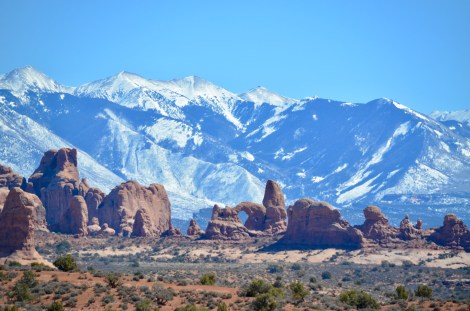
Turret Arch.

Arches National Park, Moab, Utah

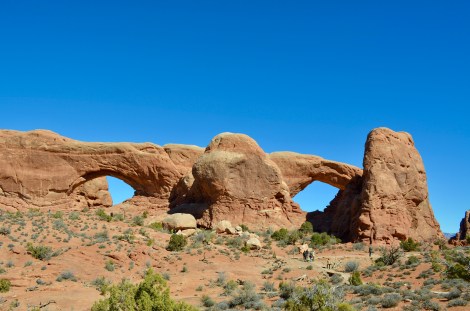
Arches known as Windows North and South.

Arches National Park

This series of rock formations is known as Park Avenue as early park visitors thought that they looked like buildings of a big city!

fullsizeoutput_2511

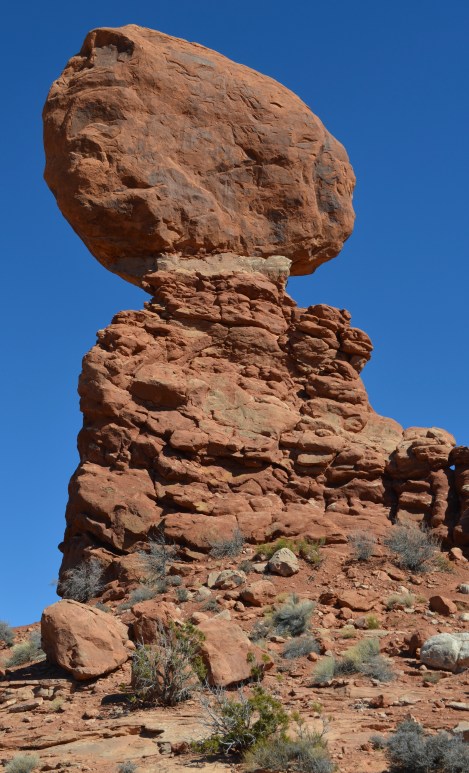
Balanced Rock: the forces of erosion are sculpting more than just arches. The caprock of the hard Slick Rock Member of the Entrada Sandstone is perched on a pedestal of mudstone.


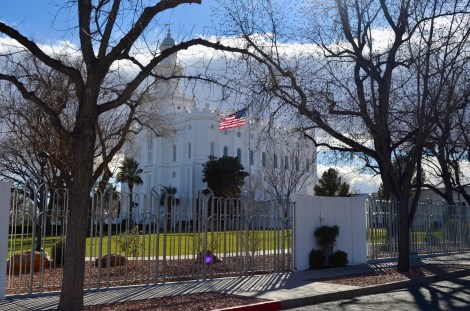
St. George Utah Temple

Mormons are a religious and cultural group related to Mormonism, the principal branch of the Latter-day Saint movement of Restorationist Christianity, developed by Joseph Smith in upstate New York in the 1820s. After Smith’s death in 1844, the Mormons followed pioneer Brigham Young to what would become the Utah Territory, today known as the State of Utah.

In 1871, Brigham Young announced the building of the first temple by The Church of Jesus Christ of Latter-day Saints in St. George, Utah. The project was dedicated in 1877 and was built to satisfy the church’s immediate need for an appropriate place for temple ceremonies and ordinances.

The walls of the temple were built of the red sandstone common to the area and then plastered for a white finish. Local church members worked for over five -and-a-half years to complete the temple. Workers opened new rock quarries, cut, hauled and planed timber and donated one day in ten as tithing labour. Some members donated half their wages to the temple, while others gave food, clothing and other goods to aid those who were working full-time on the building.

fullsizeoutput_2509

The St. George Utah Temple is the oldest temple still actively used by the Latter-day Saints Church. The temple currently has a total floor area of 110,000 square feet (10,200 square metres). After remodeling the interior, the temple was rededicated in 1975.

Sharpshooter Gunlock Will

Another day. Another state park. Another trail! Oh my, I guess we drew the short straw!

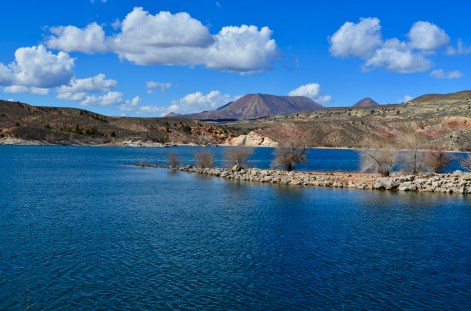
Today we head for the 266-acre Gunlock State Park and Reservoir, located some 15 miles northwest of St. George, Utah in scenic red rock country.

Residents of St. George really do enjoy an outdoor recreational lifestyle as they are blessed with so many state parks where they can hike, cycle, horse-ride, boat, swim and fish. Here at the park and reservoir, the catch of the day is bass and catfish.

The name Gunlock is the same as a small farming community one mile north of the park. William Hamblin (known as Will) was a Mormon pioneer born in Ohio who settled in the area of the lake in 1857. Gunlock Will, as he was known, was a good hunter and sharpshooter, and was skillful in repairing gunlocks, which are the firing mechanisms for muzzleloader guns.

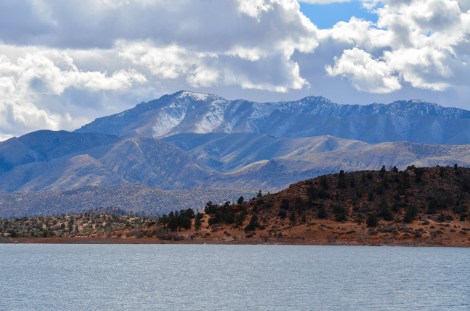
Construction of the Gunlock reservoir dam was completed in 1970 for irrigation water and flood control. The state park was opened to the public in 1970 and like the other parks we have visited since arriving, the scenery was stunningly beautiful. Even though the day was cold, the presence of water and the spectacular view of snow-capped mountains was simply breathtaking.

fullsizeoutput_2502

Gunlock State Park also has camping facilities; imagine waking up to this view!

fullsizeoutput_2503

A view across the reservoir to the snow-capped mountains.


Butch Cassidy and the Sundance Kid!

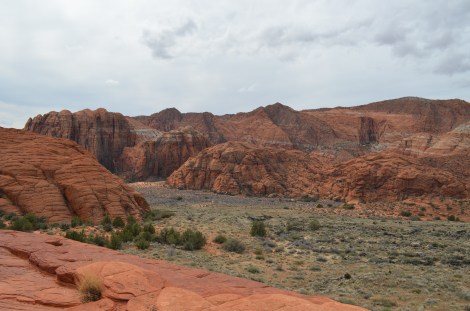
Snow Canyon State Park, where we spent our day, is a 7,400-acre scenic part tucked in between lava flows and soaring sandstone cliffs in a strikingly colourful desert environment just outside St. George, Utah.

Transported by wind more than 180 million years ago, tiny grains of quartzite sand covered much of what is now Utah. These sand dunes, up to 2,500 feet thick, eventually cemented into stone. Burnt orange to creamy white in colour, Navajo sandstone is the predominant rock, and what remains of the ancient desert sands.

Over time, water cut and shaped the sandstone to form canyons. Approximately 1.4 million years ago, and as recently as 27,000 years ago, nearby cinder cones erupted causing lava to flow down these canyons, filling them with basalt. The lava flows redirected ancient waterways which eventually began carving new canyons. As you look up, you can see lava-capped ridges that were once the floors of canyons!

Snow Canyon averages 7.5 inches of rainfall each year and vegetation includes desert adapted species such as creosote bush, narrow leaf yucca, sand sage and black brush.

fullsizeoutput_24de

Me and the intrepid explorer Miss Poppy sitting on one of the many petrified sand dunes.

DSC_0091

Where you see the light green on the photo is where lava once flowed!

fullsizeoutput_24ee

Snow Canyon State Park was the site of the Hollywood film Butch Cassidy and the Sundance Kid!

Outsized geology!

Located in southwestern Utah, near the Arizona and Nevada borders, the Zion National Park is a celebrated premier attraction. And, no wonder! We spend the day there enjoying the spectacular scenery!

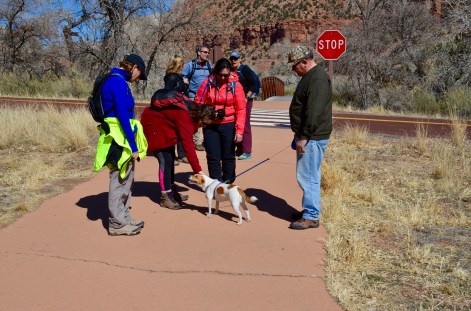
We hike the Pa’rus Trail, a 3.5 mile walk that is paved and is the only trail where dogs are permitted. Miss Poppy is in paradise, enjoying a long walk in the sunshine, checking out all the new aromas of the trail and making lots of new friends!

In contrast to the open vastness of The Grand Canyon, Zion’s vertical scenery is within touching distance. There are trails for every level of fitness, traversing eons of deposition and erosion that are creating the world’s outsized geology.

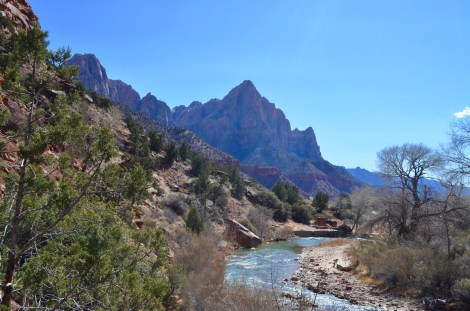
The Virgin River, which we are following, is a deceptively tranquil stream and also a relentless agent of change. During spring runoff or after a rainstorm, the waters fill with particles of sandstone. The current carries an average of 5,000 tonnes of rock fragments daily – evidence that the river not only carved Zion Canyon but continues to widen and transform the canyon scenery.

In off-season, visitors are allowed to drive their own cars through the park. The drive is stunning and without too many others around, we are able to stop and take pictures.

fullsizeoutput_24d2

Less than a mile from where we start, Bridge Mountain (far right) rises 2,800 feet above the canyon floor. 
fullsizeoutput_24d6

The Virgin River plays a dual role in this desert terrain. As a life-giver, this year-round flow promotes a rich community of water-loving plants and associated wildlife, from kingfisher to mountain lion.

fullsizeoutput_24d7

Stunning scenery in every direction!

fullsizeoutput_24d5

Miss Poppy-dog recruiting new members of her fan club!

Jurassic Park!

We are now in St. George, Utah where we visited the Dinosaur Discovery museum which was amazing!

Cast your mind back to the earliest Jurassic Period, about 198 million years ago, when southwestern Utah was home to the large, freshwater Lake Dixie. The lake hosted a vibrant ecosystem including dinosaurs and mammal ancestors who roamed along the lake shore amid a variety of plants.

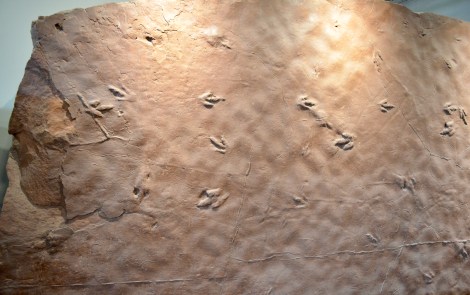
A dinosaur walking along the shores of the lake made natural mold footprints in the soft mud and silt. The sheer weight of the animal deformed not only the top layer of sediment but also soft layers beneath.

After the footprints were made, the sediment dried out, making the upper layers firm enough to resist relatively gentle weathering forces and protecting the underlying layers below.

Rising water levels deposited sand in and over the footprints, burying them and forming natural casts. Over the next 200 million years, the sediments were compacted and cemented together, becoming shale, mudstone, siltstone and sandstone.

When separated from the softer mudstone, siltstone and shale, the natural casts in sandstone appear to be “inverted” footprints. They are actual, naturally formed replicas of dinosaur feet made entirely from sediment!

fullsizeoutput_24c6

The first dinosaur tracks were discovered by Dr. Sheldon Johnson in February 2000. He went on to create the museum building it on the location of his initial discovery which was once the shoreline of Lake Dixie.

fullsizeoutput_24c9

The specimen above is the largest single block of dinosaur tracks ever collected. By measuring the length of each track in a trackway and the length of one stride, paleontologists can calculate how fast the dinosaur was moving when it made the tracks.