Near today’s city of Aztec in New Mexico, early farmers took advantage of the Animas river’s year-round water. Ancestral Pueblo people had long-lived in the Four Corners Region (consisting of the southwestern corner of Colorado, southeastern corner of Utah, northeastern corner of Arizona and northwestern corner of New Mexico), and sometime late in the 1000s, a group began building a large complex near the river.
When construction ceased two hundred years later, the community consisted of great houses, small residential pueblos and Kivas (round builds). The formal layout of the settlement and the orientation and visual relationships among the buildings indicate a grand design.
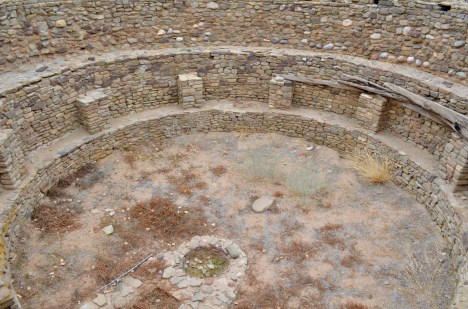
Archeologists believe Kivas were public buildings that may have brought together different clans for ceremonies and other functions. In 1916, Earl Morris headed the first dig at Aztec. He spent the next seven years excavating and stabilizing much of the site which had been derelict since the people left in the late 1200s.

The largest of the houses had at least 500 rooms that rose three stories high. Excavation revealed original roofs with centuries-old wood and vast deposits of well-preserved artifacts.

Some of the wonders of the buildings are the impressive architecture, fine masonry and high-quality building materials, all of which you can see in this wall. The strong centre of the wall is constructed using rough stones and a lot of mud mortar. This technique allowed them to build taller walls with a fine shaped sandstone on the outside which gave the wall a beautiful finish. The people of Aztec incorporated lines of green stone within some walls, the meaning of which is unknown to archeologists.
 The Blogging Brit