Grapevine Canyon!

We went off-roading again today, which, to our amazement, was Miss Poppy-dog’s favourite pastime! She is a true explorer! We couldn’t keep her on the agreed paths, she was off sniffing, climbing and having the time of her life! Who knew!

Grapevine Canyon is located in Spirit Mountain, some eight miles from our RV park, and is one of the earliest and largest sites for petroglyphs – images carved or scratched onto rocks in Southern Nevada.

The remote canyon is sacred to the Yuman and Numic speaking tribes, indigenous to the area. The springs and plants in the canyon attract people and many animals including bighorn sheep which are an integral part of this unique landscape.
fullsizeoutput_24af

The native rocks are darkened by desert varnish and are covered with hundreds of petroglyphs and, even though the day was cold, overcast and rainey, the canyon was truly amazing and we are so glad that we visited!


Chasing Cacti!

We took the Jeep today and went off-roading across the Newberry Mountains in southern Nevada!

About seven miles west of Laughlin, Nevada is the entrance to Christmas Tree Pass. The 12-mile graded, dirt road of the pass, winds up and through a ruggedly beautiful canyon rich with flora and fauna.

The scenery is breathtakingly beautiful. The rock formations rise majestically into the blue sky, forming shapes which, with a little imagination, can look like animals or Disney characters!

We park the Jeep, and conscious that the snake population will be out sunning themselves on the rocks, we leave Miss Poppy in the comfort of the car while Mike and I head into the wilderness chasing Cacti, a favourite plant species of ours.

The canyon is part of the Lake Mead National Recreation Area and the dirt road ends south of a tiny town called Searchlight, Nevada.

fullsizeoutput_24aa

Mike and I with prickly Peter!

The magnificent scenery of Christmas Tree Pass.

DSC_0163

Miss Poppy: comfortable and safe in the Jeep while Mike and I explore our surroundings!

Laughlin’s Classic Car Collection

In 1931, Don Laughlin is born in Minnesota and works winters during his youth as a fur trapper. With the profits he buys slot machines for installation in hunting lodges.

Laughlin moves to Las Vegas, Nevada in the 1950s, and buys his first casino, the “101 Club.” While flying his private plane over the California/Arizona/Nevada tri-state area near the Colorado River, he sees the potential for a resort destination. Soon after his flight, he buys an eight-room riverfront motel on 6 ½ acres for $250,000.

In less than two years, the Riverside Resort is entertaining guests with gambling and all-you-can-eat chicken dinners for 98 cents. Play at the casino is on twelve slot machines and two live gaming tables and accommodations are available in only four of the motel’s eight rooms; Laughlin’s family occupies the remaining four.

A US Postal Service inspector asks Laughlin to give a name to the area post office in order to receive mail. Laughlin suggests Riverside and Casino but the inspector suggests Laughlin because of their common irish heritage!

Today, Laughlin’s original site has developed into the Riverside Resort Hotel & Casino in Laughlin, Nevada with over 1400 rooms, a bowling centre, restaurants, shops and an exhibition of the Classic Cars he collected over the years. Mr. Laughlin lives in the Penthouse Suite on the top floor of his hotel.

fullsizeoutput_1516

Above: a rare 1955 Ford Thunderbird. This car is considered an almost perfect Thunderbird and in 1982 its appraised value was $100,000!

 fullsizeoutput_1518

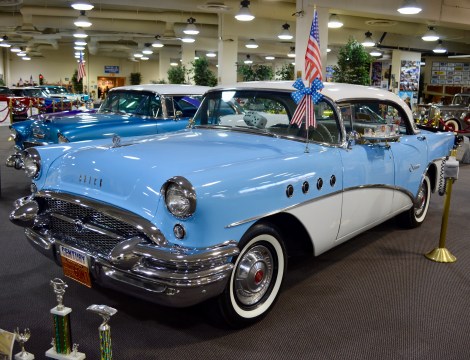
A 1955 Buick Century, four-door Riviera. The cost of it new was $3,175.

London Bridge, Arizona!

In 1964, Robert McCulloch, chairman of McCulloch Oil Corporation, founded a retirement development project on the east shore of Lake Havasu, a large reservoir on the Colorado River in northwestern Arizona, some two hours’ drive from Las Vegas.

The one problem with McCulloch’s plan is that estate agents can’t attract prospective buyers because the land is far from population centres and has a very hot and arid climate.

McCulloch’s estate agent learns that London Bridge, spanning the River Thames in England, is no longer sound enough to support the increased load of modern traffic crossing it every day and is for sale. He convinces McCulloch to buy it and bring it to the Lake Havasu area to attract prospective land buyers.

In 1967, the bridge is dismantled, its facing stones are each numbered and transported to a quarry in Devon in England where some five to nine inches (12 to 22 cm) are sliced off many of the original stones.

The bridge arrives in pieces at the Port of Long Beach, California and is transported overland to Lake Havasu City, where re-assembly begins.  On September 23, 1968 London’s Lord Mayor, Sir Gilbert Inglefield, lays the foundation stone.

fullsizeoutput_150b

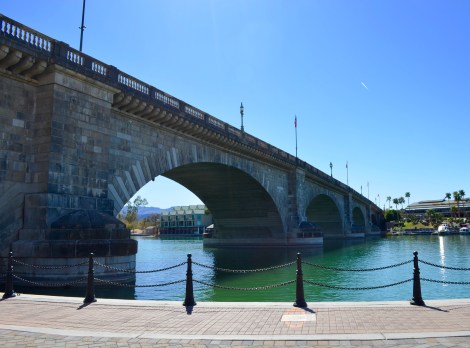
Today, London Bridge in Lake Havasu City is a reinforced concrete structure clad in the original masonry of the bridge that once spanned the River Thames in London. 

fullsizeoutput_1511

Reconstruction of London Bridge in Arizona takes over three years and the project is completed in late 1971. The bridge links an island in the Colorado River to the main part of Lake Havasu City.

T-Rocks

We are on the move today from Tucson to Bullhead City in Arizona. En route, we stop in the quirky little town of Quartzite, Arizona to visit T-Rocks, a geologists’ mecca!

Oh my, what an amazing selection of raw and polished crystals, minerals, fossils, petrified wood, glass and so much more! One can purchase Geodes that can be cracked for you on site!

Not that we are shopping for anything, but we buy a piece of Madagascar petrified wood which was once-living wood which has now been turned to stone. When the wood is buried under mud, sand and volcanic ash, solutions dissolved in the groundwater slowly infiltrate its cells, and by a complex chemical process which takes place over millions of years, the wood is replaced by the mineral quartz.

We also buy a Trilobite fossil! A Trilobite was a bug-like animal with a soft segmented body held together by an external skeleton. It roamed the oceans for over 270 million years but became extinct during the Paleozoic Era, 240 million years ago!

The quirky part of Quartzite is found in the Reader’s Oasis Bookstore which is owned by an ageing hippy gentleman called Paul Winer who wanders around his shop, and the town, wearing only a thong! As we were in the motor home and towing the jeep, we were unable to get into the car park to visit and so, no photo … perhaps that is a good thing!

fullsizeoutput_1500

fullsizeoutput_14ff

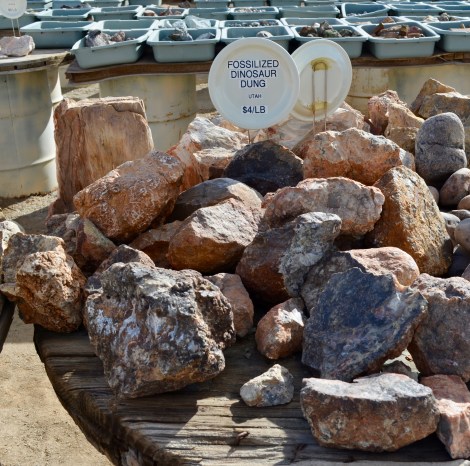
Nothing like a piece of fossilized dinosaur dung to adorn your home!


It’s a kind of magic!

There are 315 Tiffin motor homes parked at this rally and by noon tomorrow we all need to have left! This fact worries us!

When we arrived, there was a team of folks, volunteers like us, who directed us to where we needed to park and then guided Mike to enable him to park in our allocated space. It was not easy and he certainly did a great job. Tomorrow morning, there is no one directing anyone and it causes us concern because we are packed in to every available space there is!

In asking folks how it works, everyone just smiles, knowingly, and says that it happens, like magic! All 315 owners needs to pull the motor home out of its various space, move to somewhere where we can attach our tow vehicles, before finally pulling out of the fairgrounds and heading to our next location.

Perhaps by tomorrow night, I too will be a Houdini believer … I’ll let you know!

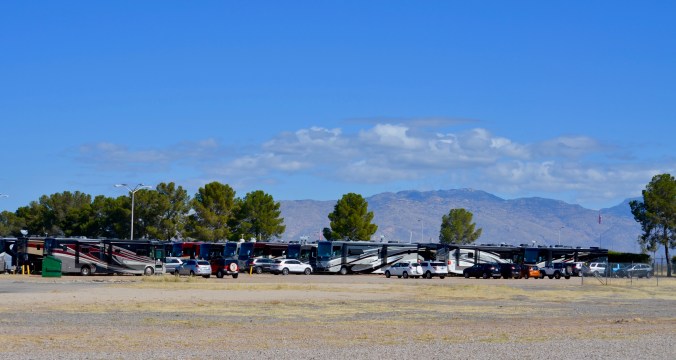
I have spent a few days taking photographs of the motor homes that are parked everywhere here at the Pima County Fairgrounds in Tucson, Arizona. Without a drone, or renting a helicopter, I am unable to depict the true scale in one image, but below are several not so good photos to attempt to show what 315 motor homes, each with a tow vehicle, looks like parked at one site. The photos certainly don’t do justice to the scale of the operation so please add in a heaped tablespoon of imagination!

DSC_0138

Volunteering at Tiffinville

When Mike and I signed up for this Tiffin rally, we also signed up as volunteers to help the organizers in whatever way they needed assistance – parking, registration, transportation, seminar assistant, to name a few tasks.

Those wishing to volunteer are asked to work up to three hours a day and to have a skill set that includes: the physical ability to walk, bend, sit and stand as necessary during their given shift, strong communication skills, patience, flexibility and kindness!

Predominantly, Mike and I have been assigned as golf-cart drivers, ferrying people around the vast Pima County Fairgrounds just outside Tucson in Arizona where the rally is taking place. Rides to lunches and dinners are very popular for the 30 minutes before and after meal times and especially for this rally as the weather has been unseasonably cold and windy, and folks attending are retired and their physical fitness spans a wide spectrum!

But, it has been great fun and a wonderful way to meet so many different people, all of whom have been absolutely delightful. Needless to say, once my accent is noticed it creates an immediate focus and the subject changes to impersonations of how the English talk, the Royal Family, Benny Hill and the real value of roundabouts!

fullsizeoutput_14f5

Me at work today. My fellow volunteers tease me mercilessly about driving the golf cart on the wrong side of the road!

Tiffinville, Arizona!

The basis of this latest road trip is focussed around our attending a Tiffin motor home rally in Tucson, Arizona.

What is a Tiffin rally! Well, Tiffin is the manufacturer of our motor home. It is a family run business based in Red Bay, Alabama which started back in 1972. Part of the lifestyle for motor homers, is the people and the camaraderie of those whom you meet along the way. And, way back when, the Tiffin team decided to organize an event, invite Tiffin motor home owners to come together, learn something through attending seminars, make new friends through social events and offer owners the opportunity to spend time with like-minded folks.

The idea took off and today, the Tiffin team organize three rallies each year, one out west (aka this one in Tucson), one in the centre and one in the east of the US. Each rally accommodates 300 Tiffin motor homes and the event runs from Monday to Friday. Here’s an amazing fact, this rally sold out in 2.5 minutes! Imagine that! Three hundred motor home owners signed up the minute the rally website went live and in under three minutes it was sold out!

fullsizeoutput_14f0

After dinner tonight, we were entertained by an English Father and Son duo, Terry & Nick Davies – pictured, whose stage name is the Piano Men Generations, and who performed a medley of songs by Elton John and Billy Joel. They were absolutely fantastic, and the Dad, Terry, doubles as a comedian!

Stalactites and Stalagmites

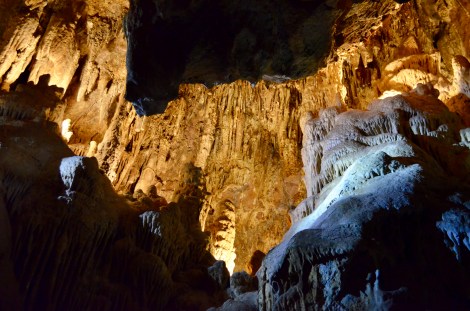
The Colossal Cave Mountain Park on the outskirts of Tucson, Arizona is one of the largest dry caves in North America, which maintains a pleasant seventy degrees Fahrenheit temperature all year round. Located in the Rincon Mountains at an elevation of 3,700 feet, the entrance commands a panoramic view of the Sonoran Desert.

The cave is not fully explored, but scientists estimate that there are at least 39 miles of natural tunnels inside the cavern. Due to the enormously complex, three-dimensional maze, it took over two years to map the two miles of passageways that are fully explored.

Groundwater seeping through limestone formed the cave. Over millions of years, stalactites, stalagmites, columns and draperies formed slowly from water dripping from the ceiling. As the climate became more arid, the cave gradually dried up. Today, Colossal Cave is “dry” and the formations are no longer growing.

According to legend, the cavern served as a bandit hideout twice in 1887, after two train robberies. According to rumour, up to sixty thousand dollars were hidden away in the cave and later retrieved by one of the robbers.

fullsizeoutput_14e9

The cave was officially discovered in 1879, but artifacts and soot-blackened ceilings testify to use by prehistoric cultures.

fullsizeoutput_14eb

Water flow that over millions of years now resembles draperies or curtains!

Extreme living!

Desert extremes would wither most plants, but not cactus. Able to withstand infrequent rain and harsh temperatures, each employs its own strategy for survival.

Gently sloping alluvial hills below the Tucson Mountains in Arizona create the ideal habitat for 25 different species of cactus which grow here, the most famous of which is the saguaros, that grow in stands so dense that they’re known as cactus forests.

Saguaros grow very slowly at first – an inch or so during their first six to eight years. It may be 70 years before they sprout branches, known as arms. They reach full height, 40-50 feet, at about 150 years and some may reach 75 feet with long, woody ribs which support their multi-tonne bulk.

Seedlings have the best chance of survival when sheltered by “nurse trees” like mesquite, ironwood or palo verde. As rain falls, the saguaros cactus collect water through shallow roots extending about as far outward as the main trunk is tall. As the cactus soaks-up water, accordion-like pleats in its trunk and arms expands to allow for storage in the spongy flesh.

In early summer, cream-coloured flowers appear and white-winged doves, lesser nosed-bats, honeybees and moths feed on the nectar and pollinate as they go. In July the saguaros produce deep-red fruit providing food for both animals and humans.

fullsizeoutput_14e5

Me at the Saguaro National Park in Tucson, Arizona pictured with a saguaro cactus that is 102 years of age! 

Pictured left: a Fish-hook barrel cactus; right: a Chain-fruit cholla cactus, part of the cactus family of the Saguaro National Park which was an absolute delight to visit.