Vincent Van Gogh!

Born on March 30, 1853, Vincent Van Gogh would be tormented by severe mental instability for the majority of his life, die from his own hands, and ultimately change the outlook on art for the rest of history.

In 1886 Van Gogh moved to Paris where his art began to take on the style that would make him famous. He was using more color, applying the paint with thick, bold brushstrokes, and painted all that surrounded him. Van Gogh arranged to show his work, to positive reviews, but was still unable to sell any pieces.

Van Gogh moved to Arles in the south of France where he entered the most productive and creative period of his life painting his famous Sunflowers. However, it also was a time of great turmoil for him beginning a period of hospital stays for mental illness and physical decline.

After just ten years of painting and producing some 900 paintings, Van Gogh took his own life in 1890. Never fully appreciated in his own time, it wouldn’t take long for the art world to recognize the genius they lost. Within twenty years of his death, there were memorial shows of his works all over the world – influencing generations of artists to come.
IMG_1439

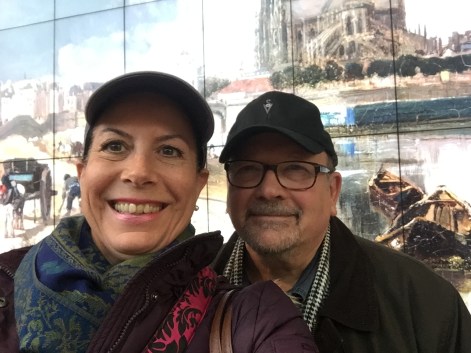
Michael and i at the Van Gogh museum in Amsterdam.

Herr Herring!

One of the most popular snack foods to eat in Amsterdam is “raw” herring which you traditionally grab by its tail, throw back your head and lower the fish into your mouth while biting off tasty morsels!

In reality, the fish is not really “raw.” First of all, it is partially gutted on board the fishing vessel, it is then salted, and frozen for a minimum of two days which affects the taste of the fish and its tenderness: the freezing process ensures that no parasites remain alive as the fish is not cooked before it is served.

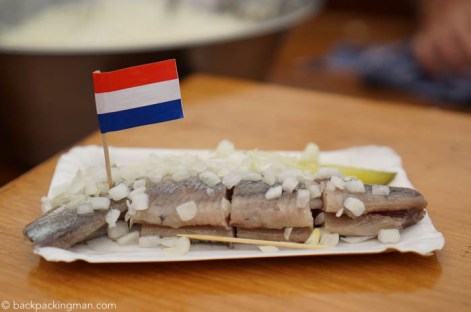
After the fish is defrosted, the herring is further cleaned and prepared at stalls when customers order it. The fish stands will slice the herring into small pieces and place it on a card dish with raw onions, pickles and a tooth pick sporting the national flag which serves as the utensil to eat the herring. As to the taste, well, if you like sushi, you’ll love it and it’s also good for you as it has cholesterol-lowering properties!

Herring fishing occurs all year round, but the fat content, which impacts the taste of the fish, varies with the season. The best herring is called “Holland New” which indicates that fish has been caught between the middle of May and the end of June. Earlier in the year and the fish is too thin, and later it is too fat. By law, “Holland New” must have at least 16% fat.

fullsizeoutput_12d3

Mike and I had lunch here yesterday – herring, smoked salmon, cooked flounder and shrimp! Great family-owned fish shop right by a very busy market.

herring-albert-cuyp-market-amsterdam

National delicacy: sliced herring served with onions, pickles and a tooth pick which doubles as a utensil!

Master Rembrandt!

Today, four of our intrepid travelers spent a number of glorious hours at the magnificent Hermitage Museum in central Amsterdam. With a number of exhibitions on display, we were able to gaze at masterpieces until our non-artistic brains froze in appreciative overload!

Rembrandt was born in 1606 in Leiden, a town in the southern province of The Netherlands. He died some sixty year later, an alcoholic and a pauper but leaving behind a legacy that still dazzles anyone who is lucky enough to view his works.

Following a number of years at a Latin school, Rembrandt is enrolled at Leiden University at the age of 13. However, this is not a good fit, and after only a few months, he leaves to pursue his true love of painting and becomes apprenticed to an artist.

In 1624, Rembrandt relocates to Amsterdam to work with Pieter Lastman, a painter of biblical, mythological and historical scenes with an eye for a landscape. From Lastman, Rembrandt learns how to paint faces, hands and feet………. this is his real introduction to portraits and what he is best known for as an artist.

When you stand six inches from the canvas, the brush strokes he uses to create a depth to the subject matter is mind-blowing; his painting technique introduces light and movement which so many of his contemporaries are unable to do; and he somehow conjures up a three-dimensional effect with the colours he selects.

fullsizeoutput_12ce

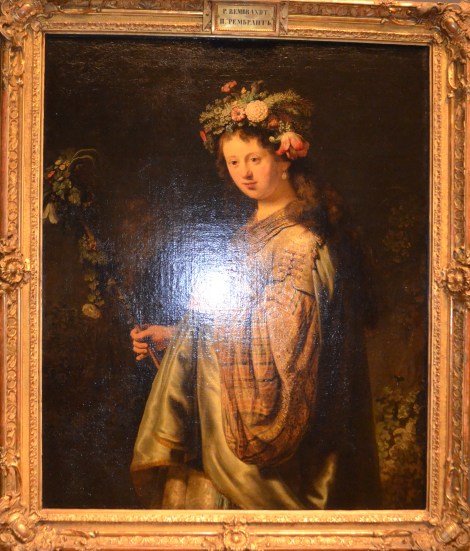
In 1934, Rembrandt paints his young wife Saskia as Flora, the Roman goddess of spring, youth, flourishing nature and fertility. With her left hand, she gathers the heavy folds of her cloak around her stomach intimating to the viewer that she is pregnant. When you look really closely at Saskia’s left hand and pearl earring, you can see that Rembrandt has in fact moved both, yet the outline of where her hand and earring were originally located remain visible at close quarters!

 fullsizeoutput_12c2

A selfie with Rembrandt! From left: Mr. Bob, Uncle Mike, the blogger and Chris!

The World’s most famous Anne!

Anne Frank was born on June 12th, 1929 in Germany to parents Otto and Edith Frank, and an older sister, Margot.

With Hitler’s rise to power, and a growing level of anti-Semitism, Otto decides that it’s time to leave his home town and take his family to somewhere safer – Amsterdam, The Netherlands. Otto sets up a business in Amsterdam, the family finds a new home and the girls attend school.

On September 1st, 1939 Germany invades Poland and it is the start of World War II. For a while there is hope that The Netherlands will remain neutral, but on May 10th, 1940 German troops invade the country and five days later The Netherlands surrenders and is occupied.

Anti-Jewish regulations soon follow. Jews are allowed into fewer and fewer areas of the city, their bicycles and cars are confiscated, they are forced to re-locate and live in dedicated Jewish areas, display a Star of David on their outer clothing and live by ever-increasing laws and restrictions. Otto’s business is confiscated.

Together with his Jewish business partner, Otto and his family go into hiding on July 6th, 1942 in the rear annex of his business premises. One week later they are joined by another three-member Jewish family and an eighth person joins them later in the year.

Shortly before going into hiding Anne receives a diary for her birthday. She starts writing straightaway and during her time in hiding she writes about events in the secret annex and about herself. Her diary is a great support to her.

Tragically, after more than two years in hiding, the Frank family and their friends are discovered and deported to concentration camps. Anne’s father, Otto Frank, is the only one of the eight people in hiding to survive.

After her death, Anne becomes world-famous because her father ensures that the diary his daughter wrote while in the annex is published.

Let’s Talk about Sex, Baby!

Boulangerie: a shop where you buy bread!

Patisserie: a shop where you buy cakes!

Condomerie: a shop where you buy condoms!

Welcome to Amsterdam’s Red Light district!

The area is a network of alleys containing some three hundred small, one-room shop-fronts, rented by female prostitutes who offer their services from behind a window or glass door which is, typically, illuminated by red lights (or blue lights which indicate that the prostitute is a transvestite). The area also offers sex shops, theatres, peep shows, museums – one dedicated to sex, one to prostitution and one to erotism – plus a number of “coffee shops” that sell cannabis.

Amsterdam prides itself on its liberal and tolerant attitude, embracing the fact that people may be into prostitution, soft drugs and pornography – and that it is only human. So instead of criminalizing everything, they enjoy the honesty of it all, or so they say!

Prostitutes in the Netherlands are also taxpayers. As a legal profession, the government ensures that all prostitutes are able to access medical care and work in better conditions by regulating and monitoring working practices and standards. Help is also at hand in the district itself thanks to the prostitution information centre and, contrary to popular belief, the Red Light district is one of the safest areas in Amsterdam.

Top Left: a “condomerie”, Miss Vivienne makes her blogging debut, a view of the Red Light district and a “Sex Palace”. It is strictly forbidden to take pictures or film women behind their windows. 

IMG_1402

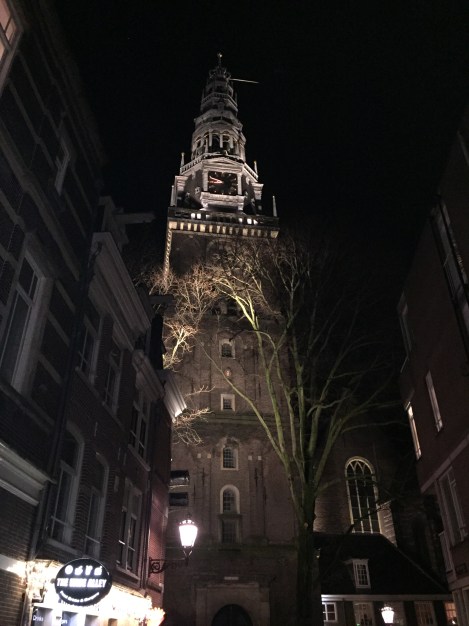
In the middle of the Red Light district is a magnificent 14th century building known as the Old Church.

Dutch Courage!

Yesterday, Mike, Mr. Bob and myself traveled by train from Cologne to Amsterdam in the Netherlands where we will be staying a week. We were joined by Uncle Mike who flew in from Chicago, and today, Chris, my stepson, arrived from Houston!

Bols is the oldest distillery in the world which has been brewing liqueurs in Amsterdam since 1575. Their first flavours were Cumin, Cardamom and Orange!

Fast forward about 100 years, and it was Lucas Bols, grandson of the Founder, who began to ship the family’s liqueurs all over the world. Not only that, but he was also a major shareholder of the Dutch East India trading company which gave him the privilege of first choice of newly arrived exotic herbs and spices. This helped him create over 300 liqueur and spirit recipes which turned the family business into a world-famous brand.

Lucas Bols must also be credited with leveraging the family’s experience in the process of distillation by producing genevers, or Dutch gin, made from long fermented Rye, Wheat and Corn. In 1820, Bols master distillers introduced a revolutionary new recipe based on malt spirit, neutral grain alcohol and botanicals which proved to be perfect for a new phenomenon in America, the cocktail!

The story goes that the expression “Dutch Courage” came to be after English soldiers fighting in the Anglo-Dutch wars (1652 to 1674) noted the bravery-inducing effects of genever on Dutch soldiers. The English set about making their own version, Gin, which would become popular in England thanks to King William of Orange who was also head of state of the Netherlands!

From left: Mr. Bob and Chris at the “House of Bols” exhibition and taste experience!

Cologne’s Christmas Markets

The Christmas markets in Cologne have to be the best we have visited in Europe, to date! They are beautifully laid out, each vendor with an individual, wooden “hut” from which to sell their products, and not touristy rubbish, but high-quality goods such as hand-crafted wooden tree decorations depicting scenes of Cologne, hand-made leather belts, intricately carved clocks, pure-butter biscuits in branded tins, candles, hats, scarves, gloves, and so on.

Each of the markets is heavily biased towards selling food and drinks such as hot Gluhwein to keep-out the cold; Gluhwein is a spiced red wine that is a popular drink in cold European countries which I remember enjoying on skiing holidays; hot eggnog laced with rum and served with a big dollop of cream on top; beer, of course; deep-fried potato cakes served with mustard; brats (sausages) of every description known to man served in buns with lashings of sauerkraut; hot smoked salmon sandwiches; and, cheese served every which way – hot and spread on rye bread, sliced thickly and wedged in rolls, in sauces covering ham, salami and whatever else comes to hand! It’s made my mouth water just writing about it!

Some of the markets have ice rinks and merry-go rounds for children; many have stages where bands and choirs entertain the crowds. And, all of the markets we visited were jam-packed with families, friends and workers all enjoying whatever was on offer and barely a tourist in sight, apart from us!

The experience really has been magical!

Pretty entrances to the markets!

Drinks stands and vendor units.

Mike and I enjoying an eggnog!

fullsizeoutput_1281

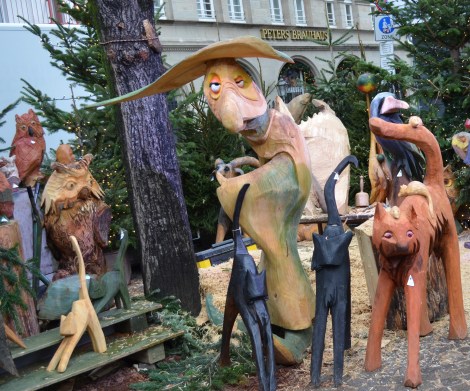
Magnificent hand-carved wooden animals for sale!

The Gifted Family Nose!

From birth, Johann Maria Farina, an Italian perfumer, was fascinated by the different smells that tickled his nostrils on visits to Rome and Venice. Farina was driven to follow his nose and was always swirling glass vessels of fragrant liquids and trying out new scents and essences!

In 1709, Farina made his new fragrance world-famous by naming it Eau de Cologne, meaning “Cologne Water”, in honour of his new German home-town of Cologne.

Farina’s Eau de Cologne was used only as a perfume and was delivered to nearly all the royal houses in Europe. His ability to produce a consistent fragrance utilizing dozens of essences was seen as a sensation at the time resulting in a single vial costing half the annual salary of a civil servant.

Back in the eighteenth century, there was no trademark organization with which you could register your new product, and it was not long before “4711 Original Eau de Cologne”, named after the location where it was developed, appeared on the Cologne market, and remains today one of the oldest fragrances still produced. Nowadays, “cologne” is used as a generic term for perfumes for men or women, but it conventionally refers to those usually marketed towards men.

fullsizeoutput_123e

The Farina House is now run by the eight generation of the Farina family. Farina’s scent contains a secret combination of citrus oils such as lemon, orange, bergamot (an inedible lemon) and lime in addition to those of violet, jasmine, sandalwood and frankincense.

Museum Ludwig

In 1976, private collectors Peter and Irene Lud­wig, alongside representatives from the City of Cologne, signed an agreement to develop Museum Ludwig which would house a donation of some 350 works of art from their private collection of modern art. This was the kick-start the museum needed, and over the years it attracted other donations and sought works for purchase to build it collections.

After her husband’s death in 2001, Irene Lud­wig do­nat­ed an ad­di­tio­n­al 774 works by Picasso catapulting the Museum into the heady ranks of housing the third largest col­lec­tion of Picasso’s works in the world.

Today, the museum houses an impressive collection of the most significant trends of twentieth-century and contemporary art including a focus on “pop art” including important pieces by Andy Warhol. At the time of our visit, we enjoyed viewing a special exhibition of the works of American-born, Pop artist James Rosenquist. The ex­hi­bi­tion pre­sents the artist’s rich­ly col­oured works to­gether with col­lages and archi­val ma­te­rials which served as the ba­sis for his of­ten monu­men­tal works.

fullsizeoutput_123a

Us in the Andy Warhol exhibition. From Left: Mr. Bob making his blogging debut, Mike and me taking the photograph that you’re looking at!

Works by Pop artist James Rosenquist who died in March 2017.

Dom Cathedral

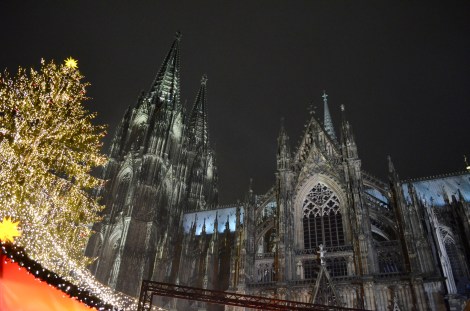
Rising over 500 feet into the sky, the twin spires of Cologne’s Dom Cathedral are Germany’s tallest and most visited landmark which is now a World Heritage Site attracting some 20,000 visitors a day!

Construction of this renowned monument began in the 13th century, was halted two centuries later due to lack of funds, re-started in the 19th century and completed, to plan, in 1880!

In World War II, the cathedral suffered fourteen hits during aerial bombing raids by the Allied Forces, and, although badly damaged, it remained standing in an otherwise completely flattened city; the twin spires provided an easily recognizable navigational landmark used by the pilots during missions. The cathedral and the immediate area surrounding it was also the site of intense tank combat between American and German forces in March 1945.

Post war renovations to the cathedral were completed in 1956. However, an emergency repair on the northwest tower’s base carried out in 1944 using poor-quality brick taken from a nearby ruined building remained visible until 2005 as a reminder of the war, when it was decided to restore the section to its original appearance.

Maintenance work is constantly on-going and the cathedral is rarely completely free of scaffolding, as wind, rain, and pollution slowly eat away at the stones.

Dom Cathedral, Cologne, Germany December 2017

Peskey scaffolding ruining my picture of the twin spires of the Dom Cathedral!

fullsizeoutput_1221

To the side of the Cathedral is the Dom Christmas market.