Back blogging December 12th!   

I will be back blogging on December 12th when we will hit three European cities!

The first stop is Cologne, Germany where we will enjoy the fabulous Christmas markets, the wonderful culture, the history, the food and likely some good German beer!

From Cologne, we will take the train to Amsterdam where we will be joined by other intrepid travelers for yet another adventure in a city steeped in avant-garde, modern-day living, incredible history and fantastic art. And, if that isn’t enough, three of us will then head to London to spend Christmas with the Hagerty clan and catch up with some friends too!

Get ready to buckle up and enjoy the winter scenes of some wonderful European cities – it will great to have you along for our next adventure!

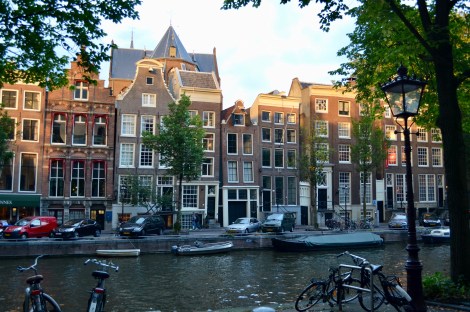
fullsizeoutput_1198

A typical street in Amsterdam where we visited in September 2016 and had such fun that we are returning to the great city in December. See you there!

Home James!

I have no idea where the expression “Homes James” comes from, but it is one that my Mum has always used when arriving home from a holiday or a big shopping expedition, and it seems to have stuck! And yes, we do have a James in the family, one of my nephews, but this expression has been in use long before he was even a twinkle in his parents’ eyes!

We arrived home on Monday night having driven some 475 miles from Lubbock to Magnolia. It was a long day of driving but we are beginning to land a motor home travel routine that works for us; I think that we prefer to have as few “driving” days as possible in order to maximize the exploring days.

En route to Colorado, we met a lovely couple in the Lubbock RV park who were in the site next to us. The gentleman was the sole driver and his travel mantra was that he wanted to be at least one-third of the way through the day’s journey by the time the sun came up! Mike and I are both completely stumped by this, as for us, the whole point of having a motor home is to see and explore the magnificent US of A. How can you do that in the dark! Hey ho, we are all different and if that works for him, good luck.

In line with our home owners’ association, and as our home is on the golf course, we are allowed to park the motor home for two nights at the beginning and the end of every road trip! This is really fantastic as it enables us to open the garage doors and simply load and unload the motor home each time we are preparing or returning from a trip.

We have also moved the motor home storage unit to somewhere that is within 15 minutes or our home. Not that we were unhappy with the first site, but it had minimal security and the new place has cameras everywhere recording everyone that comes and goes.

fullsizeoutput_1197

Roxanne parked in her new site and ready for the next adventure!

Prairie dogs!

Welcome to Lubbock where we are staying in a RV park that is home to a field of very vocal Prairie dogs which are driving Miss Poppy crazy!

Prairie dogs are a type of burrowing squirrel, native to the grasslands of North America. On average, these stout rodents grow to about 12 to 16 inches long, which includes a short tail and they weigh-in at around one to three pounds.

Prairie dogs are highly social and live in large colonies and collections of prairie dog families that can span hundreds of acres. Members of a family group interact through oral contact or “kissing” and grooming one another, but they do not perform these behaviours with prairie dogs from other family groups.

They are mainly herbivores feeding on grasses and small seeds, though they do eat some insects. They live below ground in burrows which help control their body temperature and enable them to watch for predators from the burrow’s entrance. Their burrows are highly organized and have nursery chambers for their young, chambers for night, and chambers for the winter. They also contain air chambers that may function to protect the burrow from flooding and a listening post for predators!

fullsizeoutput_1192

Prairie dogs watching out for Poppy!

Capulin Volcano

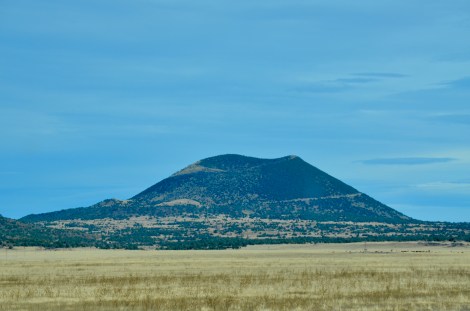
Capulin Volcano is one of the outstanding landmarks located in the northeast corner of New Mexico, where the rolling grasslands meet the foothills of the Sangre de Cristo Mountains, and it was an unexpected surprise as we drove past it on the first leg of our journey home!

Approximately 60,000 years ago, firework-like explosions of molten rock erupted thousands of feet into the air. As the cinders cooled, four lava flows formed the volcano, a near perfectly shaped symmetrical cinder cone, rising to an elevation of over 8,000 feet above sea level.

What makes visiting this extinct volcano so special is that you can you drive all the way around it, hike its mile-long circumference and follow a trail down into the 400 feet deep crater.

Surrounding the Capulin Volcano is a large volcanic field containing at least 100 recognizable volcanoes. Volcanic fields consist of clusters of many small volcanoes, each up to two miles across. Thousands of years may separate the eruption of each small volcano, but they all occur within the space of a hundred miles or so, and are restricted to several hundred thousand to a million years in time.

fullsizeoutput_1187

The volcano’s highest point provides unobstructed, panoramic views of the volcanic field, distant snow-capped mountains, and portions of five states – Colorado, Kansas, New Mexico, Oklahoma and Texas!


Seeking Presidential Pardon!

Starting in 1947, a new custom of presenting the White House with a turkey for Thanksgiving (the last Thursday in November) began under President Harry Truman.

George H.W. Bush instituted the turkey pardon as a permanent part of the presentation beginning in his first year in office – 1989 – in response to protests from animal rights activists! Since then, at least one of the turkeys presented to the President has been taken to a farm where it will live out the rest of its natural life.

From 2005 – 2009, the pardoned turkeys were sent to the Walt Disney World Resort in Florida, where they served as the honorary grand marshals of Disney’s Thanksgiving Day Parade! Last year, Virginia Polytechnic Institute received the 2016 pardoned turkey!

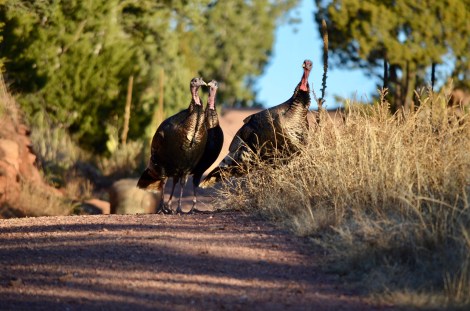
Eventually, I managed to capture on camera the wild turkeys strutting around our RV park in Colorado Springs. I saw nine of them together but was unable to get them to pose for a group picture! My beloved former neighbor, Ron, who knows all things turkey, tells me that “Tryone” is a young bird and that he will get bigger in size and weight, but that right now, he would make for some good eating!

fullsizeoutput_116d

Tryone is seeking the 2017 Presidential Pardon to live out the rest of his natural life as a “ward” of the Krywanio Family!

fullsizeoutput_1188

Tryone and his buddies strutting around our RV park in Colorado Springs!


Fountaneer – Part II

With history, it sometimes takes a few iterations of a name before one becomes permanent, as is the case with Pikes Peak.

Initially, the Ute Indians called the Rocky Mountains eastern-most peak the “Sun Mountain” because it catches the early morning rays. In the late 1700s, Spaniards referred to the peak as El Capitan.

In 1806 Lieutenant Zebulon Montgomery Pike was dispatched to survey the area. Pike kept a journal detailing his travels and wrote about a mountain of “blue cloud” in the distance that he called Grand Peak. Pike and his men attempted to reach the summit in November of 1806 but were beaten back by a severe blizzard. Fourteen years later the first ascent was recorded and in the 1950s, Pikes Peak became the mountain’s official name.

At mile seven on Pikes Peak highway, the climb to the summit really begins and for the next 12 miles, the road winds up and around and around and up, seemingly never to end! Mike is driving and I have Miss Poppy on my lap and it begins to get really scary sitting on the passenger side as you glance down where there is nothing but a sheer drop, especially when bad-boy husband drives close to the edge to scare the two of us!

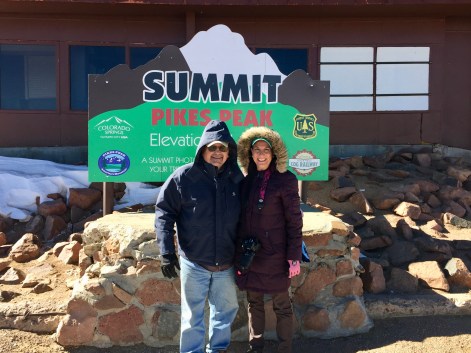
And, then you are there, at an elevation of 14,115 feet (4,302 m), the wind is howling, it is 35 degrees F, and it is magnificent!
fullsizeoutput_117d

Perched on top of the mountain is the Summit House where you can buy souvenirs and enjoy a coffee and a donut, which is the tradition!

fullsizeoutput_1177

Mike and Poppy – we checked to ensure that it was OK to take Poppy to such a high elevation and immediately after the picture she returned to a warm blanket in the car!
fullsizeoutput_1183

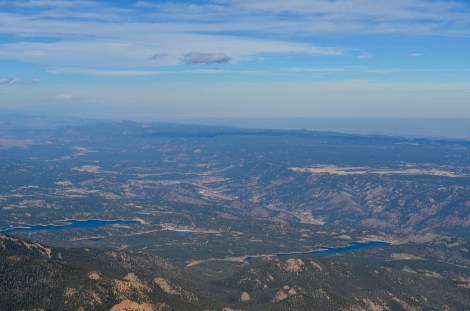
The two other reservoirs on Pikes Peak. Views from the summit are amazing but you have to take pictures quickly because the wind is so strong that you’re fighting to stay upright! 

fullsizeoutput_1173

It’s difficult to see, but above the firm outline of the mountains is a second, white outline of the Rocky Mountain range in the distance!
Fourteener – Part I

In mountaineering speak, a fourteener is a mountain peak which has an elevation of at least 14,000 feet (over 4,000 meters), and Colorado is blessed with 53 of them, the most of any US state!

Likely the best known is Pikes Peak here in Colorado Springs which is where we headed today. There are insufficient superlatives to describe how breathtakingly beautiful the experience was from start to finish and so I am not going to rush and try to cram everything into one blog, but will spend the next few days sharing with you the jaw-dropping scenery we have enjoyed all day!

Our journey begins at the Pikes Peak Highway, a 19-mile toll-road that starts at an elevation of 7,500 feet and winds up the mountain depositing you at the summit where the elevation is 14,115 feet and the temperature has dropped 30 degrees!

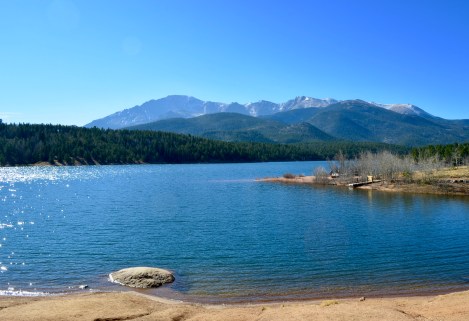
First stop is at mile six, elevation 9,000 feet, where we find the Crystal Reservoir: to secure clean mountain water, Colorado Springs began its development of water collection and storage on Pikes Peak in 1891. As the region’s population grew, the city purchased water rights from resources deeper in the Colorado mountains.

In 1935, the Crystal Dam was built, storing 1.1 billion gallons of Blue River water from the Breckenridge area. The water is pumped through more than 70 miles of pipe to get here.

There are three reservoirs on Pikes Peak – Crystal, North and South Catamount – which are open to the public. The reservoirs are annually stocked with trout and visitors and locals can enjoy fishing and non-motorized boating, from early May to mid-October each year.

fullsizeoutput_1157

The majestic Pikes Peak the morning after our first snow!

fullsizeoutput_1165

Crystal Reservoir with Pikes Peak in the background (far left).

fullsizeoutput_1168

Looking down on Crystal Reservoir as we head to the summit!

Miss Poppy! 

We are staying at the Mountaindale Cabins and RV park about 15 miles from Colorado Springs, which has spectacular views of the mountains and is far enough outside of town to make you feel that you are in the wilderness. The park is very pretty and beautifully maintained, and the people are really friendly with some 60 families or so who are staying here over the winter, or as is common in these parks, they live here permanently.

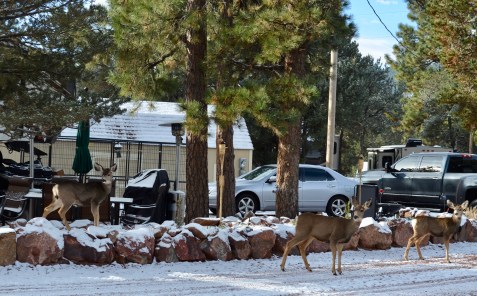
In the RV park, we have wild turkeys roaming around and although I have seen them when walking Poppy in the morning, I now take my camera with me to see if I can get a picture of them to share with you. We have fat, black squirrels who are driving Poppy crazy, and deer – whom at first I didn’t recognize – as they are completely different to the ones we feed at home. These deer are larger and fatter with heavy coats to keep them warm through the winter, and they have much bigger ears that are slightly wavy at the edges and I am not sure if they are just hungry, but they seem to have little fear of human beings as we have seen deer wandering around in very urban parts of town!

Snow has fallen during the past two nights, and other than being mystified as to the meaning of the white stuff on the ground, Poppy is having fun and is certainly enjoying herself in the cooler climate.

Left: Miss Poppy in our RV park yesterday morning. Top Right: at the Manitou Springs Brewing Company where a black squirrel was driving her nuts; enjoying at walk in the Garden of the Gods.

fullsizeoutput_1159

On the hunt for breakfast! Deer in our RV park!

Happy Halloweed!

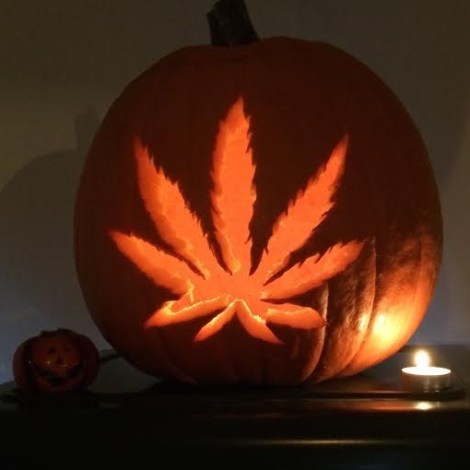
In November 2000, Colorado voters approved an amendment to the State Constitution to allow the use of marijuana for approved patients with written medical consent. Under the law, patients can possess up to two ounces of medical marijuana and may cultivate no more than six marijuana plants.

Fast forward to November 2012, and the State’s Constitution was further amended outlining a state-wide drug policy for cannabis. The amendment addressed the personal use and regulation of marijuana for adults 21 and over, as well as commercial cultivation, manufacture and sale. The commercial sale of marijuana to the general public began on January 1, 2014, at establishments licensed under a regulatory framework.

By April 2016, 62 of Colorado’s 271 cities and towns have adopted some form of recreational marijuana regulation with one notable absence – the state’s second most populous county and city of Colorado Springs where we are currently staying.

Visitors and tourists to Colorado can use and purchase marijuana, but face prosecution if found in possession in any adjacent state. Colorado’s biggest airport in Denver has banned all possession of marijuana but admits it has not charged a single person with possession nor has the airport seized any marijuana since the ban went into effect.

autumn-roast-a-high-class-event-portland-marijuana1

In the first year of implementation, Colorado’s legal marijuana sales reached $700 million.


Elevated Pumpkins!

The Arkansas River is the sixth longest river in America, weaving its way from Leadville in Colorado to Napoleon in Arkansas where it joins the Mississippi River. Geologists estimate that the river cuts its course one foot deeper every 2,500 years, eventually forming the Royal Gorge as it is known today.

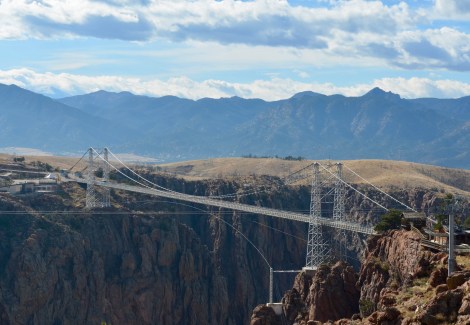
Originally built in 1929 at a cost of $350,000, the Royal Gorge Bridge is a tourist attraction near Cañon City in Colorado. The bridge crosses the gorge 955 feet (291 m) above the Arkansas River and is the highest bridge in the US.

In 2013, most of the park structures on both sides of the gorge were devastated by a man-made wildfire; the fire jumped from the south to the north side of the gorge just west of the bridge and burned over 3,000 acres of the park. The bridge itself sustained only minimal damage and a grand re-opening ceremony took place in May 2015 after the completion of $30 million in repairs and the addition of a gondola lift and the installation of a new zip-line crossing.

The “bridge” experience is outstanding. First one takes a gondola lift across the gorge which gives you a really great opportunity to appreciate the height of the bridge. After that you walk down to the level of the bridge and start walking across. Believe me, it is scary (well, I was scared)! The wind is blowing, the bridge is moving in the breeze, and there are small gaps in the wooden planks where one can see the Arkansas River below! I had to hold on to the railings when I was taking pictures but the experience was great when you are back on terra firma!!

fullsizeoutput_114c

The main span of the bridge between the towers is 880 feet (268 m) and the total length is 1,260 feet (384 m).

In celebration of Halloween, Pumpkins decorate the central section of the bridge which sits at an elevation of over 6,600 feet!

The rapids under the bridge help make the Arkansas River one of the most popular rafting rivers in the US.