As we drive between the Texas towns of Sweetwater and Lubbock (where we are now staying), the landscape reflects the county’s economic evolution that is now in its second century!
In 1910, cotton was first planted in and around the Sweetwater area accounting for almost 72 percent of the county’s cultivation income. Except for a brief recession after World War I, cotton cultivation continued to expand in the area and by 1930, 80,000 acres of cotton were planted.
The cotton economy was severely shaken during the Great Depression of the 1930s, and although World War II helped to revive the local agricultural business, by the 1950s farm consolidations, the decline of farm tenancy, and an extended drought caused a drop in the population.
With the impact of the Great Depression hitting farming community, families packed their belongings and headed west to California, so oil was discovered in the Sweetwater area in 1939. Although production was initially low, it peaked in 1956 at over eight million barrels of oil a day – a day!
Driving along the road you see what the US calls a “Pump Jack” which in the UK we know as a “Nodding Donkey.” They are both one and the same thing and refer to the equipment used to extract oil from an onshore oil well – the mechanical arm moves up and down pumping oil from the well – in this area usually around two to three thousand barrels a day.
In 2000, wind energy developers arrived in the area erecting over 1,300 wind turbines and pumping hundreds of millions of dollars into the local economy.
As you drive from Sweetwater to Lubbock, all you can see, as far as you can see, are wind turbines spinning in the ever-present breeze, cotton balls swaying on their plants and all too often a Nodding Donkey sitting in the middle of the field!

Fields of cotton with wind turbines as far as the eye can see!
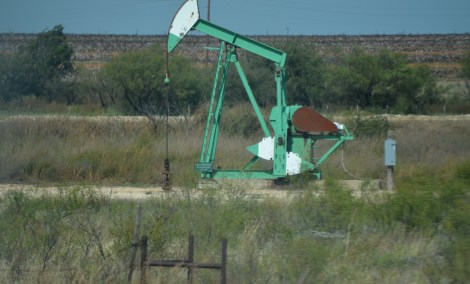
A nodding donkey/pump jack!
 The Blogging Brit