In the late 1880s, George W. Vanderbilt, then a young man of 25, found the perfect spot in North Carolina’s Blue Ridge Mountains for a 250-room French Renaissance château to be built by his friend, architect Richard Morris Hunt. The great château would be called “Biltmore House” and it is the largest private residence in America and a National Historic Landmark.
Construction of the house in Asheville, North Carolina began in 1889 and while 1,000+ workers toiled away for six years, the house was far from complete when Vanderbilt officially opened its doors to friends and family on Christmas Eve in 1895.
The centre-piece of the 8,000-acre estate is a four-story stone house with a 780-foot façade. The house is a whopping 175,000 square feet (four acres) with 33 bedrooms, 65 fireplaces and 43 bathrooms!
Inside, works of art by Renoir and Sargent, among others, adorn the walls. A chess set and gaming table, belonging to Napoleon when he was in exile on St. Helena island, are on display in the salon and Chinese goldfish bowls from the Ming Dynasty can be admired in the library.
At the time of its completion, Biltmore House, with central heating and electricity, was considered one of the most technologically advanced structures ever built and is still admired today for its innovative engineering. It used some of Thomas Edison’s first light bulbs, boasted a fire alarm system, an electrical call box system for servants, two elevators (lifts), elaborate indoor plumbing for all the bedrooms and a relatively new-fangled invention called the telephone!
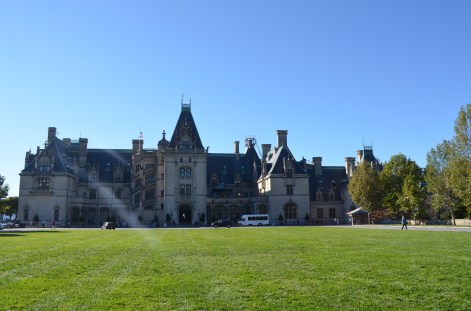
The front view of Biltmore House.
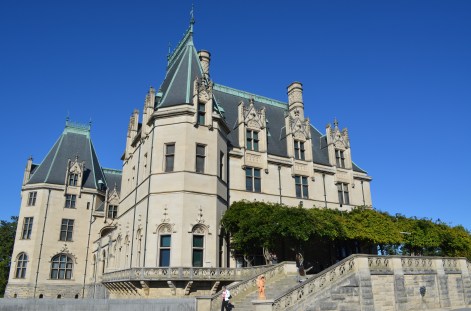
The side and corner angle of the house.
 The Blogging Brit